AI prospecting tools are transforming how sales teams discover, qualify, and prioritize leads. The key shift isn’t the introduction of large language models (LLMs) alone, but combining them with live web data to generate insights that go beyond the static snapshots of traditional sales intelligence software.
Below, you'll see how the two approaches differ, and how to build AI prospecting workflows with Apify Actors.
The shift from databases to AI agents in sales intelligence
Traditional sales intelligence software collects, verifies, and stores prospect information before providing access to that data through downloadable datasets or searchable databases. This approach works well for selecting existing records, but the prospect data is only as current as the latest refresh.
AI prospecting tools follow a different model. Instead of relying primarily on pre-collected datasets, they scrape web data and feed it to LLMs for prospect discovery, lead enrichment, account qualification, personalized outreach, and more.
This represents a fundamental shift in sales intelligence. AI prospecting platforms provide LLMs with relevant data so you get an account brief written against your ideal customer profile (ICP), not a generic record dump.
How traditional sales intelligence software works
The typical workflow followed by traditional sales intelligence software looks like this:
- Crawl public data at regular intervals from sources such as company websites, business directories, job boards, social platforms, and government registries.
- Clean, verify, and structure records according to predefined schemas to ensure consistency.
- Store the information in internal databases that can hold billions of company and contact records.
- Sell access to sales intelligence data through subscriptions or one-time data exports. Sales teams can search, filter, and export selected records. Some platforms also provide APIs for programmatic integration.
How AI tools for sales prospecting work
AI prospecting sales tools rely on a more dynamic workflow:
- Receive a goal for the workflow, such as finding new prospects or identifying buying signals.
- Start with a set of targets or signals, such as a list of companies, contacts, or specific intent like investigating recent funding events, hiring activity, technology changes, or other meaningful indicators.
- Collect relevant contextual data from the web by gathering information about the target accounts or performing automated searches to discover companies, markets, products, customers, and business activities that match the intent.
- Use an LLM to analyze, enrich, and contextualize the data, identifying patterns, qualifying accounts, and generating insights based on the defined goal.
- Optionally, generate personalized AI-powered outreach or trigger downstream automations based on the identified opportunities.
AI prospecting tools vs. traditional sales intelligence
| Aspect | AI prospecting tool | Traditional sales intelligence software |
|---|---|---|
| Data strategy | Collects and analyzes live web data from multiple sources based on specific sales goals. | Pre-collected databases refreshed periodically. |
| Data freshness | Uses up-to-date data to capture recent company changes, signals, and events. | Information can become outdated between database refresh cycles. |
| Main workflow | Discover, enrich, analyze, and qualify prospects through automated AI workflows. | Search, filter, and export existing prospect records. |
| Flexibility | Can be customized for specific markets, sales goals, and research workflows. | Limited by available database fields, filters, and built-in features. |
| Best for | Dynamic prospecting, account research, lead enrichment, trigger detection, and personalized sales strategies. | Initial lead discovery, database searches, and standardized sales workflows. |
Building custom AI prospecting tools with Apify
LLMs need rich context to understand what is happening with companies, markets, and customers. Without access to that information, they can’t return accurate prospect analysis or provide recommendations adapted to your precise sales goals.
Live web data provides that context. Compared to sales information stored in static databases, web data can capture current signals such as funding announcements, hiring trends, product launches, leadership changes, pricing updates, customer stories, and more.
However, collecting web data at scale is challenging. Websites constantly change, web pages contain unstructured data, and many sources use anti-bot technologies and other techniques to make automated scraping more difficult.
Modern AI prospecting tools, therefore, require a dedicated infrastructure layer that can gather contextual web data on demand. Apify provides that web data layer through Apify Store, the largest marketplace of tools for AI.
Apify Store includes thousands of Actors, serverless cloud programs built and maintained by Apify or the community. These Actors allow you to get public data from websites, process information, connect with AI, and automate workflows.
Actors can provide data directly to your custom AI sales intelligence tool through APIs or the Apify MCP server. You can also integrate them with visual workflow automation platforms like n8n, Make, Zapier, and Dify, build custom pipelines directly in Apify Console, or use official integrations with AI frameworks such as LangChain, CrewAI, LlamaIndex, Agno, and many others.
Explore how Apify supports three common AI sales prospecting workflows.
Workflow #1: Deep account research
AI tools for sales prospecting perform deep account research by using AI agents to thoroughly analyze a target organization, helping your sales team understand how that company actually operates.
To produce trustworthy results, LLMs need data from multiple sources, including the company’s website, LinkedIn, Crunchbase, and ZoomInfo profiles. Social media presence, public mentions, and news articles are also useful sources for deep account research scenarios.
Apify enables you to retrieve that data using several Actors, including:
| Actor | Description | Input | Output | Best for |
|---|---|---|---|---|
| Website Content Crawler | Crawls websites and extracts clean text content optimized for LLMs and AI applications. | Website URLs to crawl and extraction settings. | Page content in formats such as Markdown, text, or HTML, with metadata. | Analyzing company websites, documentation, blogs, and resources. |
| LinkedIn Company Details Scraper | Retrieves detailed information about LinkedIn company pages. | Company names or LinkedIn company URLs. | Company details such as description, industry, employee count, locations, website, and funding data. | Enriching company account data. |
| Google Search Results Scraper | Scrapes Google Search results, news, and other publicly available information. | Search queries, location, language, and scraping settings. | Organic results, related queries, AI results, and other SERP data. | Finding recent announcements, press coverage, and recent news. |
AI can then interpret the structured datasets retrieved by these Actors to create a detailed account profile that gives sales teams the context they need to understand the prospect and develop a more effective outreach strategy.
For instance, Google Search Results Scraper can find a company’s LinkedIn profile page. Pass that URL to LinkedIn Company Details Scraper to retrieve structured company information:
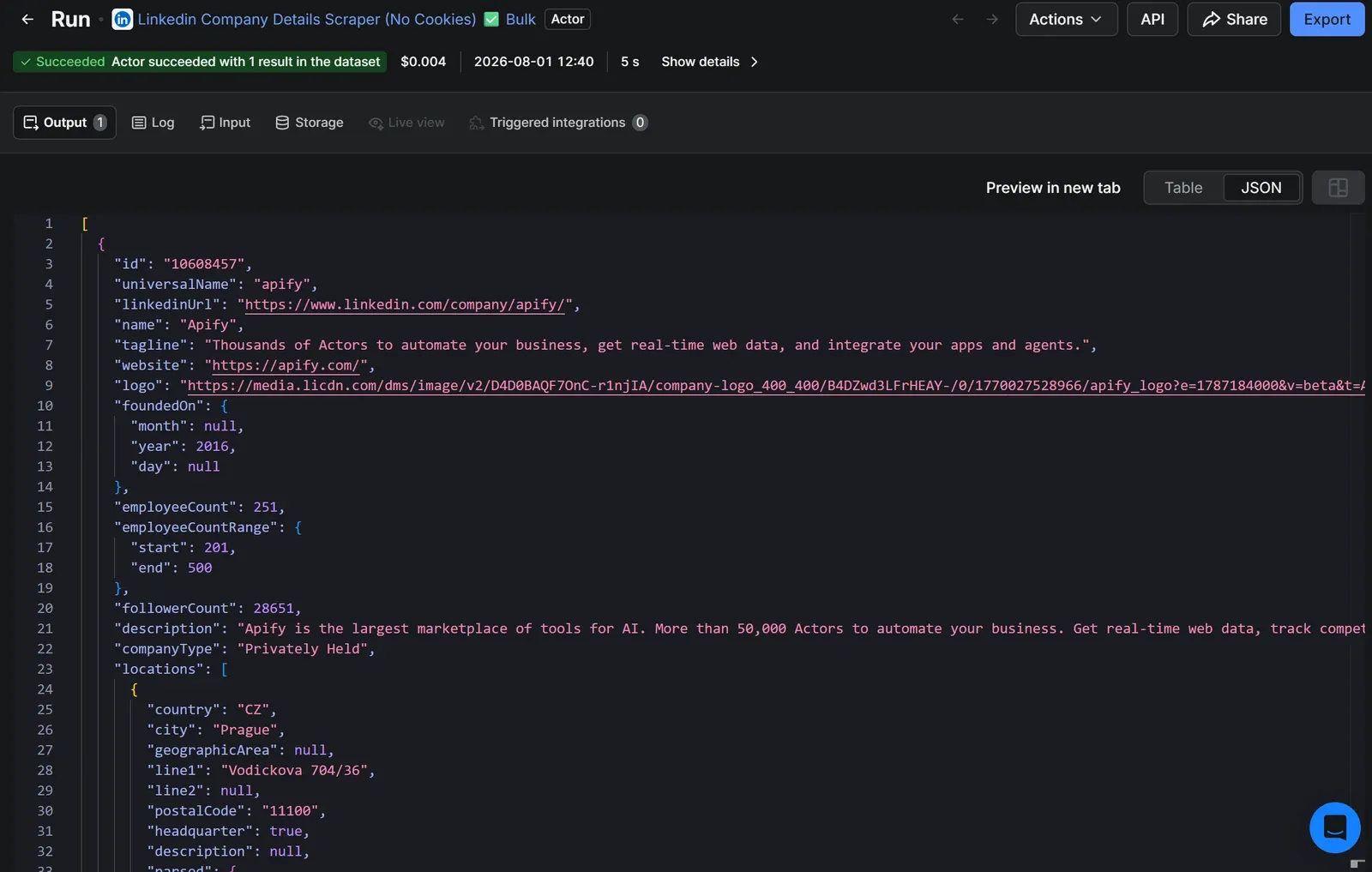
The output includes valuable account enrichment data, such as the company’s description, industry, employee count, locations, and more. The AI step in your automated prospecting workflow can then use that information to suggest personalized sales approaches based on factors such as company size, regional presence, and headquarters location.
You could pass the dataset produced by the Actor as the context for a ChatGPT prompt, for example:
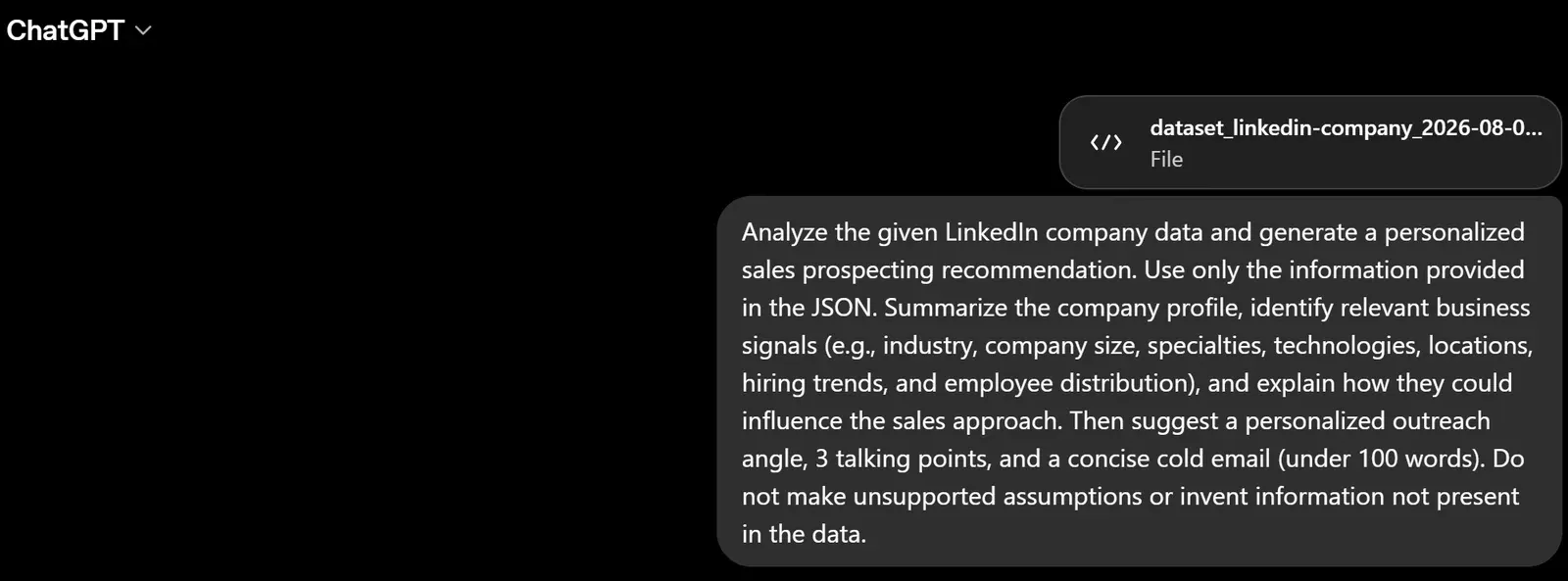
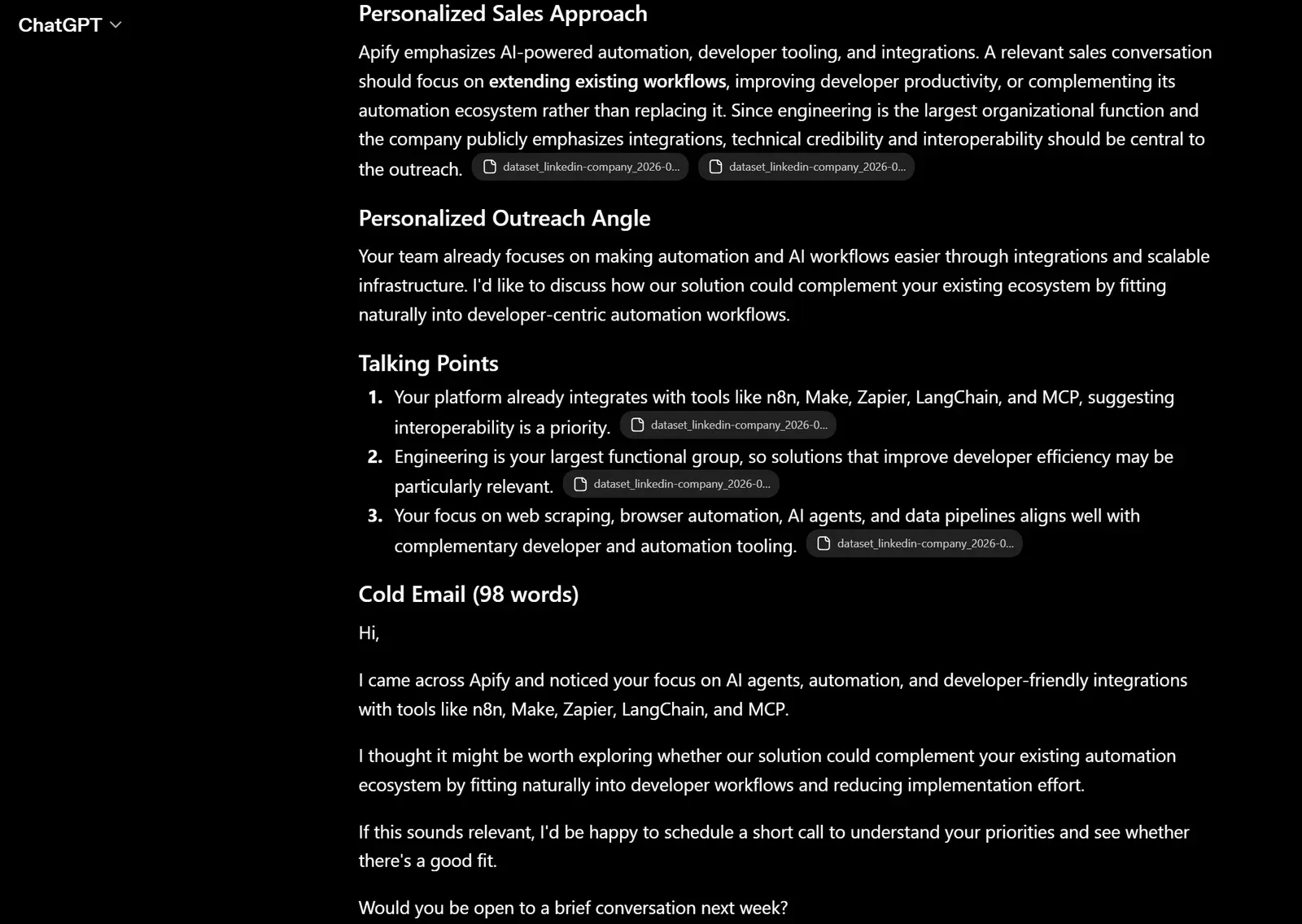
The prospecting analysis prompt working on the retrieved data and results. Note how detailed the AI prospecting analysis is.
Once you have enriched the company account with LinkedIn data, you could also use LinkedIn Company Employees Scraper to find appropriate points of contact.
Workflow #2: List building
In AI prospecting, list building is the process of automatically discovering, researching, enriching, qualifying, and organizing prospects that match your ICP.
Apify powers AI-powered list building through many Actors, such as:
| Actor | Description | Input | Output | Best for |
|---|---|---|---|---|
| LinkedIn Profile Scraper | Retrieves data from LinkedIn people and company profiles. | LinkedIn profile or company URLs. | Structured profile data, such as company size, industry, experience, and location. | Enriching prospects with up-to-date LinkedIn data. |
| Leads Finder | Finds B2B prospects using advanced search filters. | Job titles, industries, locations, company attributes, and other filters. | Contact details, LinkedIn URLs, company information, and verified business emails. | Discovering targeted prospect lists. |
| Contact Details Scraper | Extracts contact information from websites. | Website URLs. | Email addresses, phone numbers, social profiles, and other public contact details. | Finding contact information from company websites. |
These Actors can be combined into an AI list-building workflow like this:
- Use Leads Finder to discover prospects that match your ICP.
- Enrich the returned LinkedIn profiles with LinkedIn Profile Scraper.
- Run Contact Details Scraper on the company or personal websites to collect additional contact information.
- Send all data to an LLM to summarize each prospect and qualify leads.
In detail, this is the output of Contact Details Scraper when targeting apify.com:
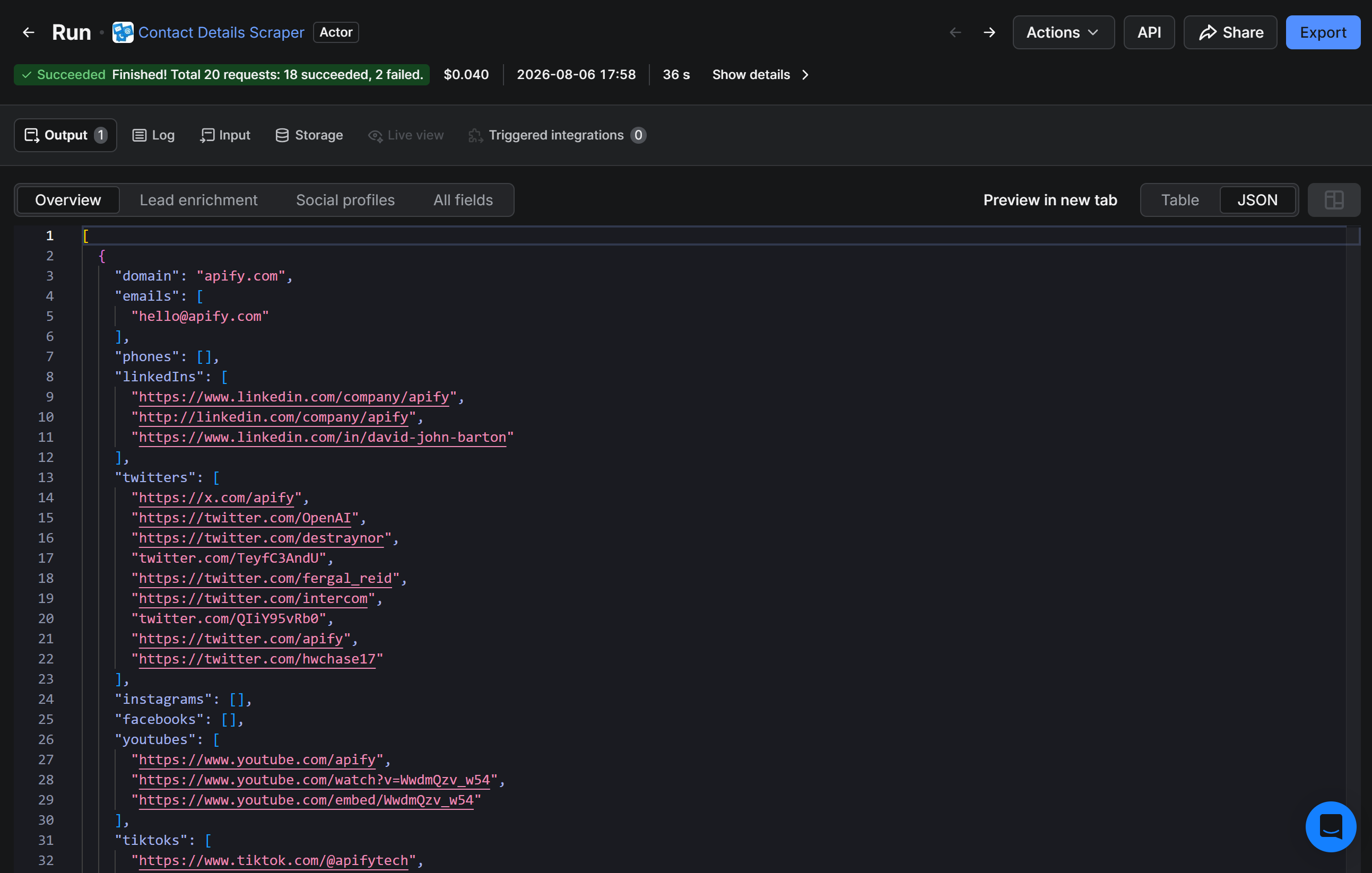
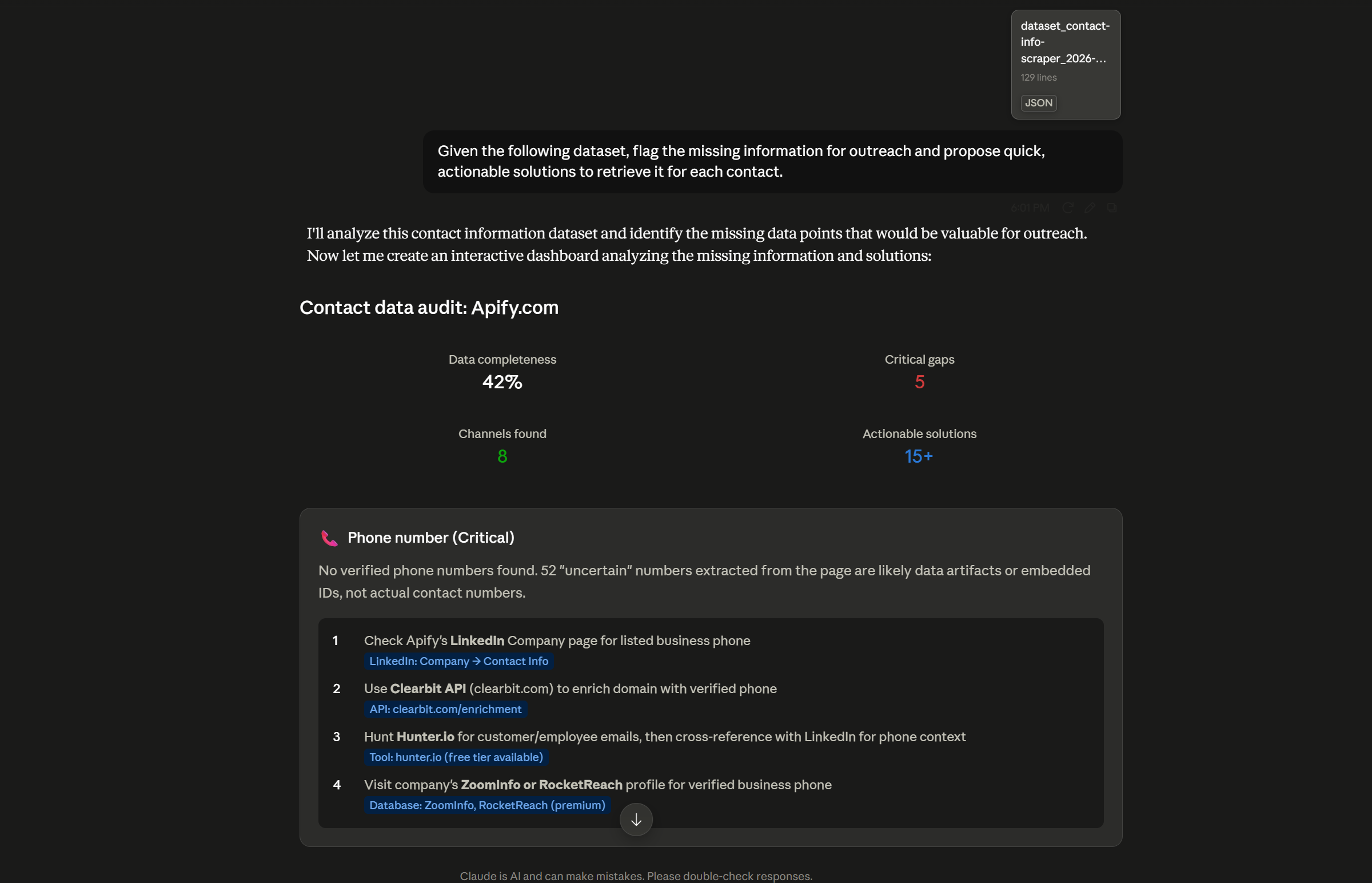
From the input website, the Actor was able to extract email addresses, LinkedIn profile URLs, and many other contact fields. In a later step of your workflow, an LLM can highlight the best outreach channels and/or flag missing information for further research as follows:
Workflow #3: Trigger detection
In AI prospecting sales tools, trigger detection is the process of continuously monitoring large volumes of data to identify important moments of change within target companies. These trigger events indicate new sales openings, such as a company raising funding or entering a new market.
Apify supports trigger detection workflows with dozens of Actors, including:
| Actor | Description | Input | Output | Best for |
|---|---|---|---|---|
| Hiring Intent Lead Scraper | Finds companies actively hiring for specific roles and enriches results with contact data. | Job title, location, and enrichment options. | Company details, job posting data, hiring signals, and verified contacts. | Identifying companies investing in specific functions. |
| Startup Funding Tracker | Tracks startup funding rounds from SEC EDGAR, TechCrunch, and Y Combinator. | Search filters, funding amount, industry, date range, and result limits. | Company name, funding amount, round type, investors, date, industry, and source URL. | Finding recently funded companies that may need new products or services. |
| Signalbase Real-Time Merger & Acquisition Signals | Detects merger and acquisition activity with company and deal information. | Date range, industries, countries, company filters, and search terms. | Acquisition signals, company details, deal information, and source URLs. | Identifying companies undergoing strategic changes. |
An Apify-powered trigger detection workflow can combine these Actors with AI as follows:
- Run the Actors to collect recent signals, such as funding rounds, hiring activity, or acquisition events.
- Send the retrieved structured data to an AI agent.
- Ask the agent to evaluate which events represent opportunities for potential new customers and explain why they matter.
- Trigger follow-up actions, such as creating CRM tasks, enriching lead profiles, or generating personalized outreach based on the detected signals.
For example, this is the output of the Startup Funding Tracker Actor for startups in the AI industry on TechCrunch that raised more than $1,000,000 in the last 60 days:
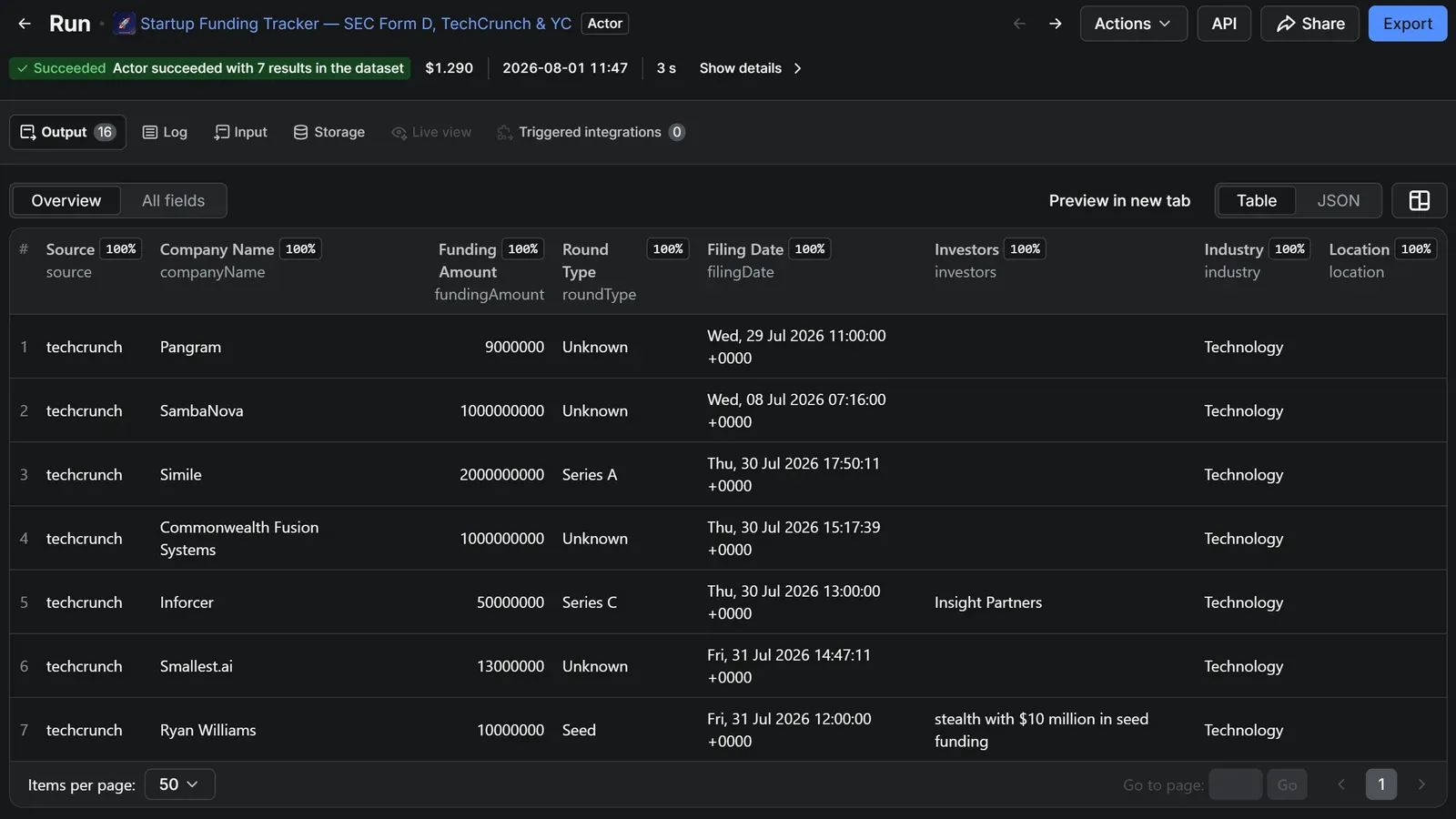
Given these leads, AI can analyze the available information and determine whether the recently funded company could be interested in your services, as in the Claude workflow below:
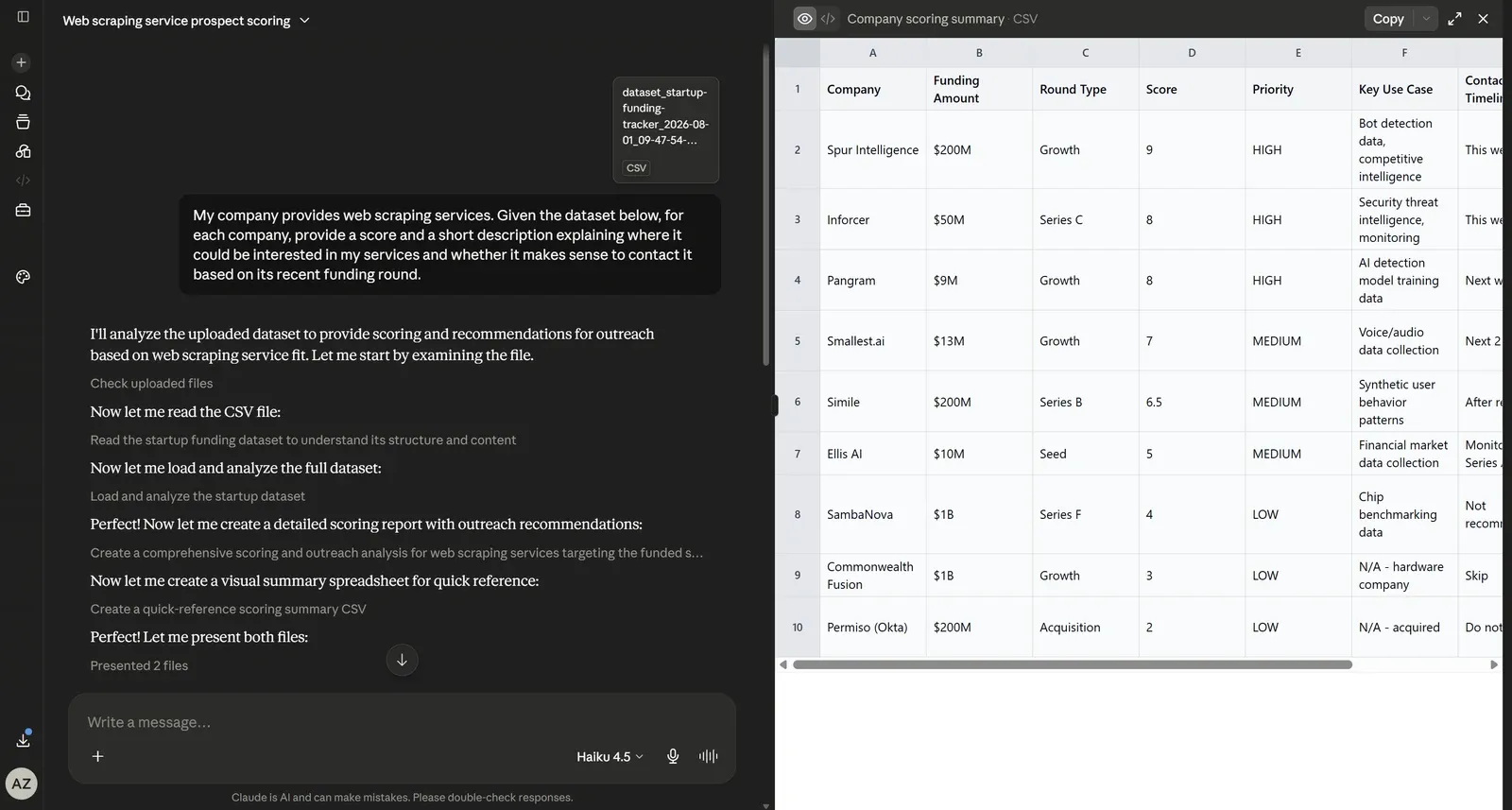
For deeper analysis, you could provide the company name (or URL, if available) to Apify Google Search Results Scraper or Website Content Crawler Actors to collect additional context about the most convincing prospects. An LLM can then use all of this data to devise a thorough sales strategy for responding to triggering events.
Conclusion
Traditional sales intelligence software usually provides static snapshots from regularly updated lead databases. AI sales prospecting tools replace that with analysis built on current information about each account."
LLMs become far more effective when grounded with live, on-demand web data about prospects. So, they require a dedicated data collection layer. With thousands of Actors for web data, automation, and AI, Apify gives you the infrastructure to build prospecting workflows that fit how you actually sell.

FAQ
How do you choose between an AI prospecting tool and traditional sales intelligence software?
AI prospecting sales tools are ideal when you need quick insights by analyzing fresh data and signals from multiple sources. Most traditional sales intelligence software tools offer ready-to-use databases, making it a good fit for initial lead filtering.
Why is real-time web data important for AI-powered sales prospecting?
Real-time web data helps AI prospecting tools identify and prioritize opportunities as they emerge. Sales teams can access AI-generated intelligence based on recent events, such as funding rounds, hiring activity, product launches, company updates, and news coverage.
How does Apify support the creation of custom AI prospecting tools?
Apify provides thousands of Actors that can collect structured data from websites, search engines, social platforms, and other online sources. These Actors can be integrated with LLMs and automation tools to build custom AI prospecting workflows for lead generation, account enrichment, outreach personalization, and many other sales prospecting scenarios.