Anfloy built an agentic outbound engine that captures buying intent from LinkedIn, enriches and qualifies it automatically, and reaches the right people with messages personalized to each one. The payoff: reply rates as high as 11%, several times the cold outbound norm, and $234,000 in qualified pipeline across three campaigns, all powered by Apify Actors.
In most outbound systems, the weak point sits at the data layer rather than in the messaging or the sequences. Stale lists, manual research, and fragile scrapers slow the whole engine down before it ever reaches a prospect.
Anfloy builds agentic systems and custom AI products for companies that want to own their automation rather than rent it. Founder Dima Bilous and his AI engineering team work with tech companies, service businesses, agencies, and info businesses, building systems clients pay for once and run themselves. The GTM engine in this case study is one they built for their own outbound, and Apify Actors are the data layer underneath it.
Apify lets our engineer agents turn raw LinkedIn signals into $234,000 of qualified pipeline, with reply rates several times the cold outbound norm. It's the data engine that makes outreach at scale actually feel personal.
-- Dima Bilous, Founder, Anfloy

Buying intent was buried across thousands of LinkedIn interactions
The people most likely to buy from you let you know. They like and comment on your competitors' posts every single day, and that engagement is pure buying signal. The problem is that it's scattered across thousands of interactions a week, and it's worthless unless you can capture it, understand each person, and reach them while the interest is fresh.
Manual research couldn't touch this. A researcher needs several minutes per person to pull their role, company, and recent activity, so thousands of engagers a week is simply impossible to work through. Anfloy was capped at a few hundred leads with that approach, and the messages that came out of it were generic enough to ignore.
The two alternatives they explored both fell short. Static lead lists were stale and carried no intent. Building their own LinkedIn scrapers meant constant breakage and ongoing maintenance. Neither option let the engine run at the scale the pipeline targets required.
An agentic pipeline that turns engagement into personalized outreach
Apify Actors solved both problems at once: maintained, pay-per-result scrapers that run at scale without babysitting infrastructure. Anfloy plugged them directly into their agentic engine and rebuilt how they source, qualify, and reach prospects.
Every day, the pipeline monitors 10 competitors. The moment a competitor posts, LinkedIn Posts Engagers, Likers and Commenters captures everyone who engaged. Each person is then enriched with LinkedIn Profile Scraper, which pulls their title, company, and location, and with LinkedIn Profile Posts, so the agents can read what they write about and care about.
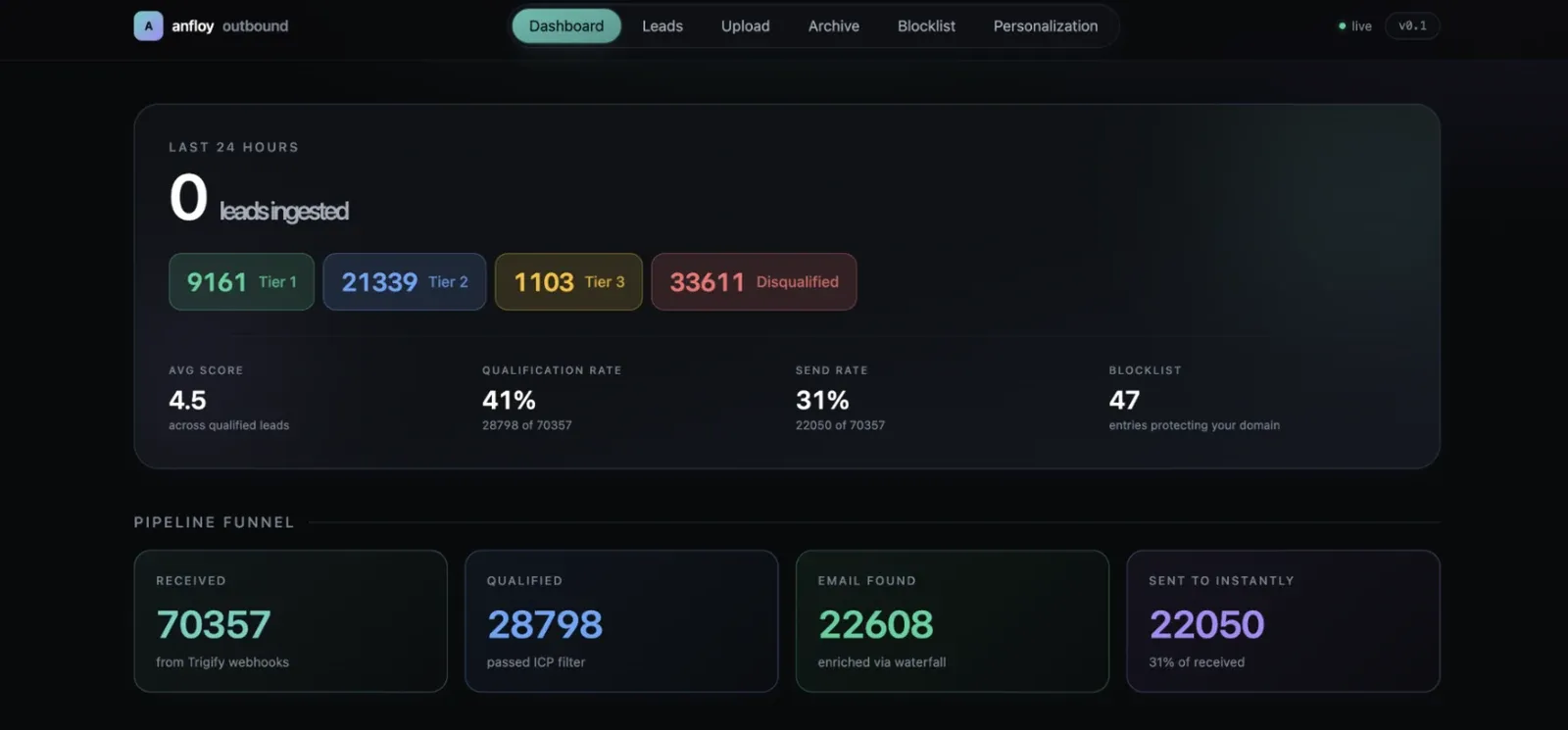
That full picture feeds a qualification agent that sorts people into tiers, disqualifies poor fits, and writes a personalization line anchored in something real: a recent post, a company detail, a shared context. Only the strongest fits move into email and LinkedIn sequences. The point is precision, not volume. The engine processes around 60,000 engagement signals and narrows hard, so only the roughly 20% that genuinely fit ever become outreach.
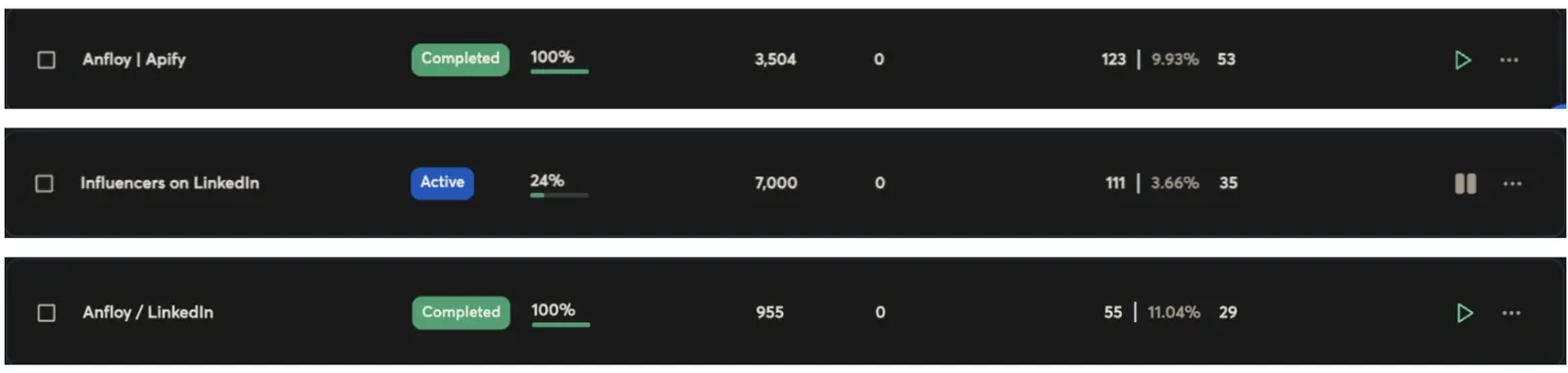
Results across three campaigns
- 60,000 LinkedIn engagement signals processed and enriched, the intake the whole engine runs on
- Top 20% automatically qualified and tiered, so outreach only reaches high-fit prospects
- 10 competitors monitored daily for fresh buying signals
- Reply rates of 11.04%, 9.93%, and 3.66% across three campaigns, several times the typical 1-3% cold outbound benchmark
- 289 replies and 117 sales opportunities created
- $234,000 in qualified pipeline
- One campaign alone: an 11.04% reply rate, 29 opportunities, and $58,000 in pipeline

Why Apify stays in the stack
Apify is now central to every outbound, content, or internal-ops system Anfloy ships that needs fresh, structured data. Apify Actors handle any source Anfloy needs: LinkedIn engagement, competitor activity, or a custom signal no standard provider offers. Anfloy never has to build or maintain their own scrapers.
“They stay at the core of everything we ship,” says Bilous.
What changes when the data layer scales
Anfloy's bet on Apify shifted the constraint in their outbound engine. Instead of being capped by how many leads a researcher can enrich by hand, campaigns are now capped by how many high-fit prospects actually exist, which is the right ceiling. The pipeline is no longer bottlenecked at the sourcing layer.
The same engine is now being scaled to more competitors and more signal sources, with new agentic systems stacking on top of it.