Nextbrowser operated as a cloud browser automation platform that enabled AI-driven workflows. It allowed users to automate repetitive tasks through cloud-based agents, but the product has recently been discontinued.
This raises a central question: Is Browserbase, one of the most popular AI-ready cloud browser automation platforms, the main alternative?
In this Browserbase vs. Nextbrowser comparison, we’ll examine both to see where they differ. You’ll also understand why Nextbrowser failed and why Browserbase has been more successful, giving you more clarity on which cloud-based browser automation tool to choose today.
Browserbase and Nextbrowser: TL;DR comparison table
Compare the two solutions at a glance:
| Browserbase | Nextbrowser | |
|---|---|---|
| Description | Cloud browser infrastructure for agents | AI cloud browser automation platform |
| Status | ✔️ (active) | ❌ (shut down in April 2026) |
| Scope | AI agents, automation, scraping, runtime infrastructure | Social media automation, engagement workflows |
| Architecture | Stateless, isolated VM per session, zero-trust infrastructure | Cloud-native browser automation infrastructure |
| Session management | Ephemeral sessions, with no reuse | Options for persistent sessions with stored login state |
| Primary use cases | AI agents, scraping, browser automation at scale | Social media automation and engagement |
| Official SDKs | Python, Node.js | ❌ |
| Open-source involvement | ✔️ (via Stagehand, Browse CLI, SDKs, MCP server) | ❌ |
| Integrations | APIs, LangChain, CrewAI, Agno, Google ADK, OpenClaw, n8n, and many others | APIs, webhooks |
| Free option | ✔️ (via a free monthly subscription) | ✔️ (via a free monthly subscription) |
| Pricing model | Usage-based tiers ($20–$99/mo) | Credit-based subscription ($20–$929/mo) |
What is Browserbase?
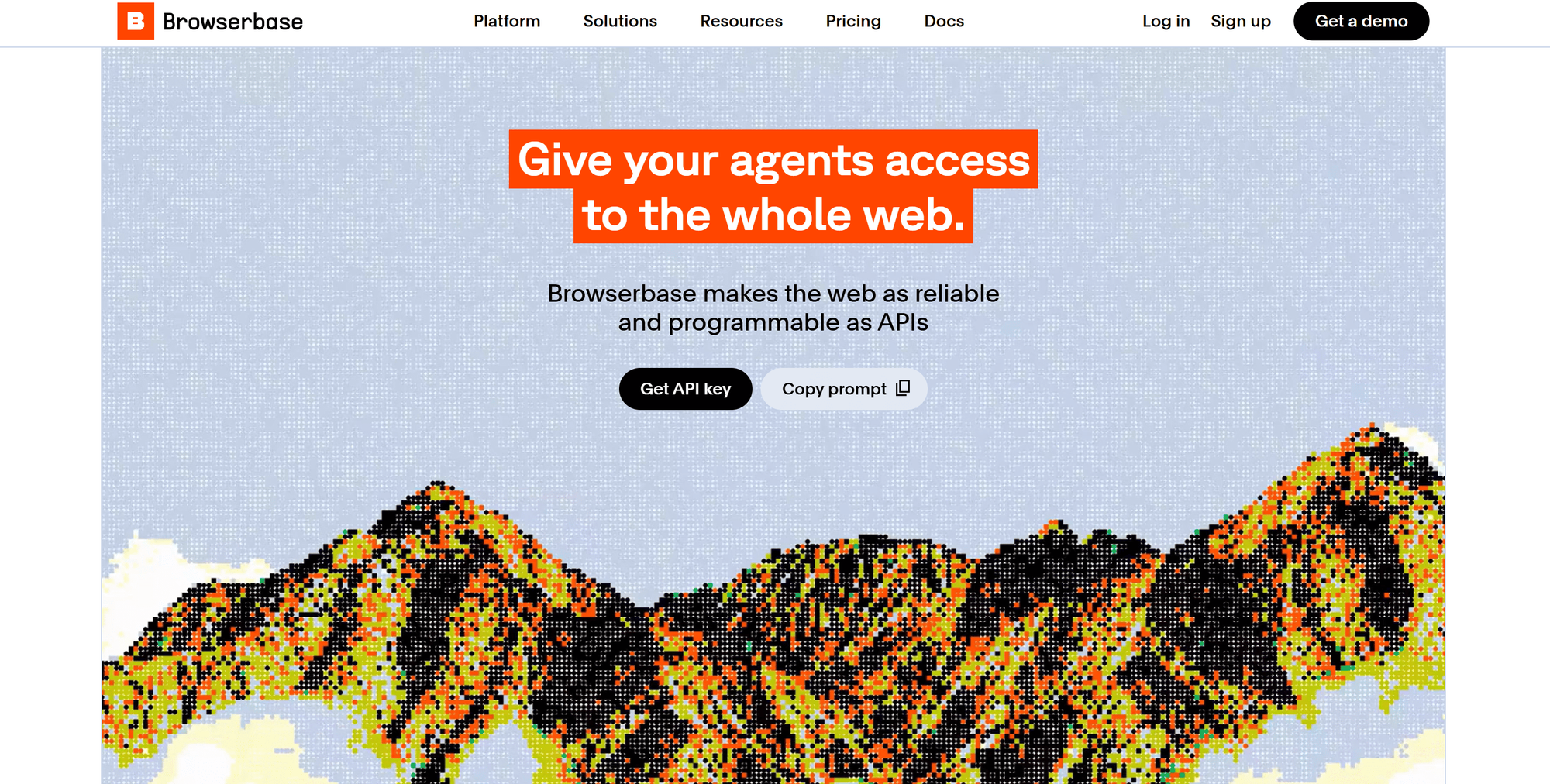
Browserbase is a browser-as-a-service platform that features a managed, cloud-based environment for running browsers at scale. It acts as a bridge between automation logic (whether AI-powered or not) and the web.
Browserbase gives you access to a controllable, programmable, remote browser interface. AI agents and automation pipelines can use it to navigate dynamic pages, fill forms, and execute user-like interactions.
The platform abstracts infrastructure concerns such as scaling, session management, and reliability. This lets you focus on building agents and automation pipelines that search, extract, and act on web data.
Products
To better understand what Browserbase brings to the table, let’s analyze its full set of products:
- Browsers: Isolated, production-grade Chromium sessions that run at scale. They support cookies, extensions, file handling, and other custom configs.
- Web data APIs: Endpoints that help AI agents discover and retrieve web content in HTML, JSON, and Markdown. The Search API finds relevant pages, while the Fetch API scrapes web pages.
- Runtime: Sandboxed, stateless execution environments for deploying and running AI agents reliably in production, with built-in isolation, concurrency, and failure handling.
- Identity: Equips AI agents with cryptographically verified credentials, supporting authentication via Web Bot Auth, credential vaults, and persistent authenticated sessions.
- Models: Unified model gateway that provides access to multiple AI providers through a single API key, simplifying integration and model switching.
- Observability: Built-in debugging tools with live session views, replays, logs, and traces to analyze agent behavior and diagnose failures.
Browserbase also powers Director. This is a visual platform for defining, testing, and deploying browser agents using plain English instructions, with the ability to export production-ready code written with Stagehand.
Open-source libraries
Browserbase comes with official Python and Node.js SDKs for connecting to its APIs. It also supports the open-source ecosystem through general-purpose tools like:
- Stagehand: A browser automation framework for controlling web browsers via natural language and code. It helps you build browser agents with AI-driven primitives. Available in TypeScript, Python, Java, .NET, PHP, Ruby, Kotlin, and Rust. It doesn’t require Browserbase integration.
- Browse CLI: Built on Stagehand, this command-line tool enables coding agents to control browser instances.
Use cases
Given Browserbase products and open-source solutions, the three main supported scenarios are:
- AI agent development: Let autonomous agents connect to real browser sessions to browse, search, and interact with the web.
- Browser automation: Automate end-to-end workflows using Playwright, Selenium, and similar browser automation libraries.
- Web scraping: Programmatically control remote browsers to extract data from JavaScript-heavy, anti-bot-protected, or dynamic web pages.
What is Nextbrowser?

Nextbrowser, also known as Next, was a cloud browser platform for AI automation that has recently been shut down. Its main goal was to execute repetitive web tasks in browsers, with a focus on social media automation.
It enabled automated posting, commenting, and engagement across multiple social media accounts (e.g., Reddit, X, LinkedIn, Facebook) through autonomous agents. At a higher level, it functioned as a cloud-based system that simulated human browsing behavior, interacting with UI elements while performing multi-step workflows.
At the time of writing, the product is no longer actively maintained. It now exists only as a landing page with limited information. You can’t access the web application or even the documentation.
Why it closed
Nextbrowser was shut down in late April 2026, following an initial period of active use and early traction.
As explained by founder Stan Sadokov on LinkedIn, the decision was driven by three main factors:
- Unsustainable infrastructure costs: Each browser session required resource-heavy cloud instances, making unit economics difficult to maintain at scale.
- Codebase complexity: The system required a full rewrite, which was considered too costly and complex to pursue.
- Small market size: The team concluded that the addressable market wasn’t large enough to justify continued investment. That’s likely been due to larger, better-funded competitors like Browserbase capturing most of the market.
Browserbase vs. Nextbrowser: Head-to-head comparison
Both tools tackle browser automation differently. Here's where they diverge.
Philosophy and architecture
Browserbase is built upon a headless browser infrastructure with a strong focus on security and isolation. The platform integrates anti-bot handling and observability for reliable automation. It also lets you deploy browser agents directly to its managed infrastructure.
Its architecture follows a zero-trust model, where each session runs in a dedicated virtual machine with hardware-level isolation, network segmentation, and ephemeral environments. Plus, sessions are never reused to reduce cross-session risks.
Nextbrowser adopted a similar cloud-native approach. The main difference was that it maintained persistent sessions, which are essential for social media account management.
Developer experience and integrations
Nextbrowser offered integration capabilities mainly through APIs and webhooks. It didn’t have an open-source core or a broader developer ecosystem. External integrations were limited, with examples such as skills for LobeChat and OpenClaw.
Overall, its design prioritized ease of use. It fully supported non-technical users, allowing them to translate natural language instructions into browser actions without writing code.
In contrast, Browserbase emphasizes developer experience and ecosystem interoperability. Alongside APIs, it supports a wide range of open-source tools through direct integrations, including LangChain, CrewAI, Agno, Google ADK, and Browser Use.
Browserbase comes with official skills and an open-source MCP server to simplify connection and integration in agentic AI systems. It also operates as an official remote browser provider for OpenClaw.
All these integrations and open-source options help attract developers, increasing visibility and helping the company organically acquire new customers. This contrasts with Nextbrowser’s more customer-first, non-developer-focused approach.
Plans and pricing
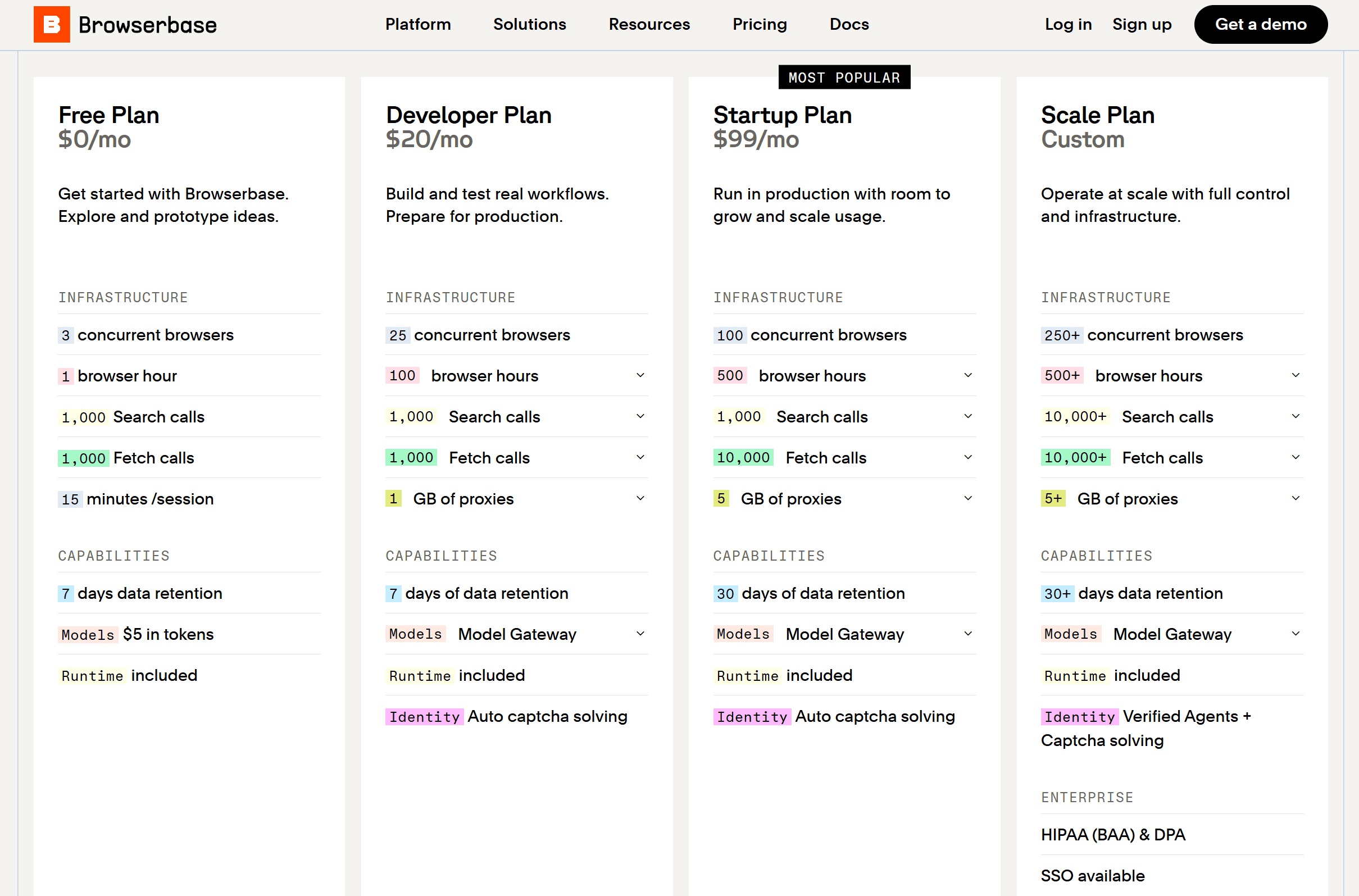
Browserbase offers four pricing tiers based on usage and scale. Usage is measured through browser hours and proxy bandwidth, while scale depends on concurrency and API request volume.
The Free plan ($0/mo) supports prototyping with limited browser hours and API calls. The Developer plan ($20/mo) increases concurrency and adds features such as CAPTCHA solving. The Startup plan ($99/mo) targets production workloads with higher limits and lower unit costs. The Scale plan is custom.
Each Browserbase plan comes with different capabilities, such as CAPTCHA solving, stealth mode, as well as data retention and model access policies.
Nextbrowser followed a subscription model based on credits, which agents consumed to execute tasks. The Free plan included 1,000 monthly credits. The Pro plan added features such as AutoCAPTCHA solving and up to 4 persistent profiles. It ranged from $20/month to $929/month, depending on the number of credits (4,000 to 200,000).
Nextbrowser is gone: What to do now?
The Browserbase vs. Nextbrowser debate is essentially settled, since Nextbrowser is no longer active. As a result, anyone previously relying on it needs a Nextbrowser alternative.
Browserbase is a strong and stable option and is unlikely to disappear overnight. In 2025, it reached $4.4M in revenue and now serves 1,000+ enterprise customers and 20,000+ developers, including Perplexity and Vercel.
Compared to Nextbrowser, which didn’t receive any funding, Browserbase has raised over $67M. This has helped it survive and thrive, without struggling under the pressure of infrastructure costs.
That said, it's not the only path forward. Depending on requirements, you may prefer other robotic process automation (RPA) and browser automation platforms, such as Apify.
Apify: A stable alternative to Nextbrowser and Browserbase
Apify is a full-stack cloud platform for web scraping, data extraction, and browser automation.
Its core concept is the Actor, a serverless unit that executes automated workflows. Actors can handle a wide range of tasks, including simulating human-like browser interactions for RPA and workflow automation use cases.
Apify has a strong open-source ecosystem, offering API SDKs in JavaScript and Python, and maintaining Crawlee, a widely used library for building solid scraping and browser automation scripts. This reflects a developer-first approach similar to Browserbase.
Apify Console lets you build end-to-end workflows integrated with Slack, Google Drive, and many other services through a no-code experience. Apify also provides an open-source MCP server for connecting AI agents to its Actor ecosystem, including browser automation Actors. In addition, Apify is available as an official integration in Zapier, n8n, and Make.
With $13.3M revenue in 2024, 35,000+ Actors, 25,000+ clients, and a developer base exceeding 11,500 users on Discord alone, Apify represents a mature and stable alternative to both Nextbrowser and Browserbase.
Compare Apify with Browserbase in the summary table below:
| Browserbase | Apify | |
|---|---|---|
| Status | Active | Active, stable, fast-growing platform |
| Scope | Cloud browser infrastructure for AI agents, scraping, and automation at scale | Full-stack platform for web scraping, browser automation, and RPA workflows |
| Core model | Managed headless browsers + APIs + runtime primitives | Serverless ready-made Actors executing automated workflows + APIs + no-code workflow builder |
| Target audience | Developers | Developers + non-technical users |
| Built-in no-code workflows | ➖ (prompt-based automation via Director) | ✔️ |
| API SDKs | Python, Node.js | Python, JavaScript |
| Open-source tools | Stagehand | Crawlee |
| MCP server | ✔️ | ✔️ |
| Built-in integrations | ❌ | Slack, Google Drive, Gmail, and 50+ others |
| External integrations | LangChain, CrewAI, Agno, Google ADK, Browser Use, OpenClaw, n8n, and others | LangChain, LlamaIndex, Google ADK, Vercel AI SDK, CrewAI, LangFlow, Zapier, n8n, Make, OpenClaw, and more |
| Financial stability | $4.4M revenue (2025), $67.5M funding, 1,000+ enterprise customers | $13.3M revenue (2024), 25,000+ customers |
| Free plan | ✔️ | ✔️ |
| Pricing | Subscription-based ($20–$99/month) | Subscription-based ($29–$999/month) |
Conclusion
The Browserbase vs. Nextbrowser comparison is implicitly won by Browserbase, as Nextbrowser has been closed. This doesn’t mean that Browserbase is the only option available.
Apify stands out as a valid cloud-based, AI-ready platform for automation and web data workflows. Thanks to its large selection of ready-made Actors covering hundreds of specific tasks, you can get started with browser automation in seconds.