Large investment firms increasingly rely on non-traditional data sources to generate alpha before official financial statements are released. However, alternative data is highly fragmented across sources, formats, and update frequencies.
This guide covers the main data categories, why web data is the easiest place to start, and how to build an end-to-end workflow in Apify that turns public web data into trading signals.
Main categories of alternative data
There are several types of alternative data, each providing different market and investment insights. The main categories include:
| Alternative data type | Common data sources | Investment insights |
|---|---|---|
| Consumer transaction data | Credit card transactions, payment processors, loyalty programs | Measure consumer spending, estimate product demand, identify revenue trends before earnings reports |
| Geolocation and mobility data | Mobile devices, GPS signals, location services | Track foot traffic, store visits, logistics activity, and regional demand |
| Satellite and imagery data | Satellite images, aerial photography, remote sensing | Monitor factory activity, crop health, shipping congestion, mining operations, and energy production |
| Corporate disclosures | Earnings estimates, investor presentations, corporate announcements | Analyze financial fundamentals, earnings signals, management guidance, disclosed risks, and corporate strategy |
| Digital and sentiment data | News websites, social media platforms, search engine trends, forums | Analyze market sentiment, identify emerging events, detect shifts in public opinion, and monitor brand perception |
| Other web-based data | Ecommerce websites, product catalogs, customer reviews, job postings, pricing pages | Track pricing changes, hiring activity, product launches, customer satisfaction, and competitive positioning |
Why alternative data is fragmented and hard to use
Alternative data for hedge funds isn’t a product you can buy from a single provider. Providers deliver data in different formats, schemas, and delivery methods - and while some feeds update in real time, others refresh daily, weekly, or quarterly.
You likely end up facing high subscription costs, inconsistent data formats, and duplicated engineering work. And once you have the data, merging the signals into one investment model is its own challenge.
Web data as the most accessible alternative data source
Websites expose a large amount of public information that you can collect at scale through web scraping. That removes the need to rely on specialized alternative data providers. Web data is also continuously updated, meaning it evolves at the same speed as the stock market.
Another major benefit of alternative web data is its variety:
- E-commerce pricing data helps identify demand pressure, discounting strategies, and competitive dynamics.
- Job postings indicate hiring momentum, expansion plans, and business growth.
- Product reviews reveal customer sentiment, product quality issues, and potential churn risk.
- News articles and social media discussions help track narrative shifts, attention spikes, and changes in brand perception.
How hedge funds turn alternative data into trading signals
Hedge funds rely on structured data pipelines to transform noisy, fragmented datasets into trading signals. A typical workflow has four layers:
- Data collection - Funds pull raw data from web scraping, APIs, and dataset vendors. Web data is often the most flexible: broad coverage, frequent updates, no expensive licensing.
- Normalization - Raw data is cleaned and standardized - fixing inconsistencies and aligning timestamps across sources - to move from a raw warehouse to structured, queryable datasets.
- Signal extraction - Normalized data becomes meaningful indicators like demand trends, growth signals, or sentiment scores, using rule-based systems, statistical models, or machine learning.
- Investment - Signals feed into quantitative models or fundamental research, combined with traditional financial metrics for a more complete picture.
How Apify supports alternative data workflows
Apify is the largest marketplace of tools for AI. For investment use cases, it acts as an infrastructure layer for collecting and operationalizing web-based alternative data.
It gives you access to thousands of ready-made tools called Actors that turn the web into stock market signals. These allow you to automate data collection across multiple alternative data sources.
Beyond data collection, Apify supports transformation and insight extraction through AI-powered analysis. The platform also makes it easy to combine multiple data streams into automated, highly scalable, no-code workflows.
Best Apify Actors for alternative data workflows
| Alternative data category | Recommended Actor | Alternative data sources | Investment output signals |
|---|---|---|---|
| AI-powered news and social media sentiment | Market Mind AI | Google News, X, stock and cryptocurrency discussions | News and social sentiment, market summaries, key discussion topics, personalized investment recommendations |
| Social media sentiment | Social Media Sentiment Analysis Tool | Facebook, Instagram, TikTok comments and posts | Comment-level sentiment scores, engagement signals, post-level sentiment trends |
| Narrative intelligence | Google Search Results Scraper | Google SERPs, AI Overviews, ads, People Also Ask, ChatGPT, Gemini, Perplexity | Search trend signals, narrative shifts, query demand, competitive positioning, AI-generated answer sentiment |
| Job market intelligence | LinkedIn Jobs Scraper | LinkedIn job postings and company listings | Hiring velocity, skill demand signals, company growth indicators, labor-market sentiment proxies |
| E-commerce pricing intelligence | E-commerce Scraping Tool | Amazon, Walmart, eBay, and other retail & marketplace sites | Price trends, stock availability, product demand signals, competitive pricing shifts |
| Business and market activity | Google Maps Scraper | Google Maps business listings, reviews, ratings, contact data | Business growth signals, review sentiment, market saturation, regional demand indicators |
How to build an alternative data workflow with Apify
In this section, you’ll build an end-to-end alternative data workflow built around Market Mind AI.
This provides mainly sentiment-driven equity monitoring insights and doesn't cover the full alternative data collection process. Still, it’s a good starting point to see how web data can translate into investment signals.
Prerequisites
To follow this tutorial, make sure you have:
- An Apify account
- A Google account to send the alternative data report via email through the Gmail integration
Step #1: Define the investment question
Log in to your Apify account, open Apify Console, then select Apify Store from the left-hand menu. On Apify Store, search for “market mind ai”, then select the equivalent card:
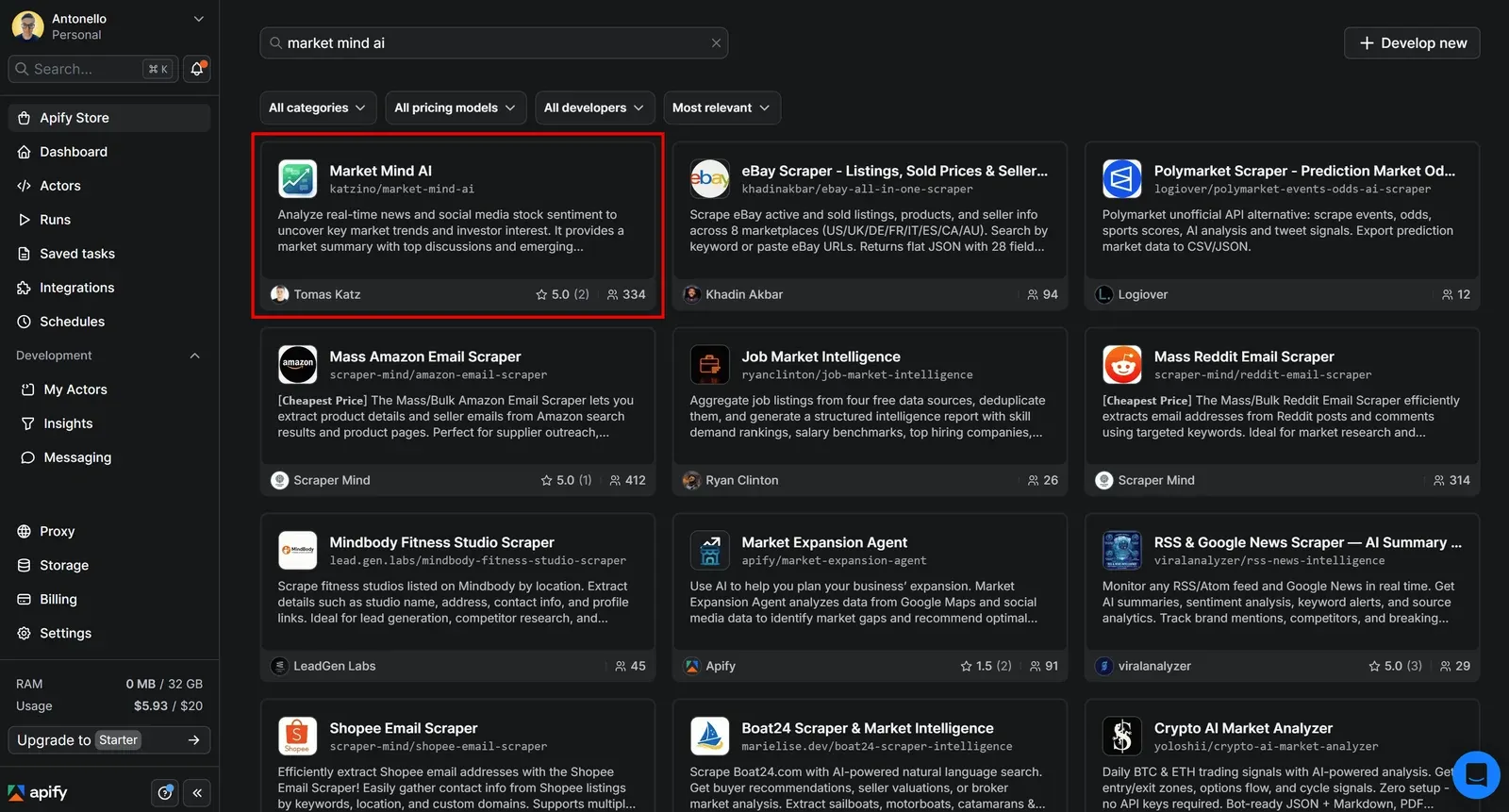
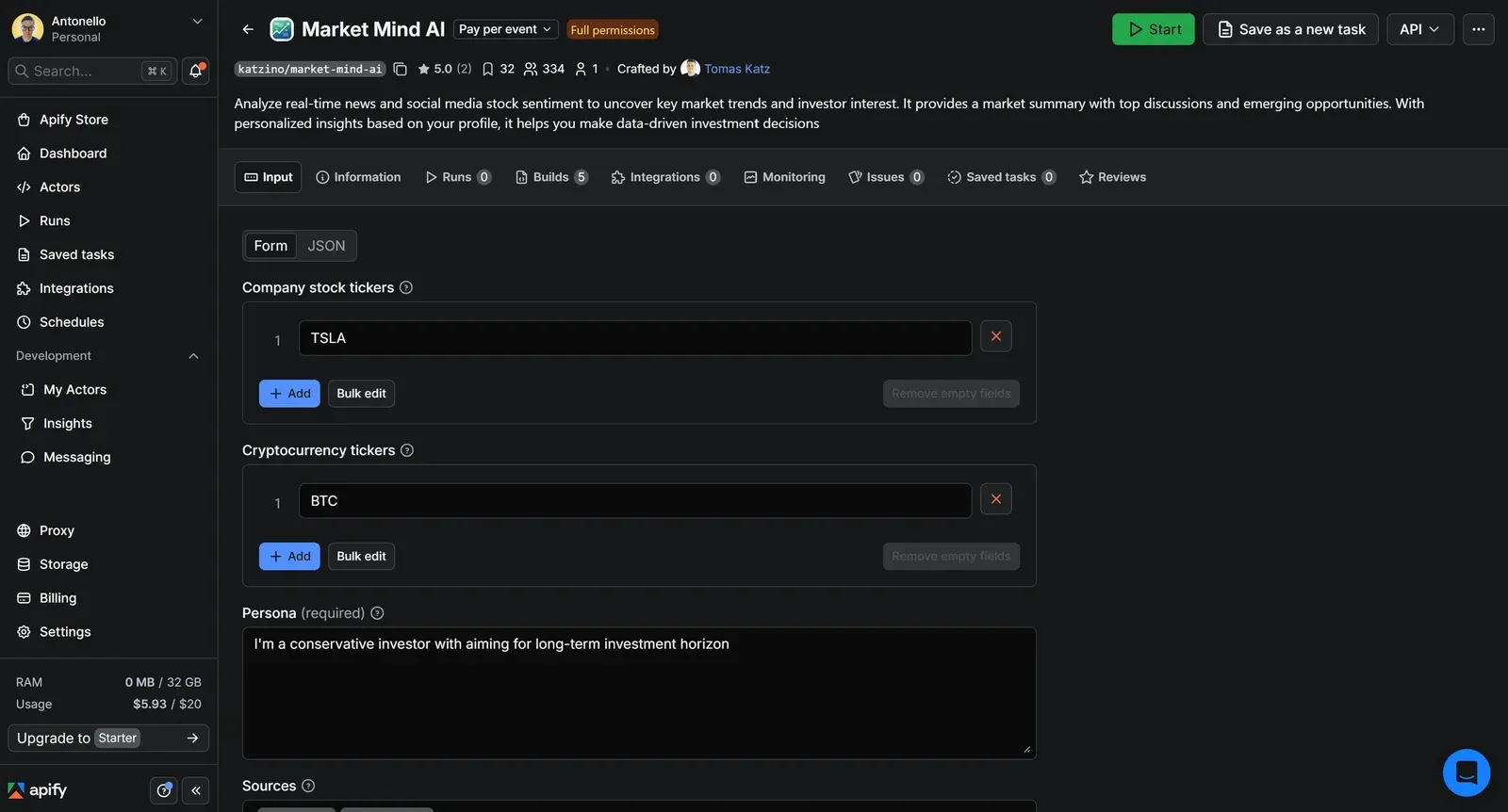
You’ll reach the Market Mind AI Actor page:
Step #2: Run Market Mind AI Actor
Assume you’re a decision-maker at a hedge fund and want to gain insights on NVDA stock using alternative data.
Populate the input of Market Mind AI as follows:
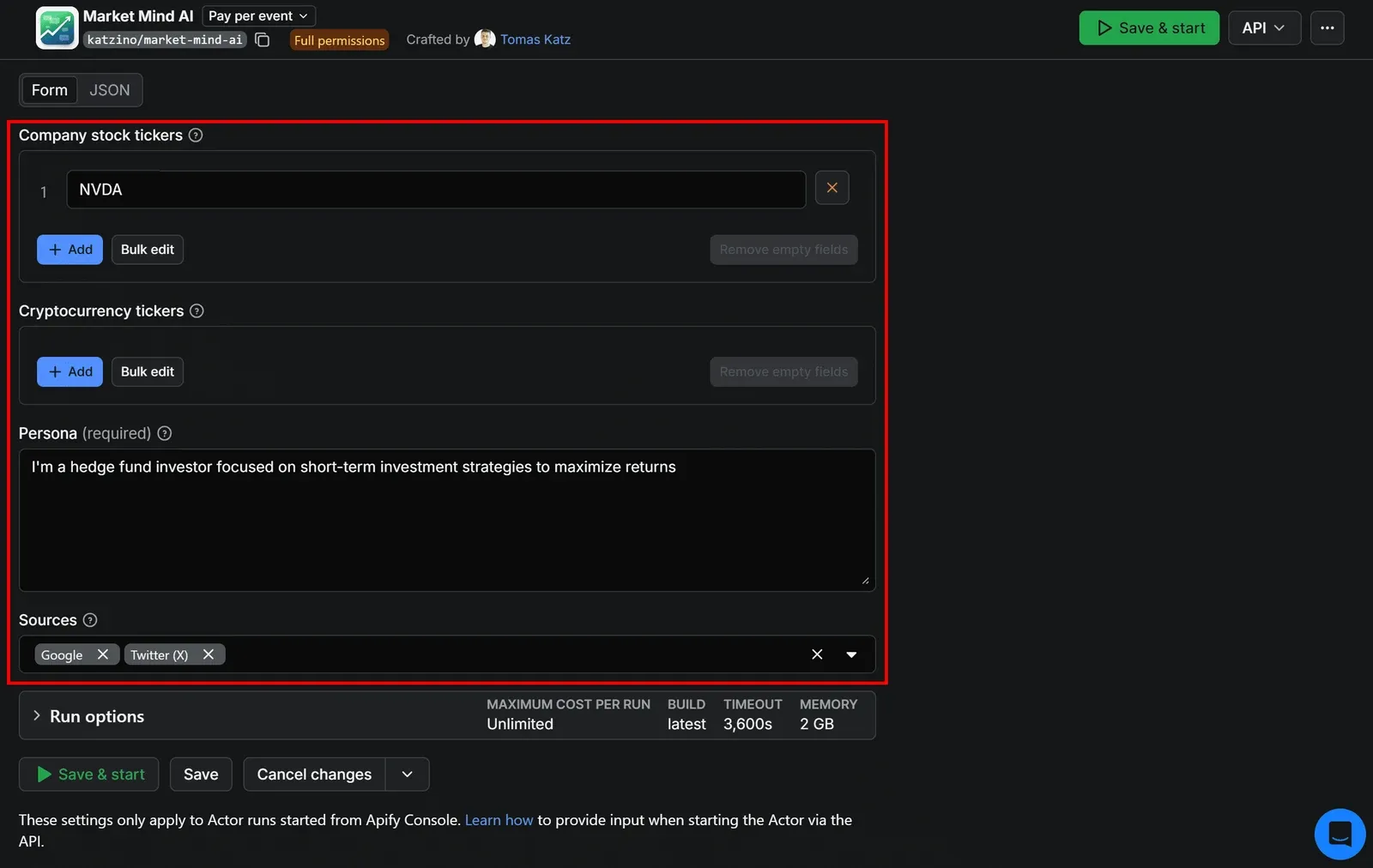
Company stock tickers:
NVDA
Persona:
I'm a hedge fund investor focused on short-term investment strategies to maximize returns
Sources:
Google, Twitter (X)
This setup allows the Actor to collect news and social media posts related to the NVDA ticker, analyze them using AI, and generate sentiment-driven investment signals. The result will be an insight-rich report based on alternative data for hedge funds.
Next, run the Actor by clicking Save & start:

Launching the Actor
The execution can take up to a few minutes, so be patient.
Note: This Actor uses pay-per-event pricing, costing a few cents per analyzed Google News article, Tweets, etc. The amount is deducted from your Apify balance. Since the free plan includes $5 in monthly credits, you can use the Actor at no additional cost within that allowance.
Step #3: Interpret outputs as signals
After the run ends, you’ll get a table-like result. To explore the output in full, select the All Fields option in the JSON data preview:
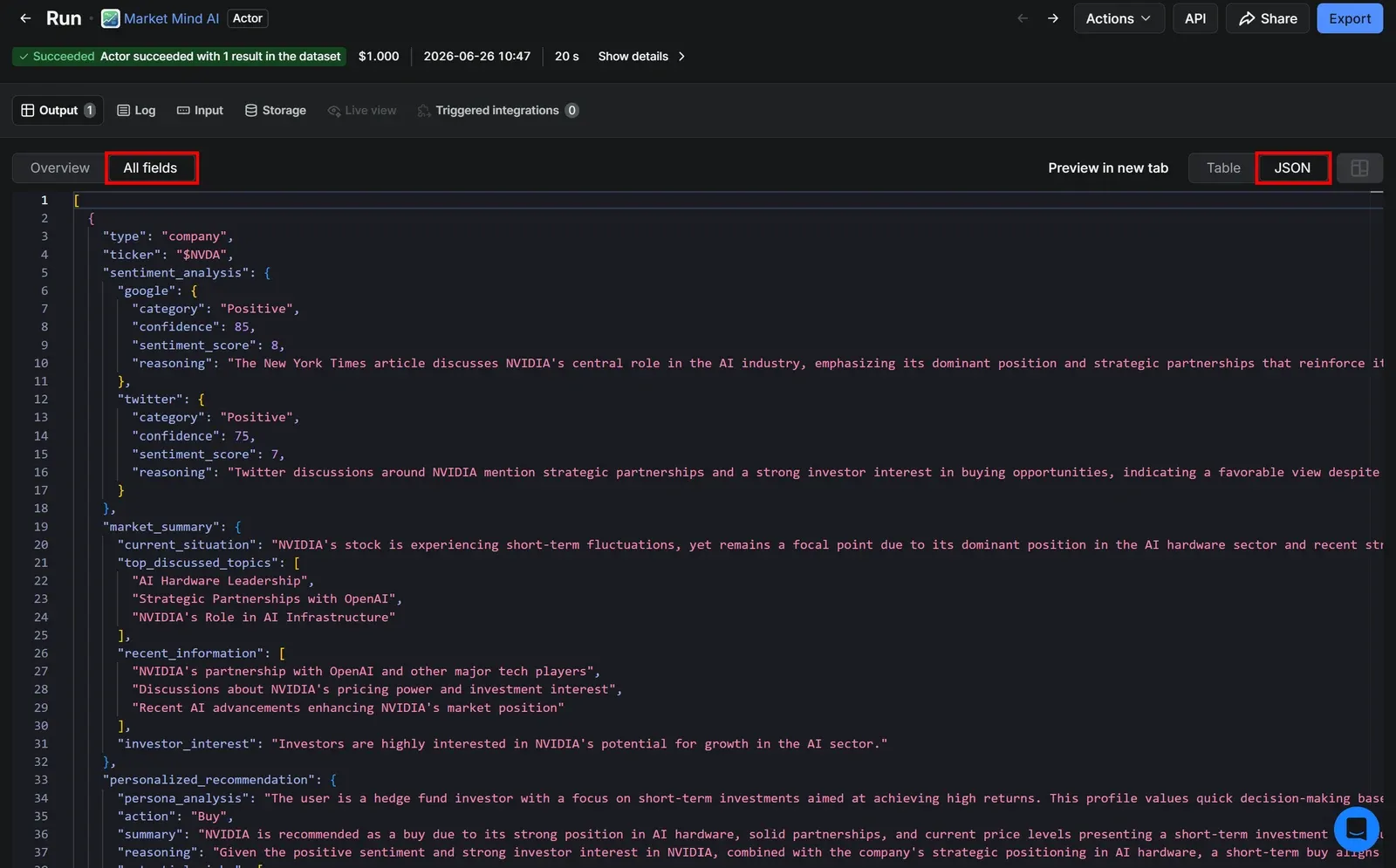
The resulting data contains a sentiment-driven investment analysis based on Google News and tweets related to NVIDIA stock. Google News sentiment reflects the broader macro narrative, while Twitter (X) sentiment focuses more on retail investor insights.
The output also includes a market summary with relevant discussion topics, the current situation, and recent news. Finally, it features a personalized recommendation on whether it makes sense to buy or not, based on the analysis produced by the underlying AI system.
Step #4: Connect the Gmail integration
The Actor’s output is now available in Apify Console, where you can export it as a dataset in XLS, JSON, CSV, and other formats.
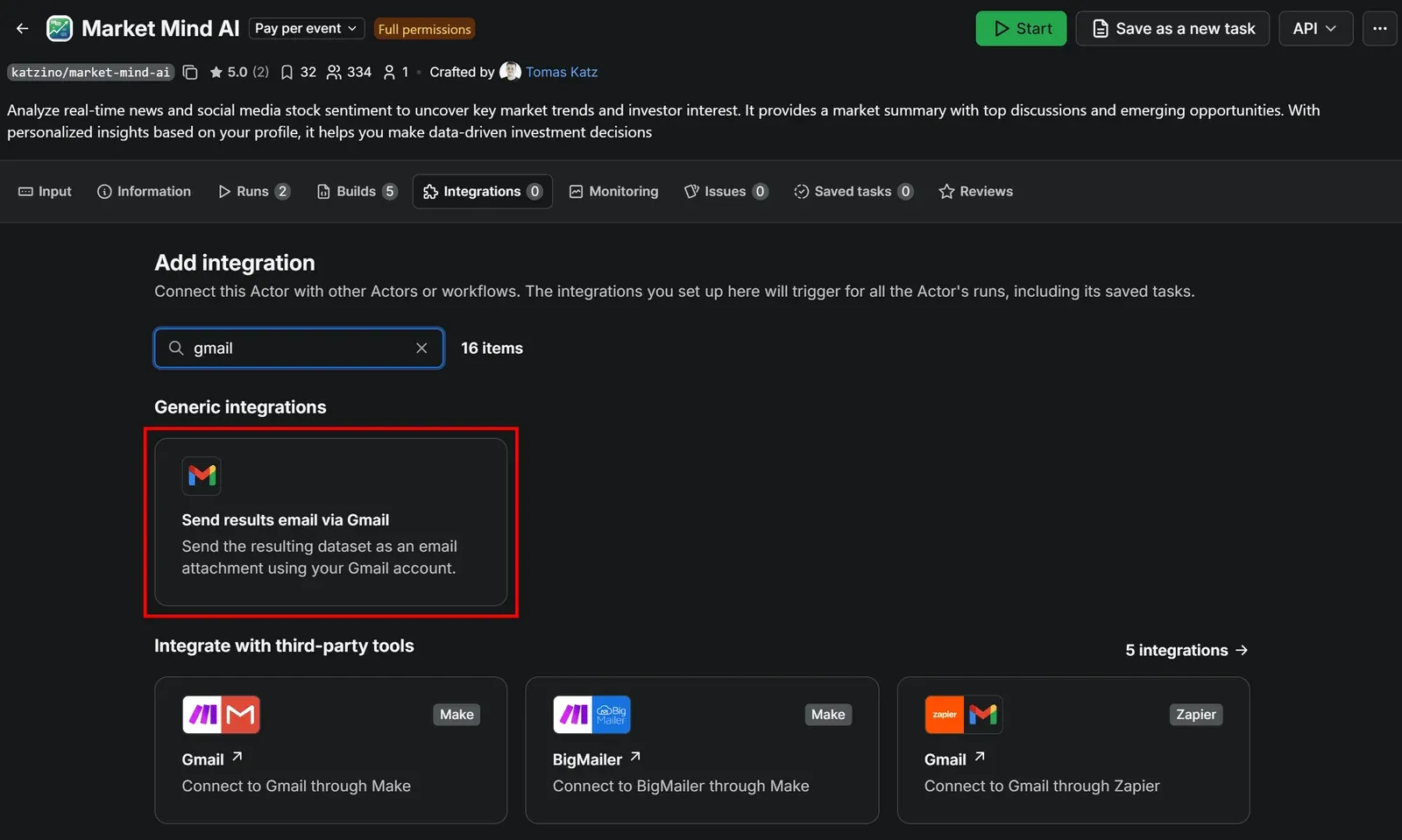
To send the results directly via email through Gmail, open the Integrations tab on the Actor page. Then search for “gmail”, and select the Send results email via Gmail integration:
Click Connect with Google and follow the on-screen instructions. Make sure to grant Apify the required Google permissions:
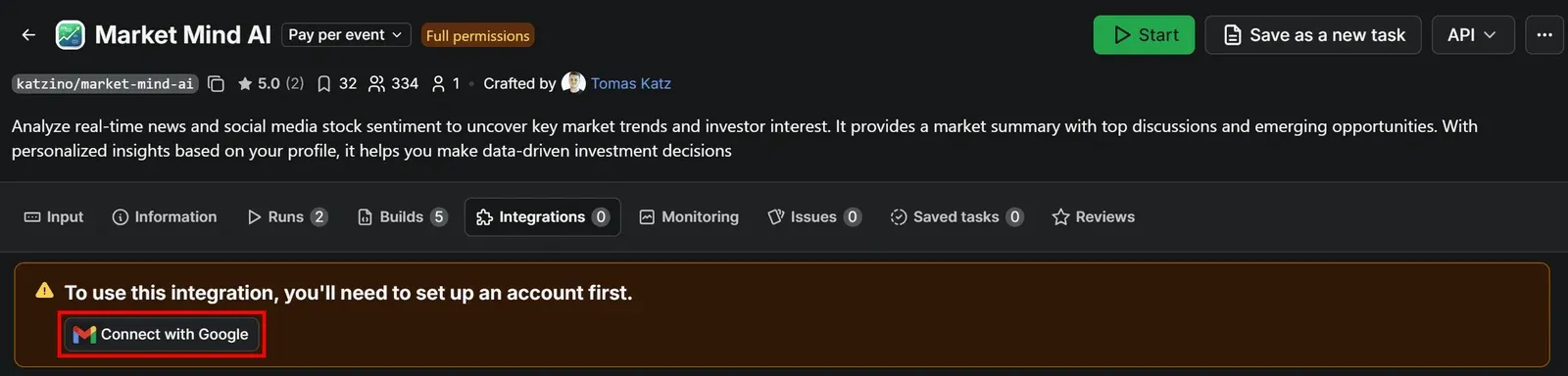
Once connected, you’ll be redirected to the setup page. There, you can configure how the dataset is sent via email through Gmail.
Give the integration a name (e.g., “Gmail integration”). Then configure the form as follows:
- Start when:
"Run succeeds"(ensures the email is sent only after the Actor finishes successfully). - Google account: Select your connected Google account.
- Email to: The recipient email address for the results.
- Subject:
Alternative data analysis(or something similar). - Body:
Attached is the alternative data analysis for real-time news and social media stock sentiment(or a similar message). - Format:
xlsx(makes the output easy to open, share, and analyze in Google Sheets).
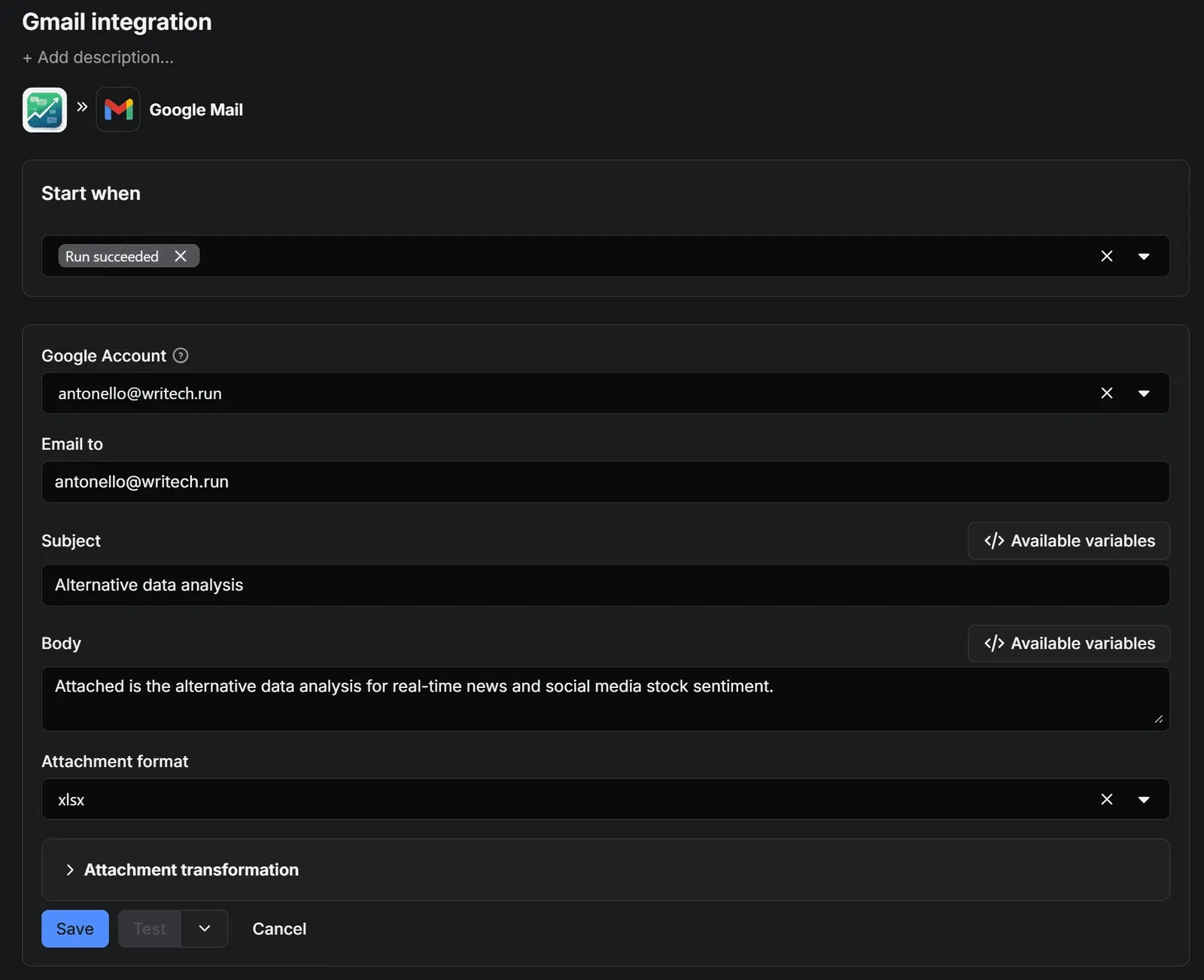
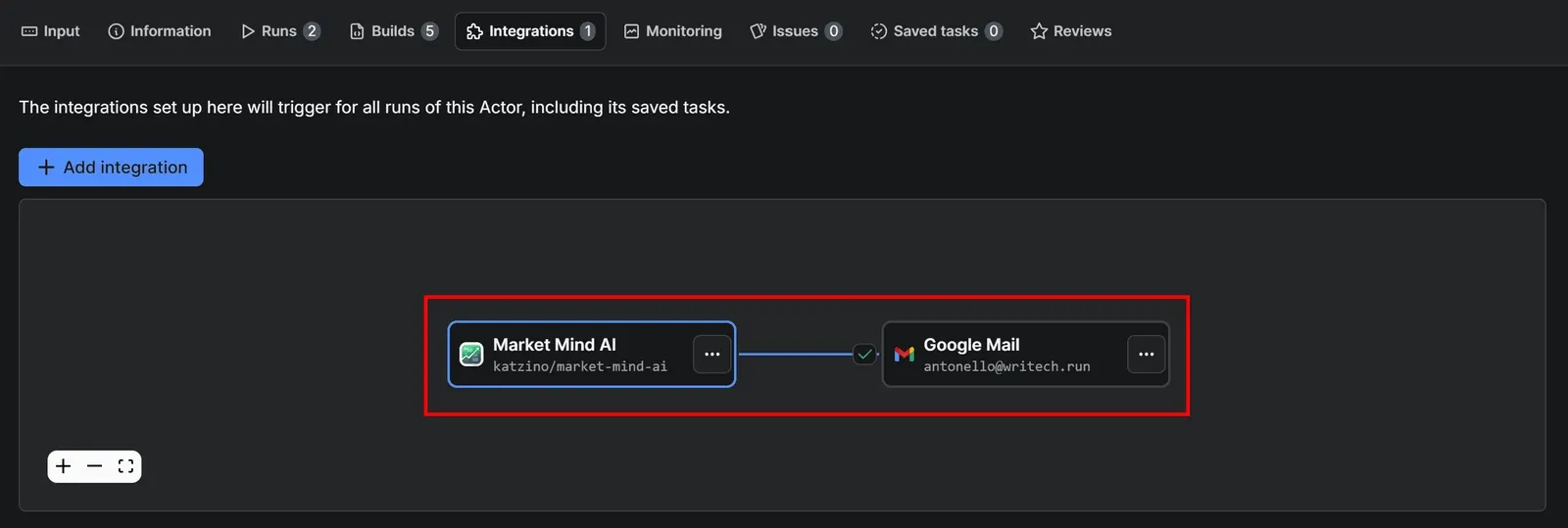
Click Save to add the integration. The Integrations section will then display the fully automated market research workflow, as shown below.
Step #5: Schedule the Actor
To succeed in the stock market, you need continuous and fast analysis. Configure your workflow to run daily (or even every few minutes).
On the Actor page, open the “…” menu in the top-right corner and select Schedule Actor:

In the scheduling modal, set the Actor to run periodically (for example, every day at 09:00 AM):
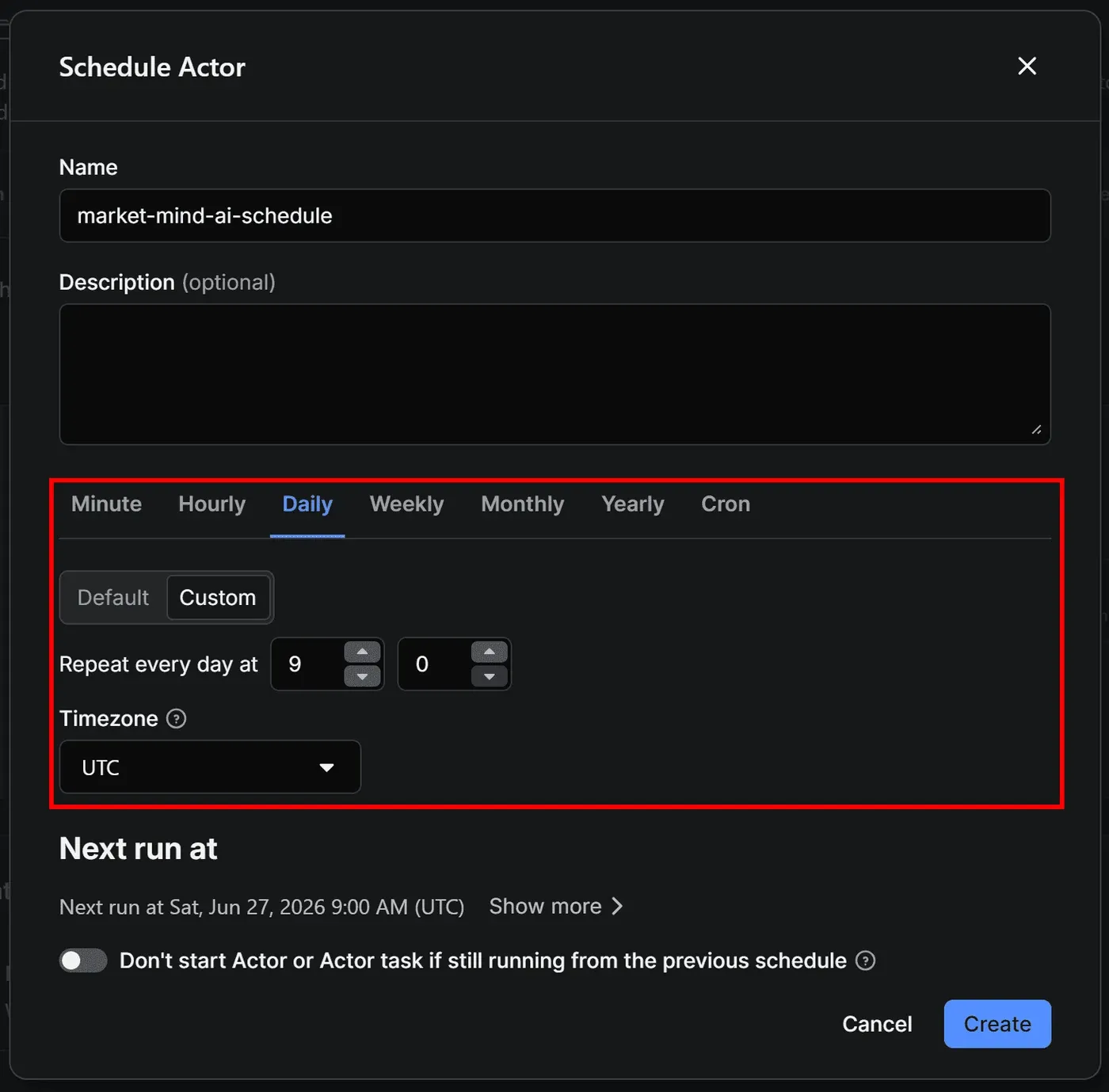
Click Create to confirm. The workflow will now run automatically based on your schedule. The email with the attached sentiment analysis dataset will arrive in the configured destination inbox after a few minutes.
Step #6: Run the workflow
Make sure the Actor input is properly configured, then run the Actor again.
After the Actor's run ends, open your inbox. You’ll receive an “Alternative data analysis” email. Open it, and you’ll see the configured body message with an attached dataset.xlsx file:
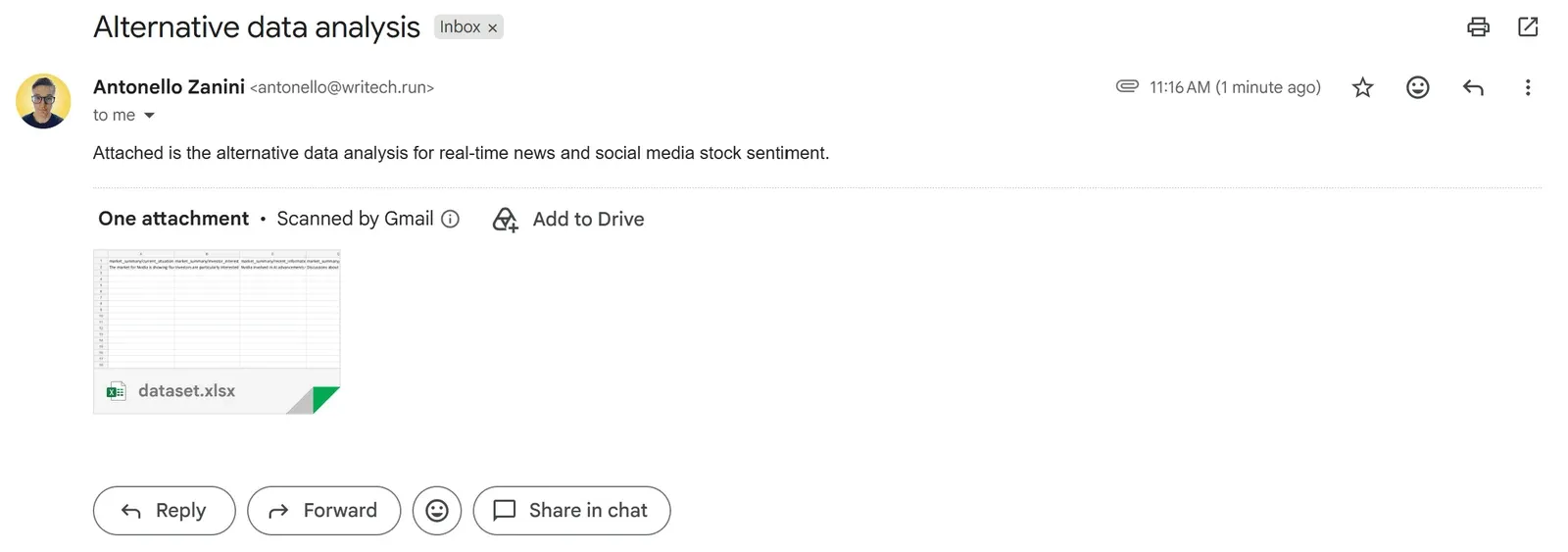
Load the attached file in Google Sheets or Excel. You’ll see the alternative data-driven sentiment analysis results produced by the Market Mind AI Actor:

The spreadsheet contains the same tabular output described in Step #3. Your Apify-powered alternative data web scraping workflow is complete.
Next steps
The Market Mind AI Actor focuses on the sentiment layer, but it doesn’t cover the full alternative data stack.
To go further, combine multiple alternative data sources by building a multi-Actor workflow directly on the Apify platform or by using the Apify integration available in n8n, Make, or Zapier.
The idea is to combine news scraping, earnings tracking, job postings, pricing data, and social media monitoring into richer, investment-ready pipelines.
Conclusion
Alternative data isn't one dataset. It's a stack: sentiment, pricing, hiring, geolocation, and satellite. The hedge funds pulling ahead are the ones combining those signals ahead of earnings, not after.
Web data is the easiest place to start. It's public, updates constantly, and doesn't need a licensing negotiation. Apify handles the collection layer: pick an Actor, run it on a schedule, and feed the output into your model. When one signal isn't enough, combine several Actors into one pipeline.
FAQ
What is alternative data?
Alternative data refers to non-traditional datasets used to gain earlier insights into company performance. It helps investors detect trends, demand shifts, and market signals, usually ahead of traditional disclosures.
What are the best alternative data sources?
The best alternative data sources include web data, transaction data, geolocation data, and satellite imagery, as well as news data, social media posts, and corporate announcements.
Where does AI fit into alternative data workflows?
AI plays a key role in alternative data workflows for cleaning, interpreting, and summarizing large volumes of raw data into actionable signals. It’s especially useful for transforming unstructured information into structured insights for investment decision-making.
How do hedge funds use alternative data for gaining alpha?
Hedge funds generate alpha by relying on raw alternative data to identify mispriced assets, anticipate market moves, and improve investment decisions before information is reflected in official financial statements.
How does Apify support alternative data workflows?
Apify supports alternative data workflows by providing hundreds of ready-made Actors for investment data collection and analysis (e.g., price tracking, job postings, review monitoring, etc.). You can also combine multiple Actors into a single, end-to-end custom alternative data pipeline.