
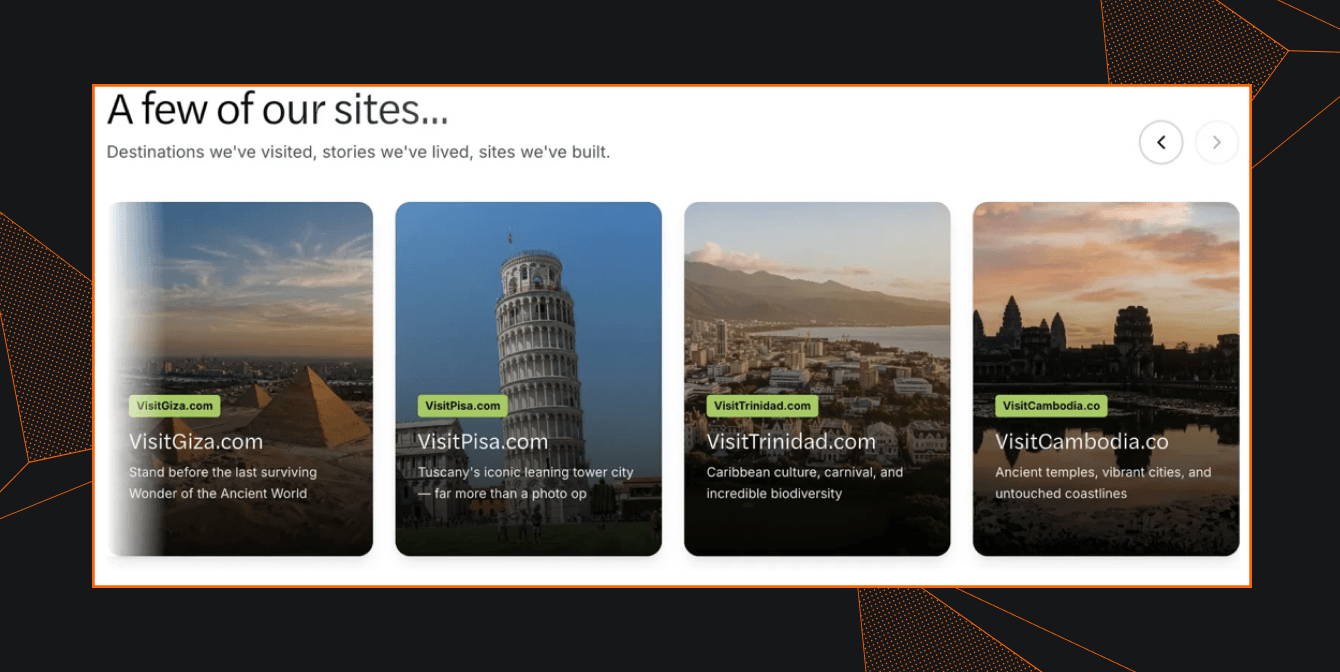
Marcus Cent has 30 years of experience across front-end and marketing roles. He has never been a developer. Now he runs Visit.Network solo, a portfolio of destination travel sites including VisitRome.com, VisitSlovenia.com, VisitPisa.com, and VisitPalawan.com. It's monetized through affiliate partnerships with Booking.com aggregators, Viator, GetYourGuide, Agoda, and Headout.
There is no editorial team and no in-house developers. Across 60+ premium domains and 20+ live sites, the whole network runs on a custom Next.js CMS, Claude Code workflows, and Apify Actors as the data layer.
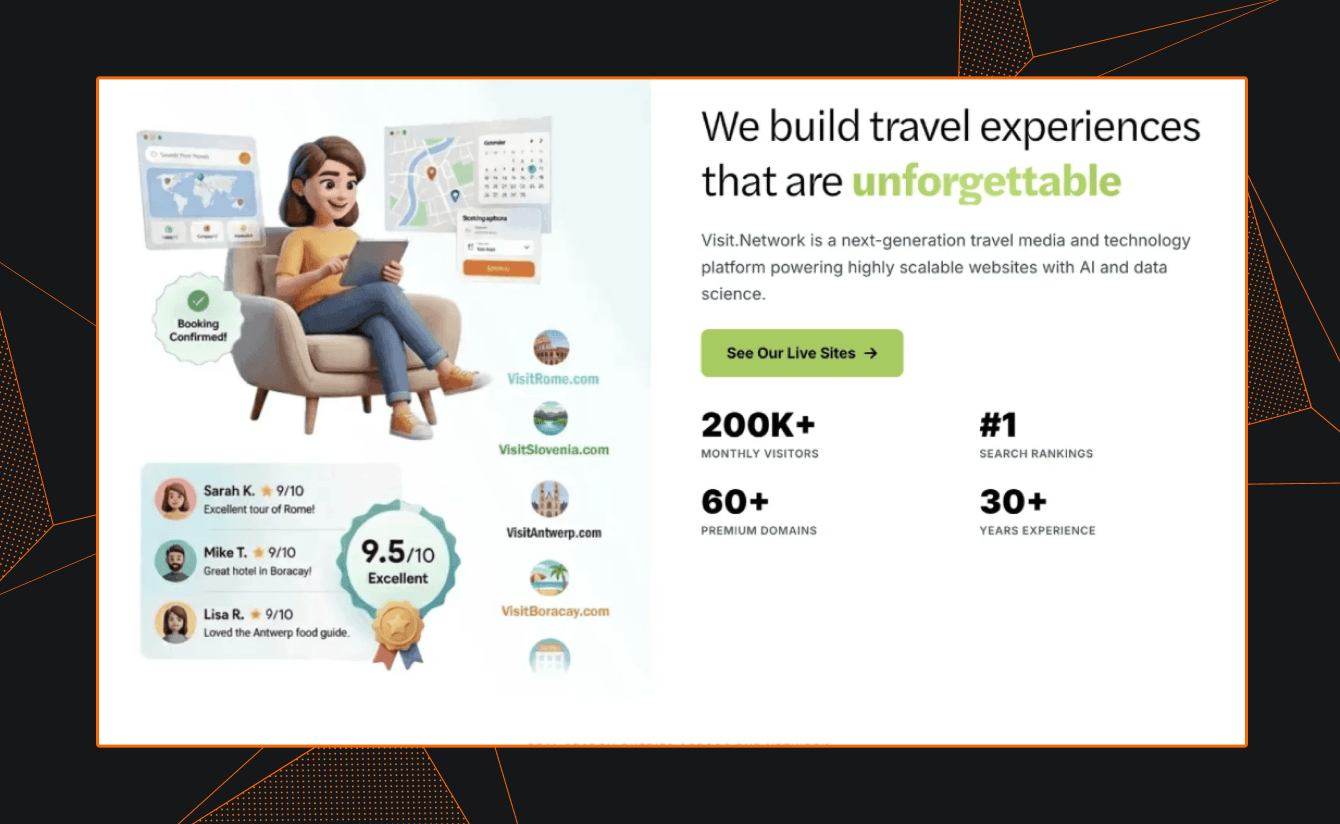
"Visit.Network is unusual because it is not a traditional editorial travel company with a large writing team," Marcus says. "It's a highly automated travel publishing platform built around structured data, affiliate integrations, and programmatic destination coverage."
VisitRome.com, the flagship, hosts 439 hotel records and generates around 3-4 bookings per day at peak, roughly $100/day. Network-wide, the sites draw 200K+ monthly visitors and rank at the top for destination searches.
The data was the bottleneck
When Visit.Network first launched six years ago, every data task ran through outsourced developers. A single scraper meant 5-15 hours of Marcus's time, 10-30 hours of developer time, and $300-$1,500 in freelance cost. Scripts broke whenever a target site changed its layout.
"Even a fairly simple scraper could take several days once you included briefing, coding, testing, debugging, deployment, and fixes," Marcus says. "The biggest pain point was not just cost; it was the loss of momentum. If every idea requires a developer, you test fewer ideas."
Apify makes it possible to move from testing 100 records to processing thousands, and lets me focus on how the data creates value.
-- Marcus Cent, founder, Visit.Network
Scaling up with Apify travel Actors and Claude Code
Claude Code let Marcus design his own data workflows. Apify Actors do the extraction:
- Booking Scraper pulls hotel records (prices, ratings, amenities) for "places to stay" pages.
- Tripadvisor Reviews Scraper feeds review enrichment: themes, recurring pros and cons, and popularity signals, summarized into destination guides without republishing review text.
- Google Maps Scraper discovers restaurants and attractions (names, ratings, reviews, categories, coordinates) for neighborhood and "best things to do" pages.
"Now the first thought for every new idea is: is there an Apify Actor that can get me 80% of the way there, and can Claude Code help me process the output?" Marcus says. With this mindset, a new Actor typically goes from Apify Store to validated output in 30-60 minutes.
Before Apify, scraping usually meant briefing a developer, waiting days, and paying hundreds or thousands of dollars. Now I can often test a data workflow the same day and plug the output straight into our Visit.Network CMS.
-- Marcus Cent, founder, Visit.Network
$39/month, 90% less time, 20+ sites
Switching from developer-built scrapers to Apify Actors reset the math across Visit.Network. Cost, speed, and team size all changed at once:
- 20+ destination sites in production, with thousands of hotel, restaurant, and attraction pages
- 70-90% less time per scraper, from 1-2 weeks down to under an hour
- $39/month vs. $300-$1,500 per build, for 10,000 Booking.com-style records
Coming next: a B2B model for travel companies
Visit.Network is extending the platform with MagiPort.com, a portal builder for travel companies. It lets any travel brand drive new revenue after the ticket sale and build customer loyalty. Running on the same processes as the core Visit.Network engine, MagiPort builds fully custom destination portals on a done-for-you, pay-for-performance basis, with Apify capturing the destination content wherever the model is deployed.
Apify and Claude Code have changed the economics of Visit.Network. It allows one person to operate workflows that would have required a dev, data assistant, researcher, editor, and technical SEO person.
-- Marcus Cent, founder, Visit.Network