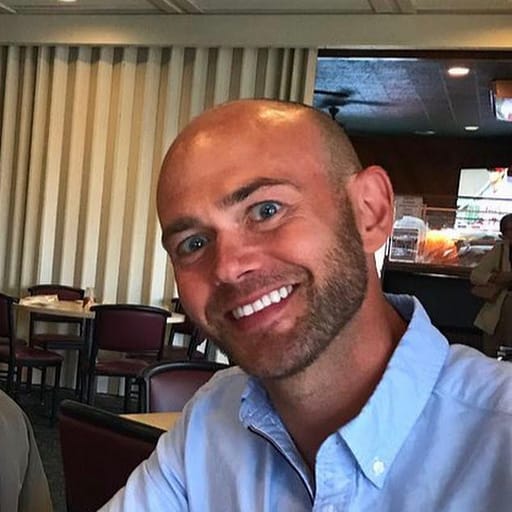
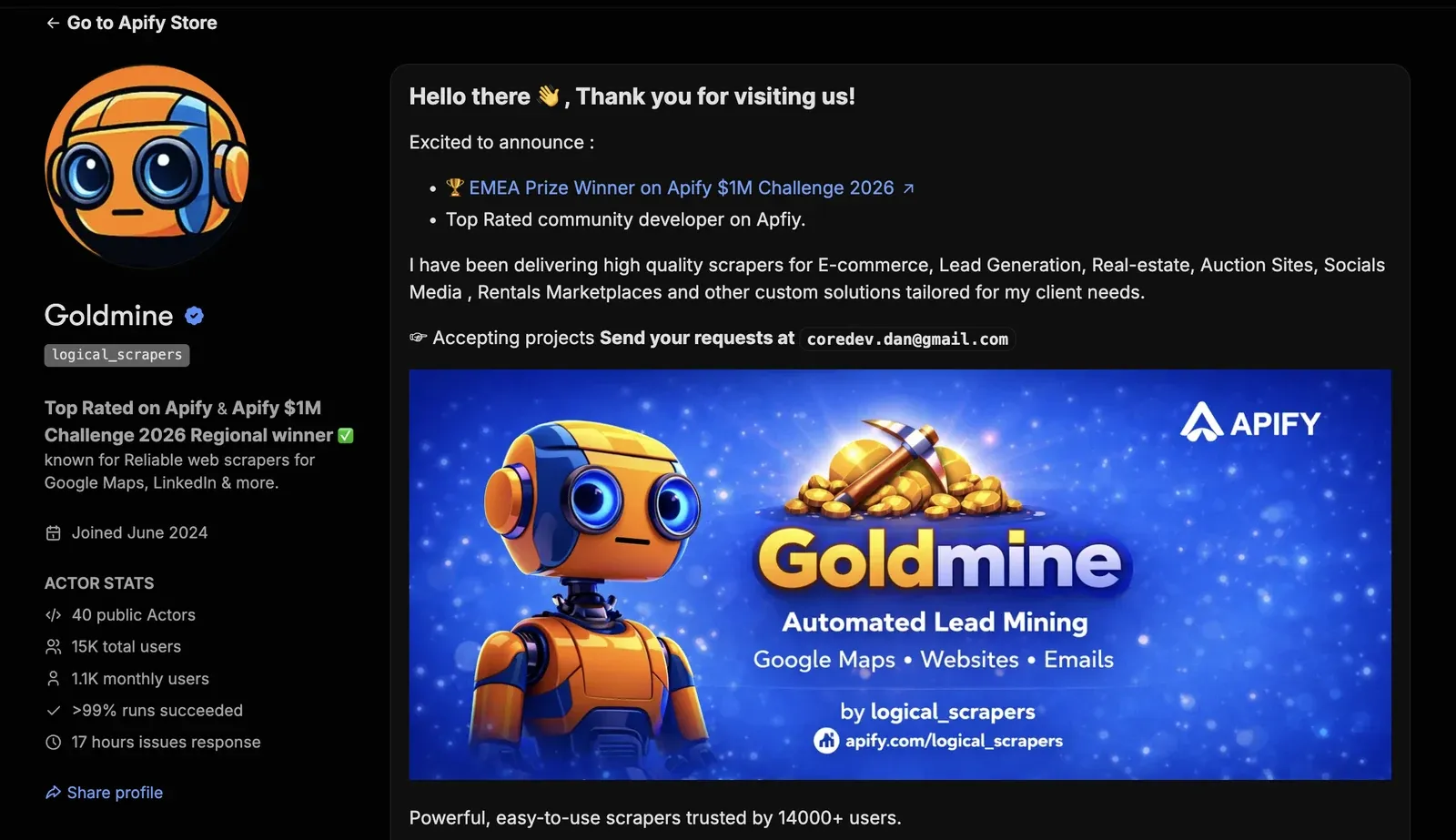
Daniel Mesfin publishes on Apify as Goldmine (logical_scrapers). Today, his profile features 40 public Actors, around 15k users, and a success rate above 99%. He joined in June 2024 and took the Europe, the Middle East, and Africa (EMEA) regional prize in the Apify $1 Million Challenge less than two years later.
Two years ago, he was solving someone else's problem at work.
The LinkedIn scraper he couldn't host
He was leading the development team at a US-based startup, and the marketing team had a bottleneck. Every lead meant opening a LinkedIn profile by hand, reading it, and writing a personalized email off the back of it. That pace capped them at 5 to 10 emails a day.
His plan was to scrape the profiles and let an LLM draft the outreach from what came back. It worked. The team started sending 30 to 40 personalized emails a day.
Getting there meant building the LinkedIn scraper, which he did himself. Then he hit the wall every self-hoster hits.
I was looking to host it by myself, but it was a bit complicated. There's proxies and rotation to deal with, so there are a lot of things to handle. The management side was a bit of a headache for me.
-- Daniel Mesfin, Apify Actor developer
That headache is how he found Apify. He picked up a public Actor to do the LinkedIn scraping, wired it into Gumloop, and the infrastructure stopped being his problem.
Then he noticed other people were publishing their own tools on the platform, and users were showing up for them. He had a few finished scrapers sitting on his PC doing nothing, so he pushed them live. They got traction, and he started putting real time into it.
LinkedIn stayed on the list. He publishes Linkedin Jobs Scraper and a bulk company scraper that runs without cookies.
His scraping background before any of this was thin. He'd tried a couple of things with Selenium to see how web scraping worked, and never went deeper than that. What carried him in was curiosity: "I love exploring new stuff as a developer," he says. "I thought, oh, I can create a scraper for this one."
Publishing was the part that hooked him
Ask him what he liked most about Apify, and he goes straight to how little stood between writing a tool and having a live product.
Apify is so easy. You just have to build the scrapers in a certain format and push, and it's live in minutes. And you can access your hosted scrapers with APIs.
-- Daniel Mesfin, Apify Actor developer
What was important to him as a developer was everything the platform absorbed: the API layer, the hosting, the infrastructure. Shipping, as he puts it, is "just like clicking a button."
For the things he does get stuck on, the docs are his first stop, and Discord is where he watches for announcements and changes. He's been in there for over a year, and he's stayed in contact with the Apify community team. When he finds bugs in the dashboard, he forwards them personally, so they reach the people who can fix them.

Shout out to the Crawlee team
He gets specific about tooling, and the credit comes unprompted.
Shout out to the Crawlee team, actually.
-- Daniel Mesfin, Apify Actor developer
His reasoning is practical. A year or two before, building a scraper meant assembling the whole thing by hand: headless browsers, proxies, session rotation, anti-bot handling.
You'd write code for every block, he says, and it took a lot of time. Crawlee replaced most of that with built-in interfaces, and he's clear about how much of his output now rests on it.
I've built more than 100 Actors in the past year. I've used Crawlee on about 90% of them.
-- Daniel Mesfin, Apify Actor developer
That number runs wider than his own profile. Forty Actors are published under Goldmine. The rest come from a small team he now builds alongside: "I've built 60-plus Actors with the team so far. I'd say a total of 90 or 100 Actors published."
He pairs Crawlee with Apify Proxy, writes mostly TypeScript with some Python, and reaches for CheerioCrawler on the simpler sites. "Everything is in one place," he says. "There's already a well-prepared framework and environment, and you just fix the puzzle."
The system he built for himself
Over time, he stopped starting from scratch. He developed his own Actor structure, a scaffold he reuses to stand up something new fast, and he's refined it release after release. Apify publishes Actor templates that do a similar job for developers starting out. By his own estimate the system has made him 70 to 80% more efficient than when he started.
He treats the Actor quality score as a diagnostic he works from, reading the criteria breakdown to see what to improve and what to strip out. He's watched it track directly with the things he cares about: "I've seen a direct relation between the score and the number of users, and the feedback as well." Some of the Actors he'd built a year earlier scored badly. He went back and reworked them.
The challenge
He found the Apify $1 Million Challenge on Discord, where he'd already been a member for over a year, and he'd "never seen such a big challenge."
The timing was great. He was deep in building scrapers anyway, and had started promoting them on Reddit and in forums, so a competition that put his work in front of people paid off either way. He picked ideas off the published list, added a few of his own, and started building.
Then client work landed on him.
As soon as I started creating Actors, I was caught up with some other projects and client work, and I couldn't find enough time to complete what I'd started.
-- Daniel Mesfin, Apify Actor developer
He didn't ship everything he'd planned. He also discovered partway through that some of the ideas on the list already had Actors covering them. He published the ones he could finish properly, and left the rest unfinished.
He won the EMEA regional prize anyway.
The side gig is becoming the main thing
He started building Actors around the edges of other work. That's changed.
I started developing Actors on Apify as a side gig, but it's becoming my main focus right now.
-- Daniel Mesfin, Apify Actor developer
The work has a business behind it now, Logical Scrapers, which grew out of the Actors he'd been publishing. He's careful to point out how many others are doing the same. "Apify is changing the lives of many people," he says. "There are people going full-time on Apify." The numbers behind his own shift are steady: around 1.1k monthly active users across 40 Actors. Social platforms carry most of the catalog, led by Instagram Profile Scraper, Threads Post Scraper, and his X profile and tweets scraper. The rest spread into e-commerce with Amazon Product Scraper, auction sites with Rbauction Scraper, and real estate with Domain.com Scraper.
What he wants next is the part that's still hard. He's experimenting with anti-bot techniques and going after "aggressively protected sites that no one has touched before," doing that research alongside other developers and contributing to open source as he goes. For someone whose first scraper was only meant to unblock a colleague, the interesting detail is what he thinks the barrier actually is.
It's very easy to start if you have a technical background. You just need to bring your skills, and you have a ready-to-go platform to publish your Actors.
-- Daniel Mesfin, Apify Actor developer