John Cole is a chemical engineer who left a PhD program to start companies, sold one, and spent five years in finance and venture capital. On top of all that, he's an Apify Actor developer, building data tools and the businesses around them in Python from his place in Almaty, Kazakhstan. He's never taken a computer science class.
John took second place overall in Apify's $1 Million Challenge and won $20,000. His Google Flights API picked up a weekly spotlight win along the way, but it was his whole portfolio that earned him the runner-up spot. What sets that catalog apart is a rule he holds to: he won't ship code he can't understand.

Fluent in Python, still learning Cyrillic
John has lived in a lot of places, but Almaty is the one he keeps recommending to strangers. "My wife and I both have careers, and her career brought us here," he says. "I kinda had to shuffle and make something portable." The need for something portable is the reason he builds Actors at all.
He's happy to pitch the city: the nicest, most beautiful place his family has lived, with great skiing on top. Russian is the country's other main language, and when he arrived, he didn't speak it at all. The Cyrillic alphabet caught him off guard. "It looks close enough to look like your alphabet, but it's not." Now he, his wife, and their three kids read street signs to each other on drives through the city, getting a little better each time.
The guy who did the programming
John's career has taken quite a few turns. Over twenty years ago, he left a PhD program to start his first company, in energy, "before it was cool to start a startup." Then came a robotics startup that built manufacturing hardware and the software to run it, which is where most of his Python came from. He grew it into a company with international manufacturing and distribution before selling it. He wasn't sure what to do next, so he went for a finance degree and spent about five years working as an MBA investment type.
The move to Almaty was his cue to go back to building. He co-founded a fintech company and was its CTO, back working in Python. The apps needed data that had no API behind it, so someone had to scrape it. That someone was him, and that is how he found Apify.
At first, he only used Apify to feed his own products. He didn't realize he could rent his Actors out to other people. When he moved away from the fintech, he shifted everything he'd built into public Actors and started sharing them with the communities he was part of. None of it came from a classroom. "I studied chemical engineering a long time ago. I was always the guy who got picked to do the programming on the group projects, and I just sort of picked it up on my own."
His whole catalog won
Ask John how he chooses what to build, and he rejects the idea that there's a method behind it.
Almost nothing is like a blue sky. I don't sit for too long and think about what to build next.
-- John Cole, founder of AlphaOSINT
Nearly everything he ships starts as a fix for a problem he hit on another project. Google Flights API is the clearest case. He and his team wanted real-time flight pricing data, went looking for something solid that ran at scale, found nothing, and turned the tool he built for himself into a tool anyone could rent.
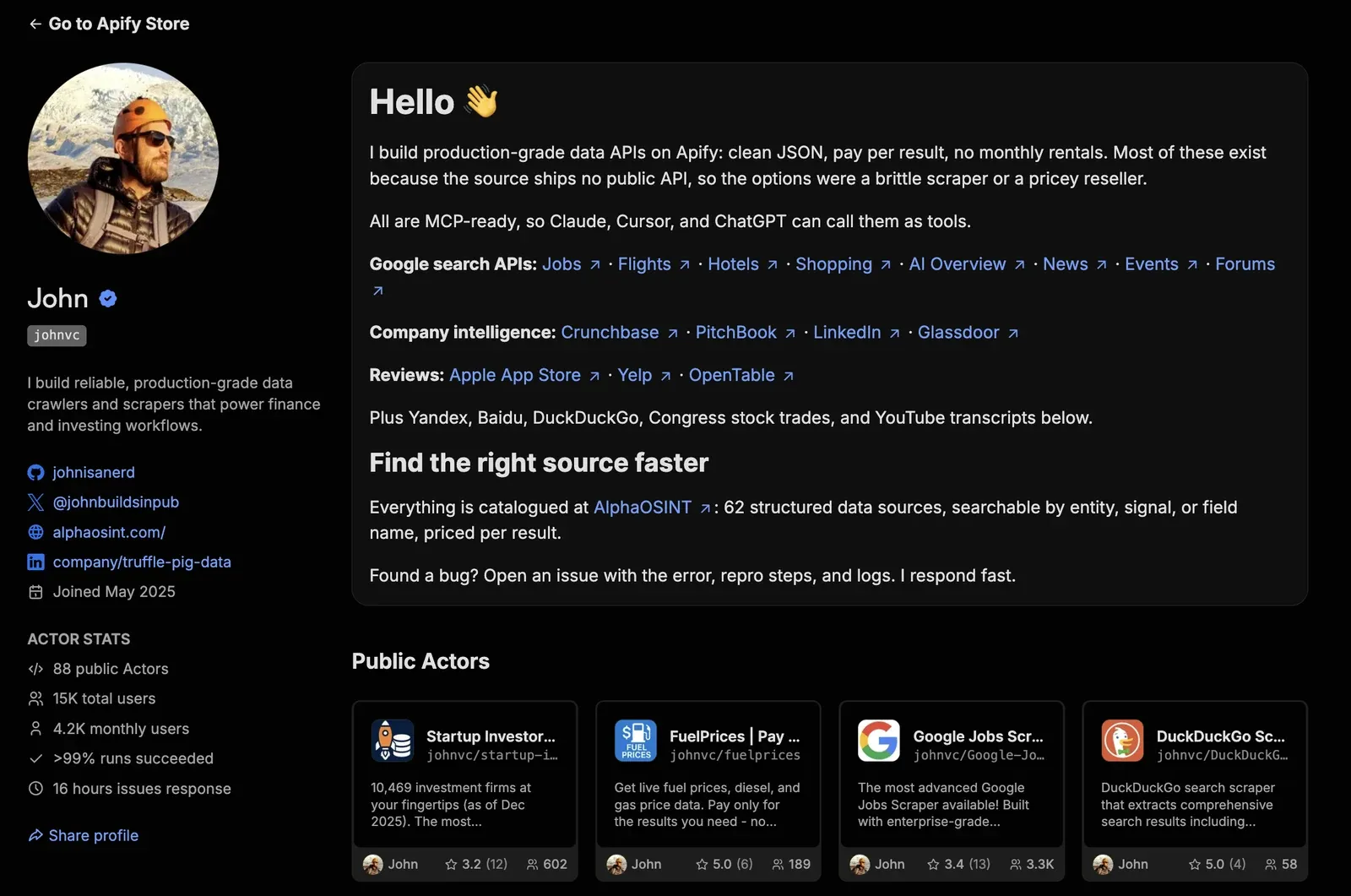
Because of that, his Actors don't cluster around a single specialty. He calls them "very practical instruments," and they cover about as much ground as his career has: search engines, job boards, travel, company intelligence, reviews, and finance tools that reach into congressional stock trades and earnings-call transcripts. He's published nearly 100 of them since joining Apify in May 2025, and they've drawn 15K users in total, 4.2K of them in the past month. He sells them all the same way: clean JSON, priced per result, no monthly rental.
Every one is built MCP-ready, so Claude, Cursor, and ChatGPT can call them as tools. A few say so in the name: Google Events for AI agents, Google Travel Explore for AI travel agents.
That range is what won him the Challenge. The judging looked at developers, not single Actors, weighing monthly active users, Actor quality, technical soundness, and whether the tools were useful to the people running them. Apify had introduced an Actor quality score by then and leaned on it to pick winners. John's whole catalog cleared the bar, not one breakout tool. Google Flights API took a weekly spotlight pick on its own, but it was the consistency across everything else that carried him to second place overall and a $20,000 prize.
He didn't see it coming.
I never won a prize or gotten a degree in programming. It was very nice validation to be like, oh, that's kinda real.
-- John Cole, founder of AlphaOSINT
Making his tools bulletproof
What holds the catalog up is a kind of "paranoia." He over-tests everything. Every new Actor gets a shell script that runs every test he can think of, so the moment he changes something, he knows whether he broke it. He wants each one to be rock solid before it ever reaches a user. It shows publicly: his Store profile reports more than 99% of runs succeeding, and clocks his response time on issues at 16 hours. He's clear about the follow-through: "Found a bug? Open an issue with the error, repro steps, and logs. I respond fast."
His READMEs get the same treatment. He started from Apify's own guide on what makes a good one, then filled in the rest from instinct he'd built as a customer: he knew what he'd wanted to see, and what he'd seen missing, long before he sold anything of his own. He calls all of this standard developer stuff. He taught himself every bit of it.
Vibe coding light
Cursor is his everyday carry. He says it changed how he writes Python, and he loads all of Apify's documentation straight into it, leaning on it for generating tests as much as for code.
But he always stays hands-on. "Maybe I'm old enough to just not trust AI tools enough to let it just kinda go." He rewrites and retests most of what he generates. He tried giving Claude Code more room, and came away with a specific complaint about where the effort really lands:
Anybody who's ever let Claude Code go for a while and then has to try to pick apart a rat's nest that it's built, that's maybe more cognitive load than if you just sat there and thought about it and diagrammed it out and did it.
-- John Cole, founder of AlphaOSINT
He calls his own approach vibe coding light. Plenty of Actors on the platform were made by pure vibe coding; his weren't, and that gap is the whole reason his catalog holds up under real use. It's the same concept that has him writing shell scripts full of tests: he won't ship what he can't understand.
He also has no patience for the online panic about coders being replaced. "I'll firmly blame YouTube for building that binary," the one where you're either ahead or hopelessly behind. When it comes to vibe coding, he references Ronald Reagan instead: trust, but verify, maybe with a little less trust.
Still finding problems to solve
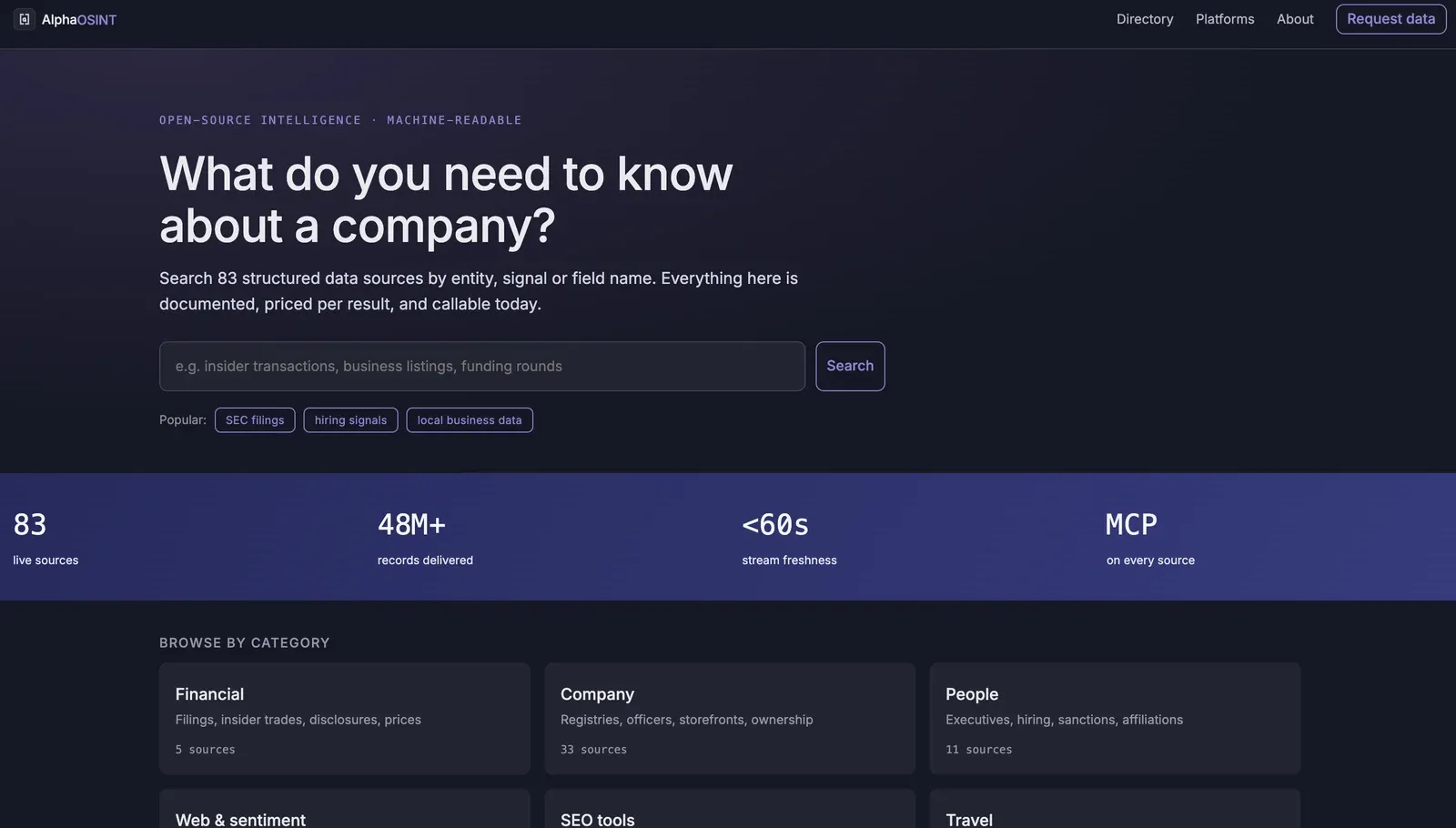
No computer science degree, and no prize for writing code before this one. Just an engineer who kept ending up as the guy who did the programming, spotted problems, and built the tools that fixed them. Those tools became the catalog that took him to second place in the Challenge, and he's still adding to it. There's a business around it now: AlphaOSINT catalogs 83 structured data sources so buyers can search by entity, signal, or field name.
What keeps him building with Apify is simple.
It's been a really wonderful experience to be able to build stuff and immediately have people use it, and see it be valuable for other people. That's made building on Apify a joyous experience.
-- John Cole, founder of AlphaOSINT