
Summary
Ahead of Armenia's June 2026 parliamentary elections, two researchers at Qriton Technologies set out to detect coordinated inauthentic behavior and foreign information manipulation across the country's online space.
Using Apify, they scaled from a targeted diagnostic sample of ~4,100 records to an account-driven crawl of around 2M raw records across six platforms, including the open web, automatically refreshed every day through election day. That scale let them establish whether the patterns they'd spotted were isolated noise or part of a persistent, externally networked influence infrastructure, and attribute narrative coordination with far more confidence.
The Armenian elections collaboration with Apify was one of the best and most effective fast-response collaborations I've participated in.
-- Andra-Lucia Martinescu, Qriton Technologies
The Qriton team and project background
Andra-Lucia Martinescu and Marius Dima are the research team behind Qriton Technologies, where they study FIMI (foreign information manipulation and interference) and the mechanics of coordinated inauthentic behavior (CIB). Andra, also co-founder of the Diaspora Initiative, comes from geopolitics, military and conflict analysis, and since 2024 has specialized in mapping information ecosystems: how disinformation travels, through which corridors, and who moves it.
"Necessity" drew her into the work. "When democratic debate online is so flooded with so much harmful content, it gets you wondering what's left. It's important to weed out the bad from the good, because there's a lot of meaningful debate that happens online, it's just drowned." She and Marius began working together during Romania's 2024 presidential elections, when Marius went looking for rigorous data to explain the patterns he was seeing online, and found that Andra was already doing exactly that.
Together, they built Qriton's CIB detection engine, an explainable-AI module designed to align with the EU AI Act, combining behavioral signatures (synchronized timing, forwarding, copy-paste, translation, mirroring) with human-in-the-loop validation, so the findings stand up as traceable evidence. As Andra frames it: "We mostly look at behaviors within these ecosystems, how disinformation travels, what the language corridors are. Stuff that's not very apparent by just reading."
The disinformation challenge
Most disinformation analysis is content-driven and small in scale: take a targeted sample, identify the obvious coordination, and publish. That was the team's starting point.
During the Romanian elections, they scraped Facebook, the dominant platform in the country, for comments, posts, and groups, supported by a community of volunteers who reported suspicious activity. The method was sound but constrained. "Within the election time, we just learned by doing it," Marius says. Reporting bad accounts through official channels took 10 days to 2 weeks, long after the influence had landed. And the deeper limitation was evidentiary: a targeted sample shows a fragment. It can prove a narrative cluster exists, but not whether it's part of a wider, persistent, externally steered architecture, the distinction that separates ordinary campaign manipulation from a structured influence operation. To establish persistence, depth, cross-platform mirroring, and participation in prior campaigns, you need volume and a precise list of which accounts and personas to follow. As Andra notes, going after "10 posts posted at the same time" isn't forensics.
The Apify solution
Andra first heard about Apify through a recommendation in the Bay Area and connected with the team, agreeing to collaborate when the right project came along. Armenia's elections were it.
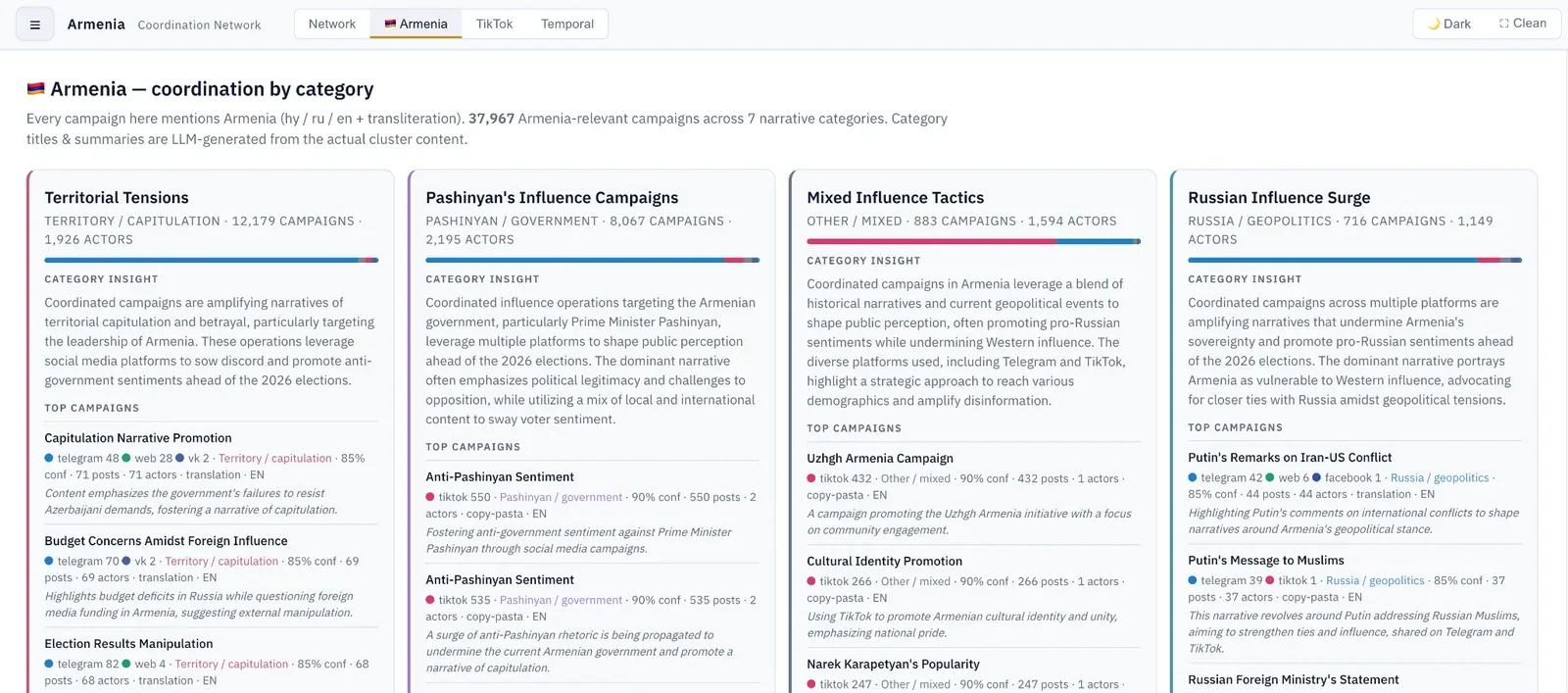
Working alongside researchers from the Atlantic Council, Armenian civil-society organizations, and investigative journalists, the team built a canonical list of accounts and personas to track: 1,570 entities in all, dominated by Telegram and spanning the web, TikTok, X, Facebook, and VKontakte.
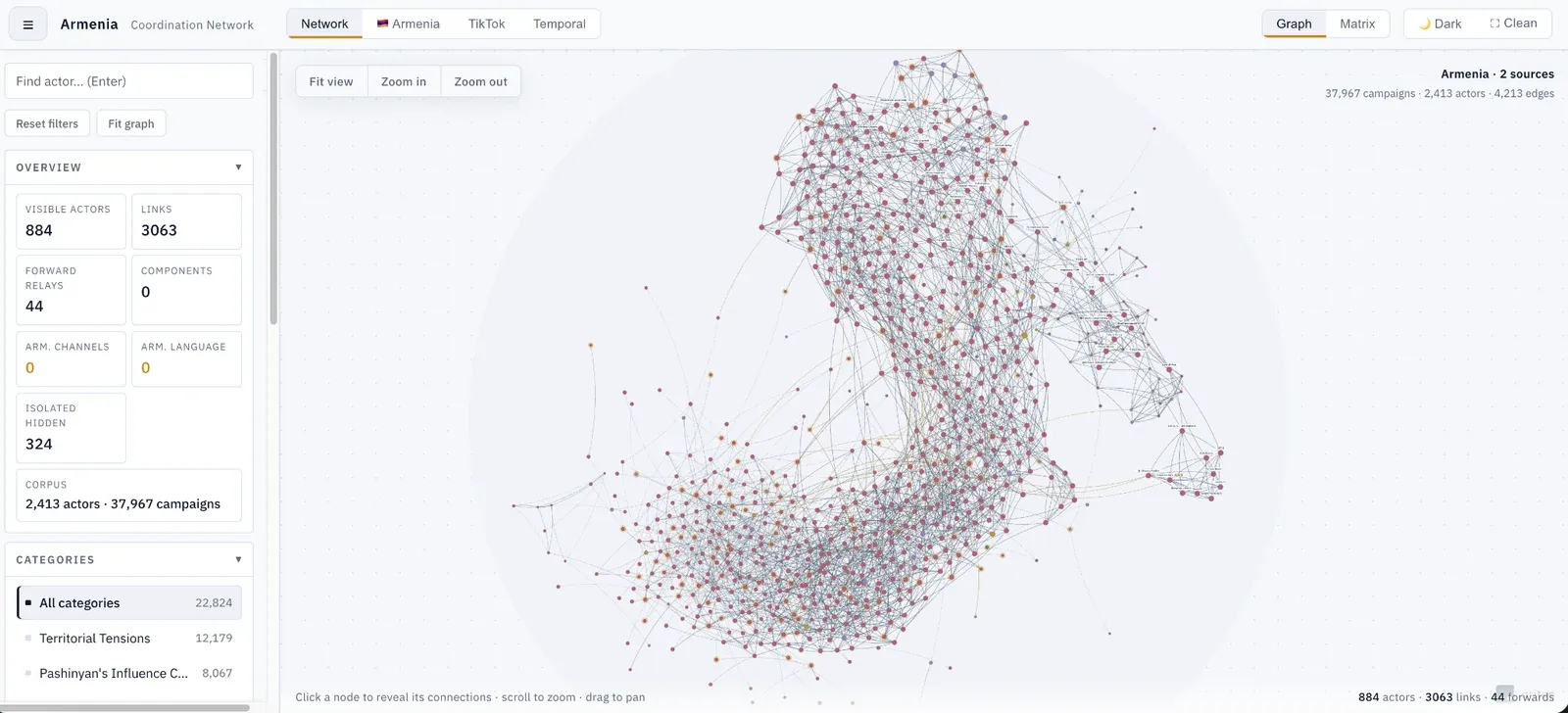
On the data side, the Apify team set up the project and built a few custom Actors to reach the parts of the story that off-the-shelf tools couldn't, while existing social media Actors handled the rest of the crawl. The whole pipeline refreshed automatically every day, right up to the June 7 vote. By election day, the dataset reached around 2M records. The output was a granular, interactive map of how narratives moved between accounts, with Telegram standing out as the main coordination layer.
For Andra, the collaboration the data made possible mattered more than the technology. "What was most impressive was the momentous mobilization around the analysis, how everybody brought their contributions," she says. "It's the readiness at the level of civil society, of the observers, of the people and journalists on the digital front lines."
That scale also opened a new research avenue. Because they weren't limited to the immediate pre-election period, they extended the analysis back to March and watched dormant anti-government and separatist narratives, planted months earlier, peak right on cue during the vote. "It's a bit richer from the validation point of view," Marius says. "We had around 2 million records. We could see even better what's going on there."
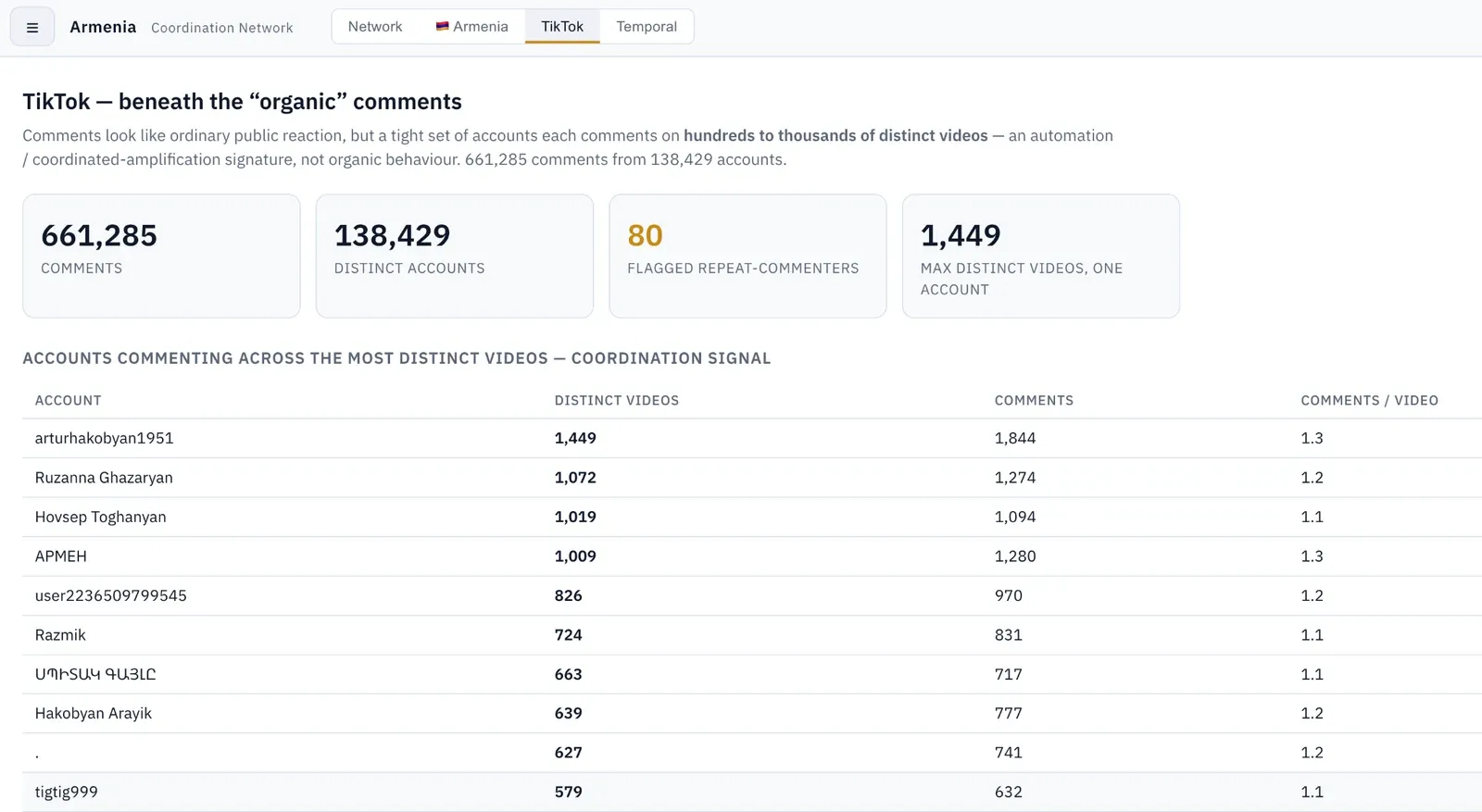
Apify handled one part of a deliberately multi-source approach: multi-platform scraping with Apify, TikTok analysis via AI Factory (an in-house tool from investigative outlet Context Romania), and the team's own content-driven work, what Andra calls "syndicating data."
Apify fits a core principle: not fighting fire with fire. "We don't use ChatGPT to fight with ChatGPT," Marius says.
Apify supplies the raw, verifiable data; Qriton's own technical stack performs the explainable detection, so every conclusion can be traced, reproduced, and defended.
-- Andra-Lucia Martinescu, Qriton Technologies
The results
By election day, the collaboration:
- Scaled from ~4,100 to 2M+ records, moving from a targeted diagnostic snapshot to a six-platform corpus that supports network-level attribution.
- Set up continuous daily collection, an automatically updated Apify crawl that ran through election day, replacing slow, manual gathering with a near-real-time pipeline.
- Operationalized a 1,570-entity canonical seed list at scale, mapping how narratives travel across Telegram, the web, TikTok, X, Facebook, and VKontakte.
- Made cross-platform coordination visible: synchronized bursts, copy-paste and translation chains, and web-mirroring isolated as behavioral signatures, with Telegram identified as the primary coordination layer.
- Documented persistent influence operatives: traceable agents linked to known cross-border operations, building on prior campaigns.
- Produced evidence-grade findings. As Marius puts it, the goal is reports "which have a legal basis. We don't have just a report, we have the mathematical proof. Anyone can bring any expert in any domain, and you can see the result of this campaign, and you can trace it."

Key takeaway
The lesson isn't "more data wins." Andra is precise on this point: "A dataset with a thousand entries, so long as they're relevant and they show a pattern, [can beat] a dataset of a million data points." The right data at scale, paired with a clear list of whom to watch, is what lets you prove coordination. "You don't just go after 10 posts posted at the same time," she says. "You look at persistence, depth, historical data, participation in previous campaigns."
Apify gave the team a way to collect that evidence continuously, across six platforms, at a volume where the coordination becomes visible on its own, and to work faster and earlier with each election cycle as the methodology matured.
Try it yourself
Qriton's coordination network is rendered interactively in its Signals tool, built on a mix of custom and off-the-shelf Apify Actors. The existing social media scrapers behind the crawl include:
Want more on the EU and data? Read how Apify helped the EU monitor 16,000 products across 176 websites, flagging when a promoted price tag violates the EU Price Indication Directive.