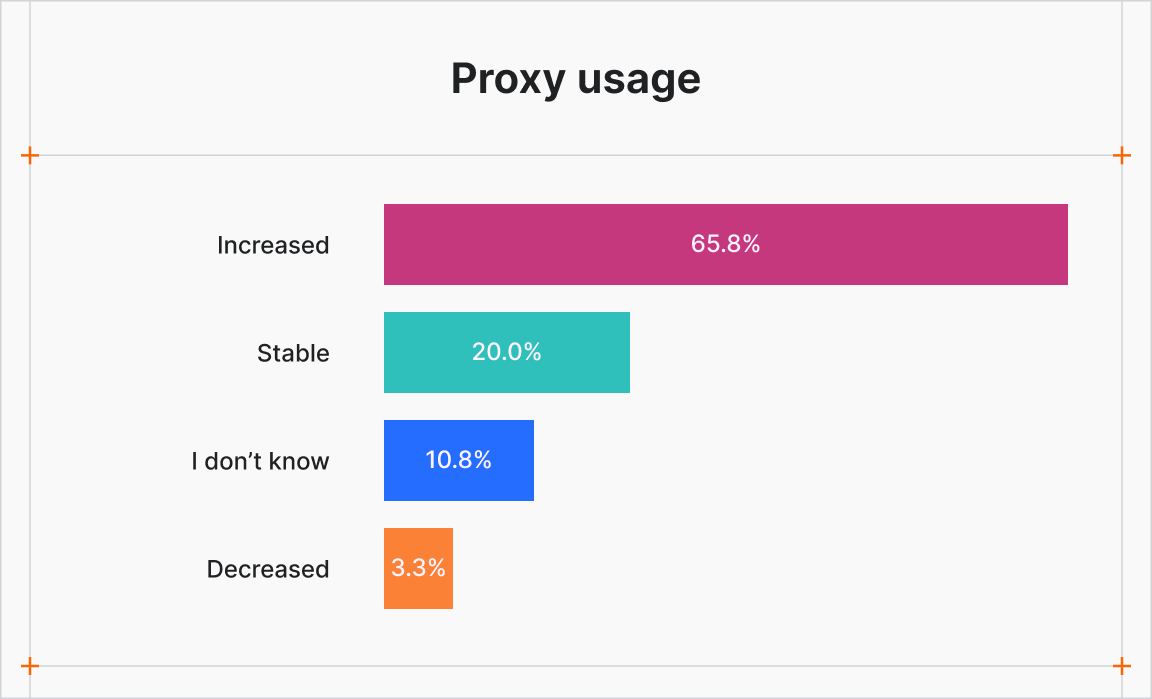
There’s no web scraping without proxies, and this year, their importance is only increasing. According to the state of web scraping report 2026, carried out by Apify and The Web Scraping Club, 65.8% of professionals used more proxies in 2025 than the previous year.
Spending trends mirror this growth. 58.3% of respondents increased their proxy budgets, even though proxy prices have generally fallen in recent years. This suggests that volume and complexity — not price — are driving costs, as scraping operations scale and anti-bot systems become more aggressive.
Another notable shift is how proxies are sourced. 43.1% of respondents now use 2–3 proxy providers, and 12.1% rely on 4–5 providers. This multi-provider approach reflects the need for redundancy, flexibility, and risk mitigation when scraping protected websites.
Proxies are also central to bypassing modern defenses. When asked how they handle anti-bot systems, respondents most frequently cited residential and rotating proxy services, alongside CAPTCHA solvers and web unlockers. These tools are increasingly required, not optional, when targeting high-profile sites.
The takeaway is clear: in 2026, proxies are tightly linked to scraping success, operational reliability, and overall cost structure.