Before ParseForge built its Actor Factory, founder Edmund Carroll had his developers play Factorio, a video game where you design automated production lines and spend most of your time tracking down whatever is jamming them. He wanted the team to understand how a factory works before they built one. That factory has now published 2,000 Actors on Apify Store, builds a new one in about an hour, and keeps the whole catalog running in under two hours of human time a week.
When we first talked with ParseForge in February, the team had just built their Actor Factory, a system that turned a website into a published Actor in under a day. ParseForge had 124 Actors and a goal of 1,000 by 2027. It shipped number 2,000 in September 2026, well ahead of schedule and at twice the target, with four people: Carroll, one senior developer, and two juniors. ParseForge marked the milestone on LinkedIn with a hype edit. "Sound on... it's a banger," the post promised.
ParseForge counts up to its 2,000th Actor
That pace is possible because of where ParseForge builds. Apify is the largest marketplace of tools for AI, where thousands of ready-made Actors are run on demand by developers, companies, and AI agents. Apify takes care of deployment, scaling, proxies, and billing, and puts every new Actor in front of the people and agents looking for that data, so a four-person team can spend its time on production instead of on infrastructure.
We weren't here to build one by one and scale via people. I never believed in just manual labor.
--Edmund Carroll, Founder, ParseForge

Factorio and the Actor Factory
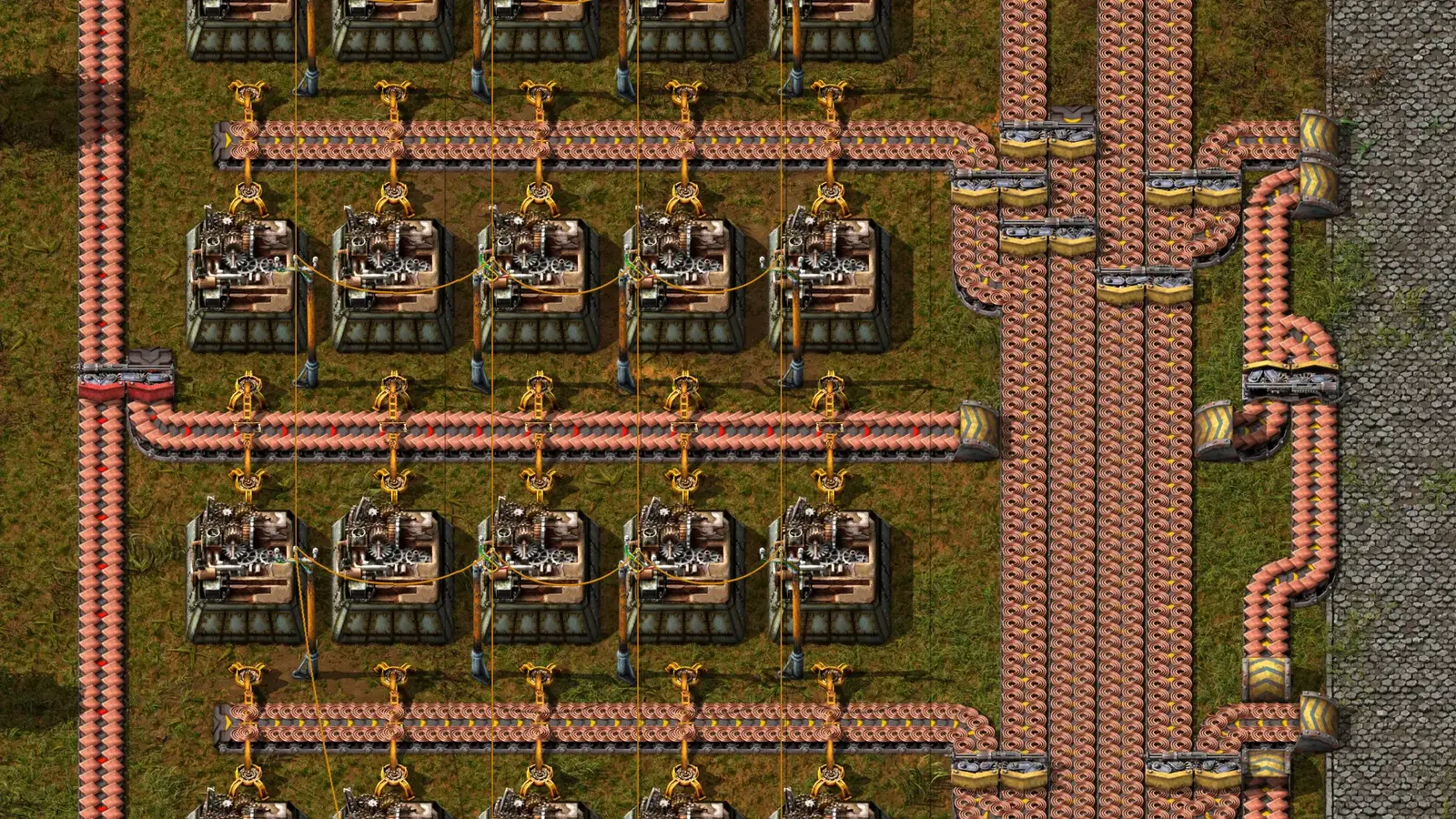
In Factorio, anything you do by hand is a problem you haven't automated yet. ParseForge applied that rule to building Actors. "We turned every step of the process we went through as humans into a factory that could help us research, identify, and score opportunities, start building, maintain, and then improve over time," Carroll says.
The game's other lesson is to keep hunting for whatever is jamming the line, and the team does that every week. "Better has no finish line," he says. "We always try to find the limiting constraint, and then unlock it. Many variations and iterations on the Actor Factory are what got us there."
The team builds with the same AI coding tools everyone else uses, Claude Code and Codex, plus harnesses it built on top. "AI was a big lever for us," he says, "but our really sharp team of AI developers is what helped us with this." The system also makes new hires quick to train. "The way we built out the system internally makes it very easy to on-ramp someone."
A self-improving machine
The factory gets regular updates. The biggest recent addition is a monitor one of the developers built, which "takes our Actors, looks across the marketplace, identifies competitors, and figures out how we can make ours better." When an Actor is underperforming, under maintenance, unprofitable, or failing too many runs, the factory makes the changes on the fly. "No humans required there," he says.
An Actor flagged for maintenance goes straight back into the factory to be rebuilt. If the factory can't manage it, a developer steps in, and the fix is fed back into the factory so the same failure is handled automatically next time.
So we have this self-improving machine. The team's effort on maintaining our 2,000 Actors is, I'd say, under a couple of hours a week. We could build another 10,000 Actors this way.
--Edmund Carroll, Founder, ParseForge
Choosing which Actors to build
ParseForge hit 2,000 Actors in about half the time it planned. "Productivity was never the bottleneck," Carroll says. "Finding good Actors was."
ParseForge's first bet was on corners of Apify Store nobody had covered yet, like government and healthcare data. Those Actors found fewer users than expected, so the team pointed the factory at proven demand instead. It set out to cover the 100 most-used Actors on the Store with versions that offer better coverage or run cheaper or faster than the competition, and he believes ParseForge now covers over 90% of them.
"It's a long-term game, and we're not planning to be a hit overnight," he says. "We believe our growth will continue to compound based on having the best team and the best-quality Actors."
16x in eight months
- 2,000 Actors, up from 124, and 31,000 total users, up from 1,900
- 4,300 monthly users
- 1.6 million+ runs at a 97% success rate, with 99% as the target
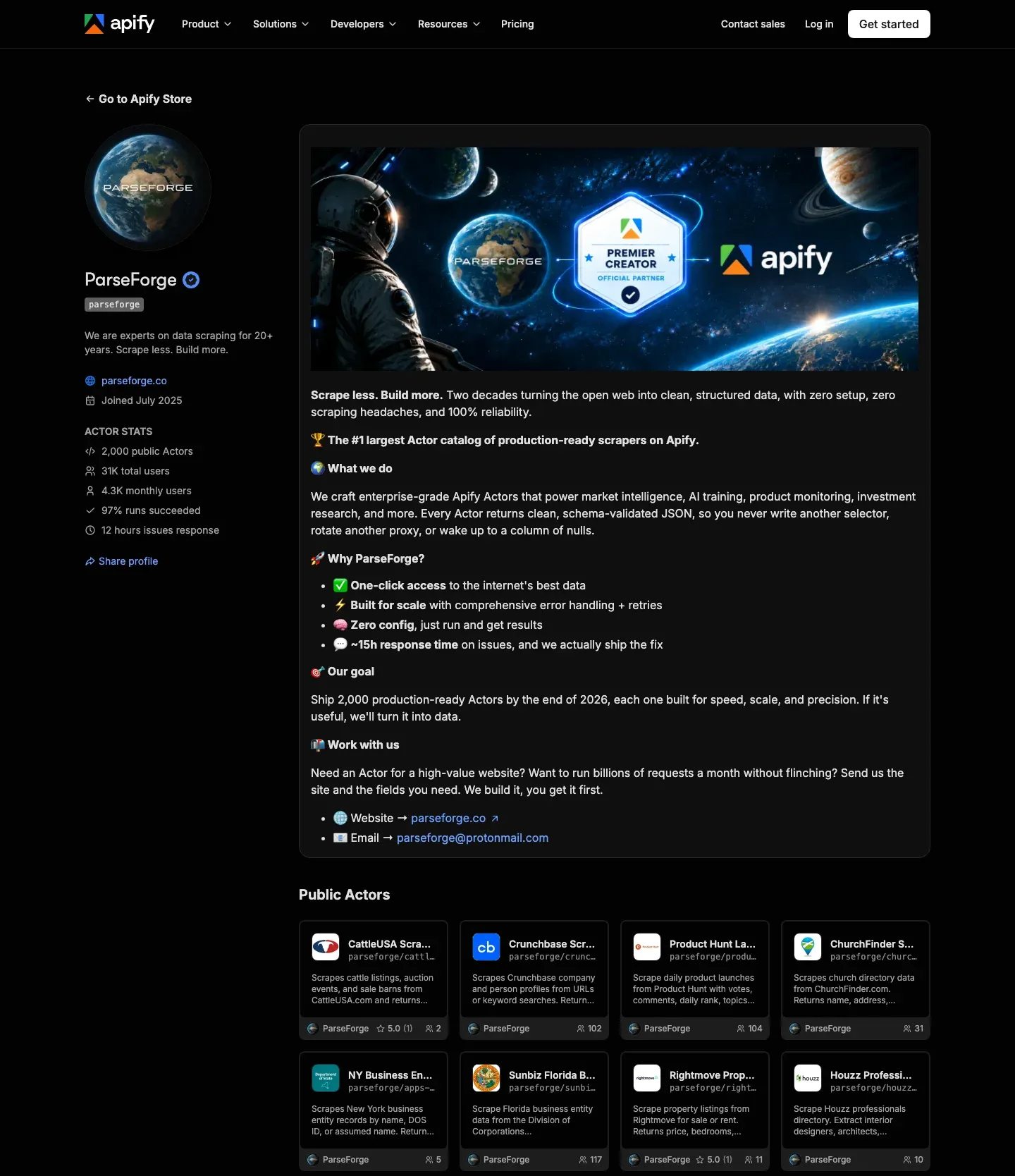
"People are using our tools to power the apps they build, and they rely on us," Carroll says. "If there's ever an outage that affects a developer, they can count on us to respond within hours and fix it within 24."
Carroll's advice: get the playbook down first
Get really good at building high-quality, reliable Actors, and focus on areas where you know there's demand. Find sources of customer demand in places that are less expected, and build with the customer first in mind. Don't scale too quickly, because you'll get choked by the amount of maintenance and work that needs to be done for all of these Actors. Focus on getting your playbook down first. After you have your playbook, scaling is much easier.
--Edmund Carroll, Founder, ParseForge