Orchestrai.eu builds AI Operating Systems (AIOS): coordination layers that let dozens of AI agents run a client's social media, content, and ops. Founder Thomas Lemarchand's clients are content studios, e-commerce operators, press groups, and consulting companies. They all share the same requirement: they own their infrastructure and their data. No vendor lock-in and no black boxes.
Every new client used to mean weeks of setup: picking the right tools, testing combinations, wiring everything in. Plus, the team needed to shrink datasets to keep Make.com's payload limits happy and the pipelines active. Thomas wanted to skip all of that and let the agents handle it themselves. Here's how switching to the Apify MCP Server cut their kickoff-to-dashboard time by 10x and scaled them to 20+ live client deployments.
I don't pick Apify Actors anymore. I describe the outcome, and the agent finds the right combo through the Apify MCP Server.
-- Thomas Lemarchand, Founder, Orchestrai.eu

Data on demand
"Our clients don't want another monitoring dashboard. They want a coordinated system of agents handling social media intelligence, content production, and operational automation in parallel," explains Lemarchand. "That only works if the agents can pull granular, structured data on demand, not whatever a closed SaaS tool decides to expose."
The Apify platform is now the default data layer underneath every Orchestrai.eu deployment. Agents combine Apify Actors that scrape Instagram comments, YouTube comments, subreddits, trending TikTok transcripts, and platform KPIs into a single monthly brief, archived in the client's Notion workspace and consumed by content-production agents downstream.
Actor testing with a single prompt
Behind the scenes, Orchestrai.eu spins up a base AI agent connected to the client's context in Notion, their website, and Google Drive, then plugs in the Apify MCP Server and describes the outcome.
A typical kickoff prompt: "I want to monitor all the company's social media, KPIs, comments, and video transcripts. Find me the best combo of Apify Actors for this mission." The agent surfaces the right Apify Actors, estimates the costs, runs a test, and produces a complete dashboard. Once the output is solid, the Actors get locked into the agent's instructions and the system ships to the client.
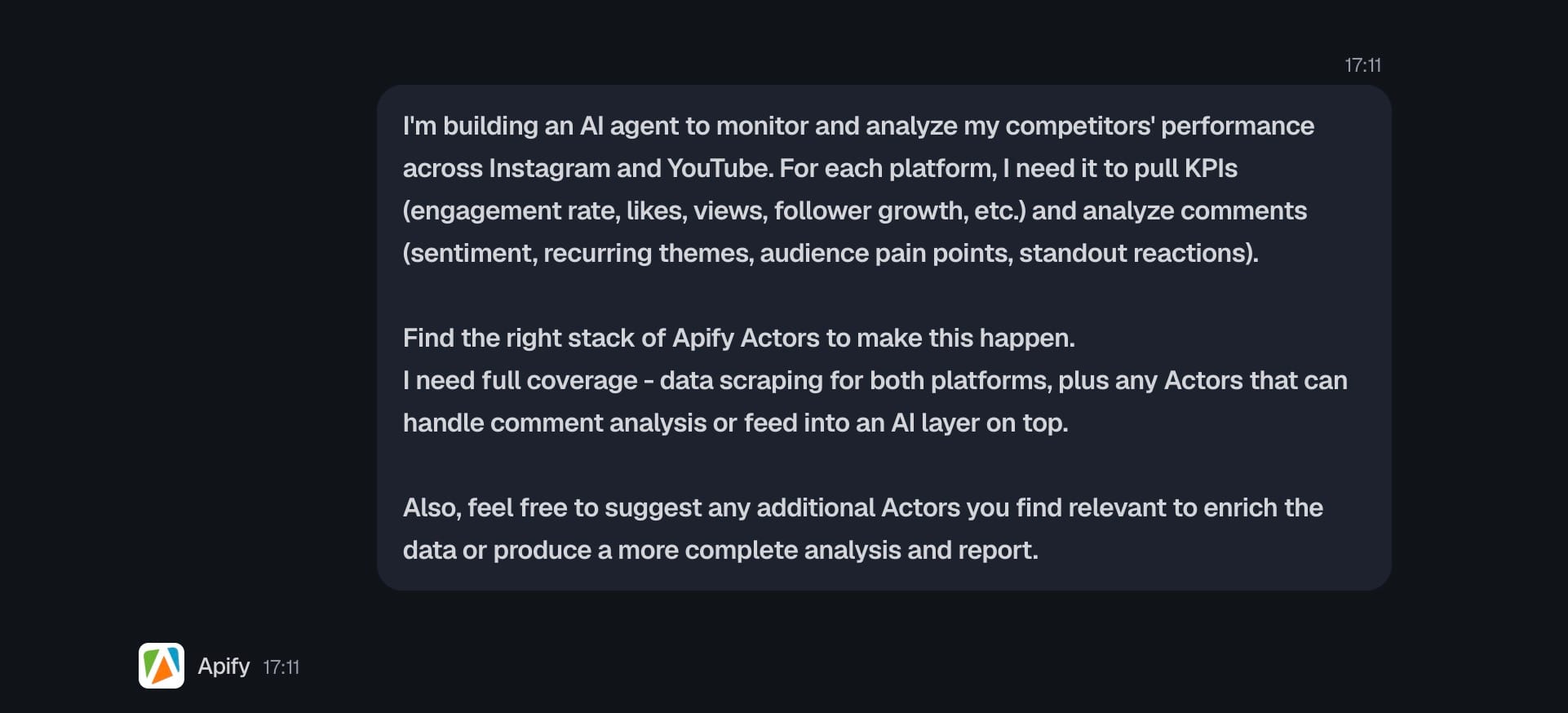
"With the old Make.com setup, it took days to land on the right Actor combination and stitch it together. With the MCP Server, the agent figures it out on the first prompt," says Lemarchand.
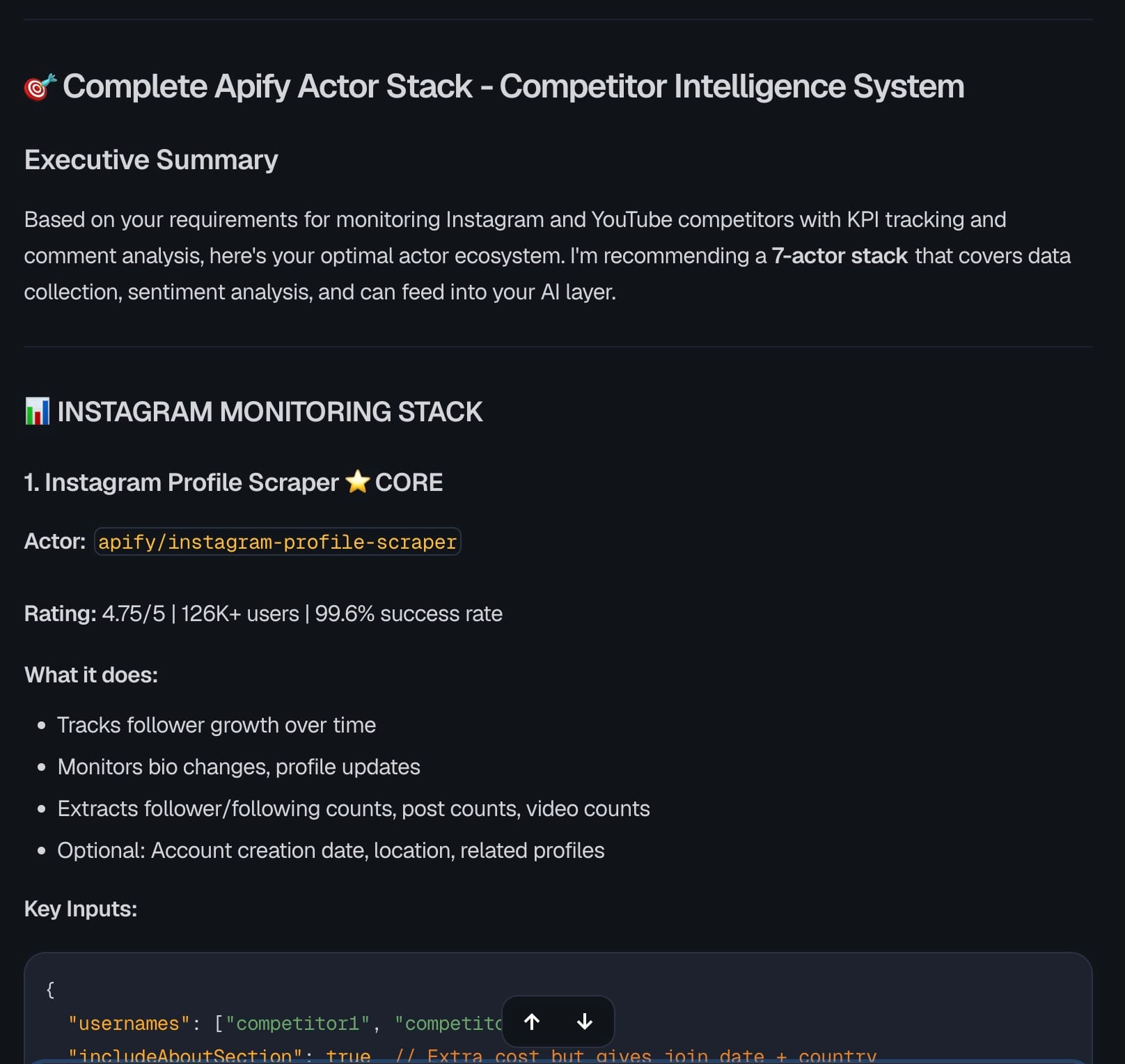
The results:
- 10x faster delivery from initial client conversation to a working dashboard
- 20+ client workflows running on the new MCP-driven architecture
- Zero time spent searching for tools
- Larger, richer datasets flowing into every analysis, since the MCP pipeline removed Make.com's payload constraints
Clients extend their own agents
Once a workflow ships, clients can extend it themselves. Need a new platform covered? Ask the agent to add an Apify Actor for it. No support ticket, no Orchestrai.eu rework.
"The agent regularly suggests Apify Actors I wouldn't have thought of on my own," Lemarchand adds. "It's a research partner, not just a runner."
More Apify Actors, smarter agents
Orchestrai.eu's bet on the Apify MCP Server changed how they sell. Instead of pitching pre-built integrations, they pitch outcomes and let the agent layer assemble the tooling underneath. As the Apify Actor catalog grows, every client agent gets more capable on day one with zero rework.
Watch how to set up your own MCP Server in minutes: