Why an ad agent needs the whole market
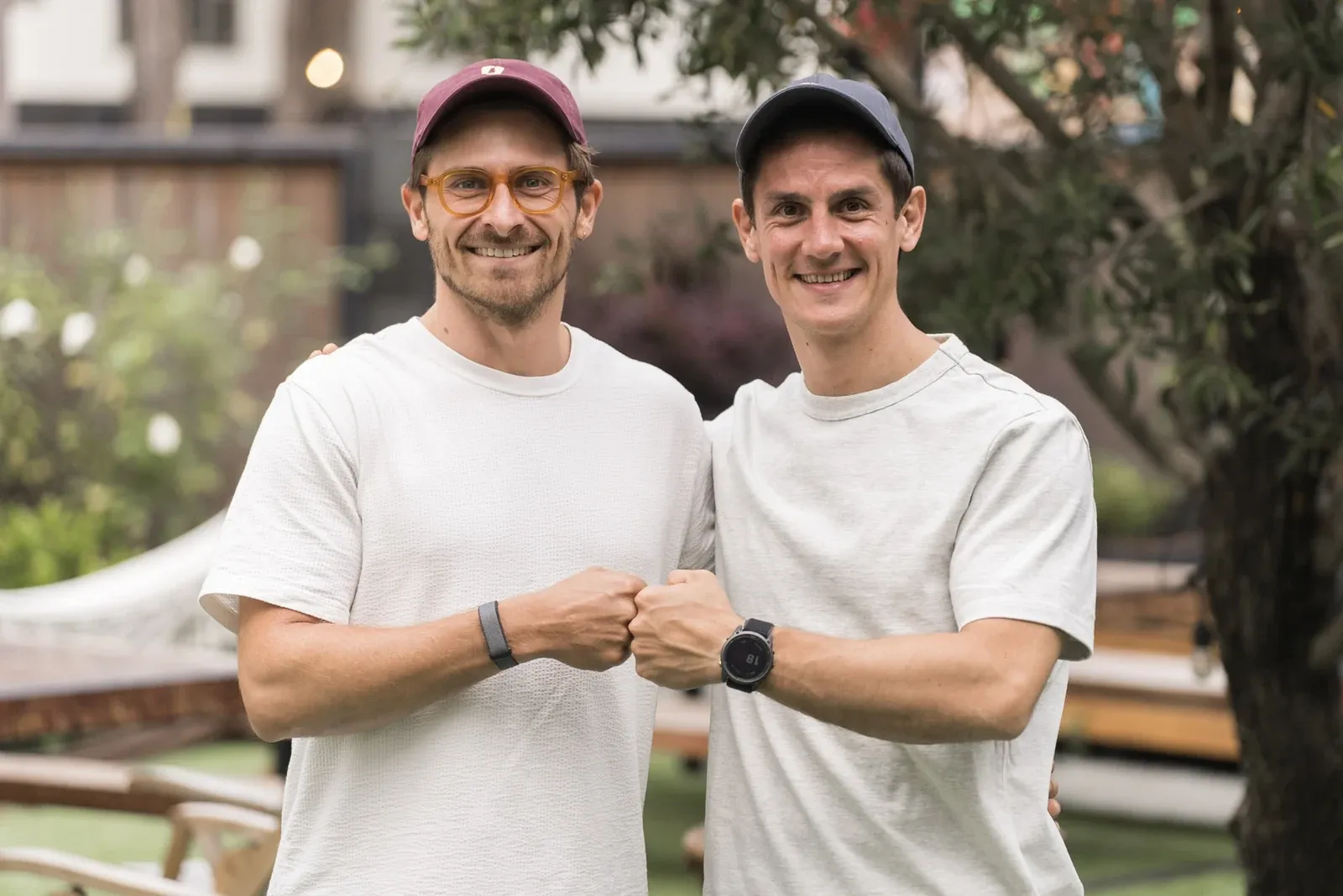
Adside is an AI platform where agents manage paid ads. You point the agents at your ad accounts, and they do the work a marketing team usually does: generate creative, track what's working across every channel, and move budget toward the winners. Robin Choy and Guillaume Miara are the co-founders, and most customers are startups and lean marketing teams running ads on Meta, Google, and LinkedIn.
For an agent to run ads well, it needs more than a company's own numbers. It needs to know what everyone else in the market is running: which formats they use, which ads they've kept live for months. A lot of Adside's customers are Y Combinator and other startups, so understanding how startups advertise is core to the product.
Both of those needs point to the same place: the public ad libraries and Apify.

Sizing up one competitor meant opening three websites by hand
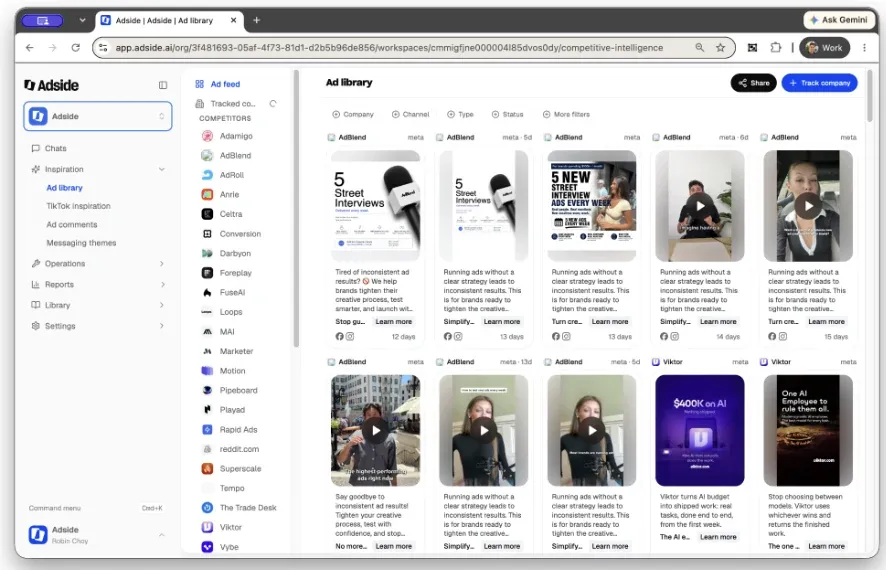
Meta, Google, and LinkedIn all keep public ad libraries, which is great, except each one is a separate website with its own layout, its own quirks, and no clean export. To see what a single competitor was running, you'd open the Meta Ad Library, then the Google Ads Transparency Center, then the LinkedIn Ad Library, and check three different pages.
Doing that for one brand is tedious. Doing it for a list of 50 competitors is a lost afternoon, and there's still nothing structured at the end of it: no history, no way to compare formats, no way to see which ads have been running for two years (the ones that are quietly working). None of it scales, and none of it is queryable.
None of these ad libraries have an official API, and maintaining scrapers for three moving targets in-house is a full-time job nobody wanted. With Apify, adding a platform is finding or building one Actor.
-- Robin Choy, co-founder, Adside
One company in, every live ad out, across all three platforms
AdsSpy wires the three ad libraries together with Apify Actors. You add a competitor, and the pipeline spreads out across platforms.
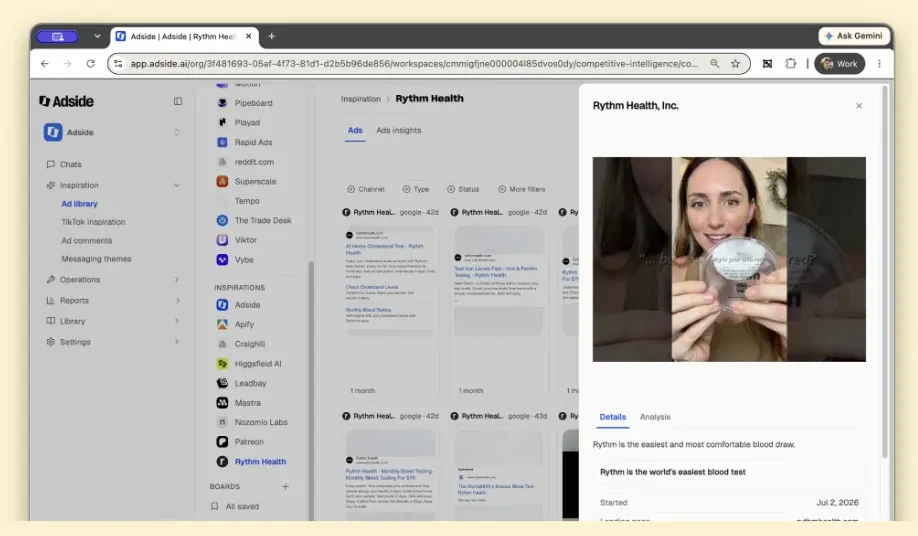
For Meta, Adside built and published its own Actors on the Apify platform. Meta Ad Library Page Resolver finds the brand's real Facebook page, which is harder than it sounds: the library has no website field, and a name search returns lookalikes. Meta Ad Library Ads Scraper then pulls the live creatives. For search and display, Google Ads Scraper reads the Transparency Center by domain, which is exact. For B2B, LinkedIn Ad Library Scraper covers the sponsored ads most tools miss.
Everything comes back as clean JSON through the run-sync-get-dataset-items endpoint, gets structured with AI, and lands in one dashboard: the ad copy, the format, the landing page, and how long each creative has been live. On top of that, Adside runs social listening with two more Actors. G2 Explorer mines reviews and Reddit Answers Scraper collects the language real customers use, so AdsSpy surfaces ad angles, not just ads.
Apify Actors plus the run-sync endpoint meant we shipped AdsSpy in days instead of months, and Apify Store covered the platforms we didn't want to build ourselves.
-- Robin Choy, co-founder, Adside
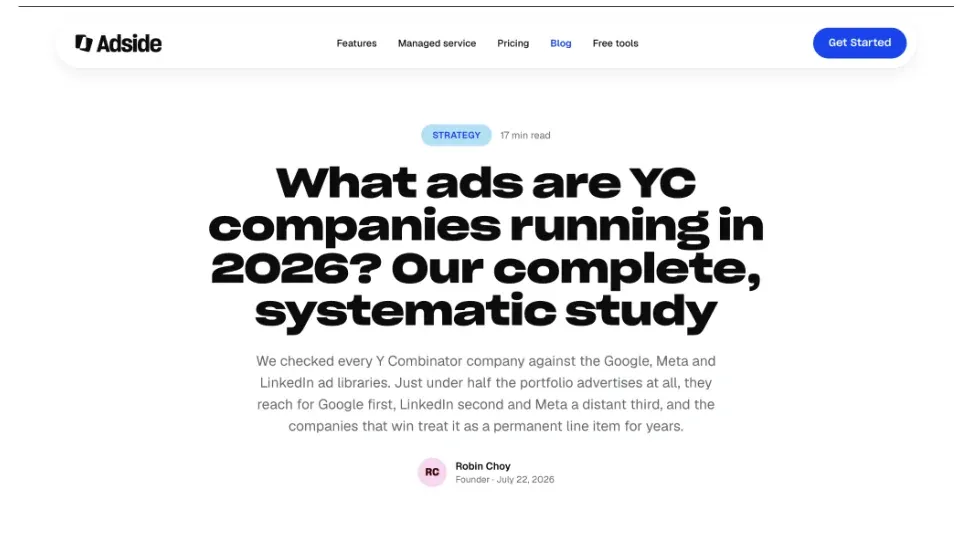
Then there's the second story. Because so many of Adside's customers are YC companies, it was worth actually understanding how YC startups advertise instead of guessing. So the same pipeline got pointed at the entire Y Combinator portfolio: all 6,055 companies, checked against the three ad libraries, in a single overnight run. That run became a public study and a free ad library anyone can browse, and it doubled as the biggest stress test the pipeline has had.
We checked 6,055 companies against three ad libraries overnight and pulled 133k live ads for under $200. That works out to roughly $0.002 an ad.
-- Robin Choy, co-founder, Adside
The results
- Three ad libraries unified into one view. Meta, Google, and LinkedIn competitor ads land in a single dashboard, so a three-tab manual chore becomes one click.
- 133k+ live ads pulled across 6,055 companies in a single overnight run, the largest test of the pipeline so far.
- Under $200 in Apify credits for that entire run, at roughly $0.002 per ad on the pay-per-event Actors.
- High-precision company-to-ad-account matching. Domain-based resolution keeps the wrong "Ramp" from being counted as the right one, which is the hard part of any ad library project.
- Six Apify Actors in production across ads and social listening, two of them built and published by Adside on the Apify platform.
- New coverage in days, not months. Adding a platform means finding or building one Actor instead of standing up and babysitting a scraper.
What's next
Every new source makes Adside's agents smarter, so AdsSpy keeps growing along the two axes Apify makes cheap: more platforms (TikTok and X are the obvious next libraries) and more history. Because each source is just another Actor behind the same run-sync pattern, adding one is a small lift, not a new project.
The public YC study is at adside.ai/blog/yc-companies-paid-ads-study, and the ad library it produced is free at adside.ai/tools/ad-examples.
Why Apify stays in Adside's stack
Adside turned a three-tab manual chore into one click, and a portfolio-wide ad study into a single overnight run. That's what's possible when the data layer stops being a project.