Should you use a specialized SERP API or a full web scraping platform? Many developers choose SerpApi for structured search results, but Apify delivers the same - and far more - often at a lower cost.
SerpApi focuses solely on SERP extraction, while Apify offers thousands of ready-made tools plus the ability to build custom scrapers and automation workflows. Here’s how the two compare.
SerpApi vs. Apify: Quick comparison
Here’s how SerpApi stacks up against Apify at a glance:
| SerpApi | Apify | |
|---|---|---|
| Type of solution | SERP scraping API provider | Full web scraping & automation platform with public Actors |
| Scope | Focused on SERP scraping and a few other sites | 10,000+ Actors across multiple domains |
| Support for Custom Scraper Building | ❌ | ✅ (ability to deploy in the cloud and publish for others) |
| Target audience | SEO professionals, digital marketers, developers | Developers, analysts, marketers, enterprises, and more |
| Data output | Structured JSON | Structured JSON, CSV, Excel, XML, HTML, RSS, etc. |
| IP rotation | Via integrated proxies | Via integrated proxies |
| CAPTCHA handling | Yes, integrated CAPTCHA solving | Yes, integrated CAPTCHA solving |
| Supported API client SDKs | Available in Ruby, Python, JavaScript, PHP, Java, etc. | Python, JavaScript |
| Ease of use | Simple API calls | Simple API calls + no-code workflows via Apify platform |
| Integrations | Some (LangChain, CrewAI, Make, n8n, MCP server, etc.) | Extensive (Zapier, Make, Slack, Gmail, Airbyte, etc.) |
| Pricing model | Subscription plans per results | Subscription plans with credits for Actor usage |
| Monetization via custom scrapers | ❌ | ✅ (Supported via publication of your Actors on Apify Store) |
| Legal coverage | U.S. Legal Shield up to $2M (on $150+/mo plans) | No built-in legal shield; relies on user compliance |
What is SerpApi?
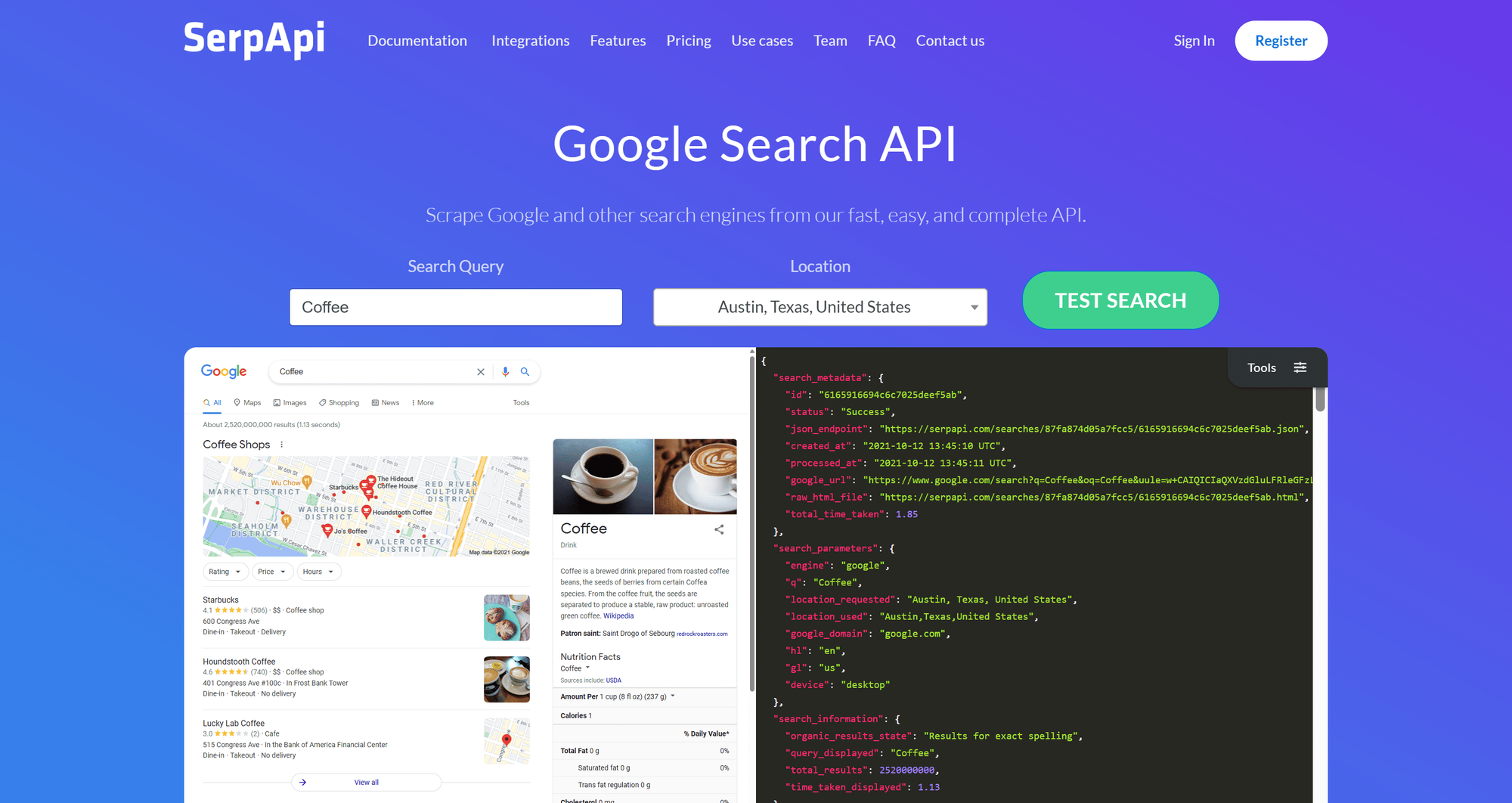
SerpApi is a scraping API service that provides dedicated endpoints to retrieve data from search engine results pages (SERPs) on major platforms like Google, Bing, DuckDuckGo, Baidu, Yandex, and others.
It handles proxies, CAPTCHA solving, HTML parsing, and all other web scraping challenges, delivering clean, structured JSON data directly via API. Beyond SERP scraping use cases, SerpApi also exposes endpoints for scraping sites that aren’t technically search engines, such as YouTube, Walmart, or Facebook.
SerpApi's most popular and widely utilized product is the Google Search API for scraping SERP results from Google.
Core features
A quick look at SerpApi’s essential features:
- Structured JSON results: Retrieve structured data with multiple fields, including metadata information.
- Real results: API requests run in a full browser, with CAPTCHA solving and human interaction mimicking for accurate results.
- Multi-language SDKs: Start quickly with official SDKs and examples in Ruby, Python, JavaScript, Golang, PHP, Java, Rust, and .NET.
- Accurate locations: Obtain geolocated Google results anywhere via location parameters, with requests routed through nearest proxy servers.
- X-Ray: Inspect scraped SERP data and find exact JSON paths linked to HTML elements for precise data extraction.
- Team management: Share searches, manage billing, and monitor usage securely with multiple API keys across unlimited team members.
- ZeroTrace Mode: Special mode to conduct searches without storing parameters, metadata, or results to help comply with GDPR, HIPAA, and other regulations.
- Ludicrous Speed & Ludicrous Speed Max options: Achieve 2x to 4x faster search data retrieval with prioritized network and parallel requests.
- U.S. Legal Shield: Receive up to $2M legal coverage for lawful scraping under U.S. law, including worldwide customer protection.
- JSON restrictor: Limit responses to required fields for smaller, faster results and efficient client-side parsing.
- MCP server: An open-source server that integrates with SerpApi, enabling AI agents to access and extract search engine results.
Target audience
SerpApi’s target audience includes digital marketers, SEO professionals, developers, and researchers who need to collect, analyze, and integrate search engine results data. Typical use cases include monitoring rankings, tracking competitors, researching local markets, building datasets for machine learning, and implementing search tools for AI agents.
Pricing overview
SerpApi pricing is based on monthly subscription plans that grant access to a specific number of results per month (plus some other features). In this context, each “result” corresponds to a successful API request (so, you aren't charged for error responses).
In short, SerpApi’s offerings can be summarized in the following table:
| Plan | Price (per month) | Searches per month | U.S. Legal Shield |
|---|---|---|---|
| Free | $0 | 250 | ❌ |
| Developer | $75 | 5,000 | ❌ |
| Production | $150 | 15,000 | ✅ |
| Big Data | $275 | 30,000 | ✅ |
Note that a free-forever plan is available, offering 250 searches per month for testing the solution. Enterprises can request custom plans with higher volumes and additional features by contacting the SerpApi team.
What is Apify?
Apify is a full-stack cloud platform for web scraping and automation. It enables you to create, deploy, and run custom web scrapers and automation workflows, or leverage one of the pre-built tools to collect data from websites.
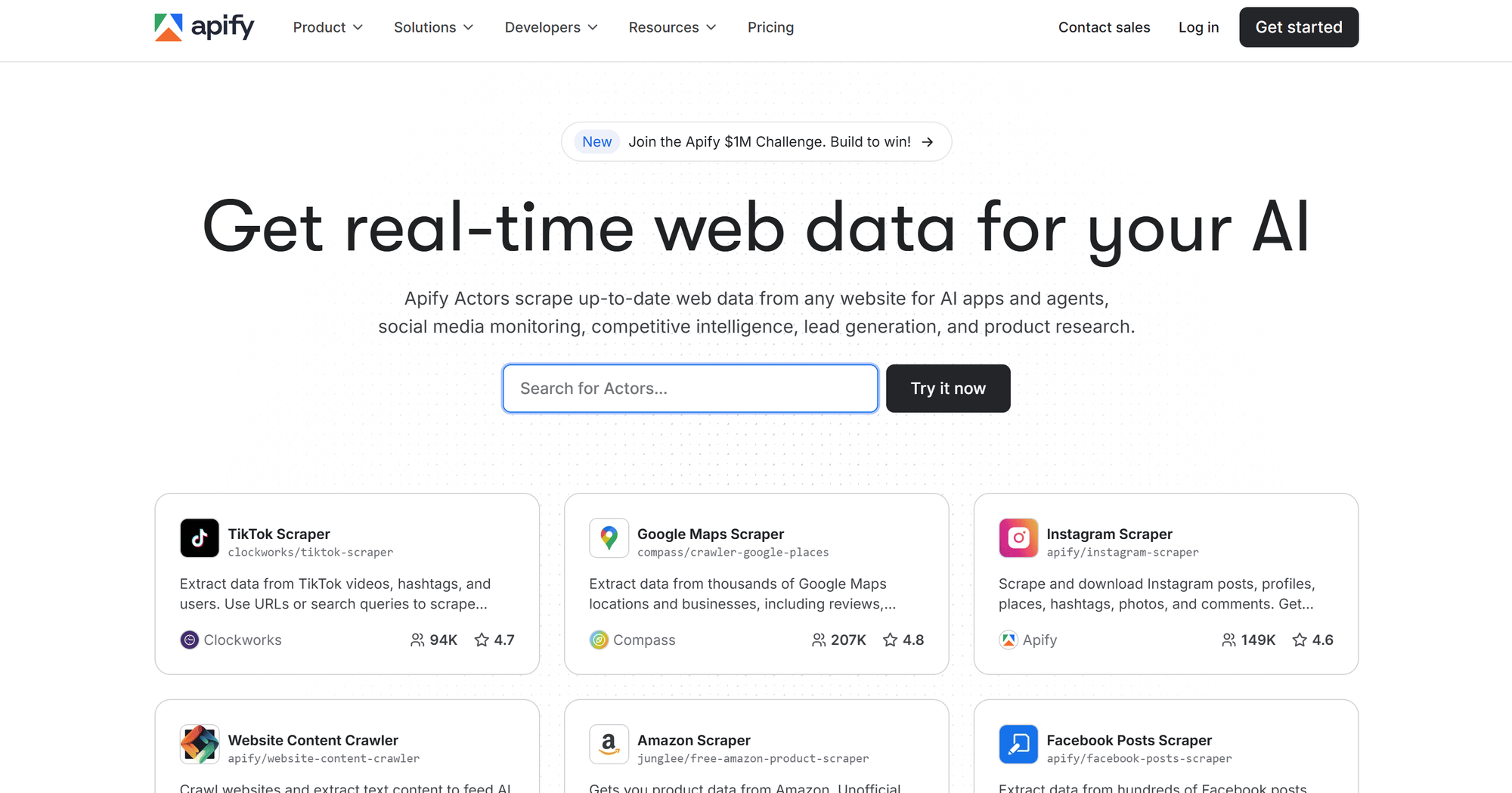
Apify's serverless cloud programs that automate tasks (typically web scraping) are called Actors. Thus, users on Apify can develop their own Actors or use the many off-the-shelf options available.
The platform handles the heavy lifting by providing rotating proxies to prevent IP blocks, scalable cloud storage for saving scraped data, CAPTCHA solving, and more. It supports both developers and non-developers with technical tools and no-code solutions to convert raw web content into structured, usable data.
Core features
Here’s a quick look at Apify’s most important capabilities:
- Build, share, and monetize Actors: Develop web scraping or automation tasks, package them, run them on Apify’s cloud platform, and optionally publish on Apify Store for monetization.
- Apify Store: Access a marketplace of 9,000+ off-the-shelf Actors for getting data for your particular scenario.
- Full API integration: Programmatically control the platform and manage Actors runs via Apify API.
- Third-party integrations: Connect Apify workflows to external apps like Slack, Zapier, and Google Drive to create automated, productive data pipelines.
- Apify CLI: Manage, initialize, and run Actors directly from the terminal.
- Cloud storage for data and files: Store scraping results and files with support for JSON, CSV, XML, Excel, HTML, RSS, and other formats.
- Built-in proxy integration: Automatically rotate residential and datacenter IPs to prevent blocks and avoid rate limiters.
- Custom scheduling: Automate Actor execution at specific times or recurring intervals to maintain continuous data collection.
- Monitoring and alerts: Track Actor performance, validate data quality in real-time, and receive notifications for errors, failed runs, or anomalies.
- MCP server: Enable LLMs to discover and execute Apify Actors via the Apify MCP server for real-time web data retrieval in AI workflows and agents.
- SDKs and open-source libraries: Use the official Apify SDKs and libraries like Crawlee, Got Scraping, and Fingerprint Suite to simplify Actor creation.
- Collaboration and team management: Manage organization roles and assign permissions to support teamwork on your scraping and automation projects.
Target audience
Apify’s audience spans a broad spectrum, from scraping enthusiasts to analysts and marketers, from individual developers and small companies to large enterprises.
Technically proficient users leverage Apify to build custom scrapers and automation workflows, and to integrate with ready-made Actors via API (or MCP in AI agents and workflows) to gather data from hundreds of supported domains. Similarly, non-technical users can achieve the same results using Apify’s no-code visual workflows and intuitive interface.
The data collected through Actors supports a variety of use cases, including competitive intelligence, lead generation, AI training, and many others. In short, Apify serves anyone who needs web data at scale and/or wants to build robust web scrapers.
Pricing overview
Apify comes with multiple subscription plans that provide a specific amount of monthly usage, along with access to certain features. The usage can be applied to Apify Store Actors or to running your own.
The main plans are summarized as follows:
| Plan | Price (monthly / yearly) | Apify Store usage | Support type |
|---|---|---|---|
| Free | $0 / $0 | $5 | Community support |
| Starter | $29 / $25 | $29 | Chat support |
| Scale | $199 / $179 | $199 | Priority chat support |
| Business | $999 / $899 | $999 | Account manager |
For more details, refer to the Apify pricing page.
When launching a scraping task on a chosen Actor, usage is consumed according to one of the following pricing models:
- Pay per event (PPE): You pay based on specific events triggered by the Actor’s source code (e.g., starting the Actor, retrieving a result, etc.).
- Pay per result (PPR): You pay according to the number of results the Actor produces.
- Rental: You are charged for the platform usage costs. After a trial period, you pay a flat monthly fee for continued access to the Actor.
Then, excess usage over your plan's credit is charged via a pay-as-you-go option to avoid interruptions.
In addition to the included usage, each plan allows flexible add-ons such as concurrent runs, extra RAM for Actor execution, additional datacenter proxy integration, priority support, and others. Users with advanced or tailored requirements can also access custom scraping solutions with scalable pricing, SLAs for guaranteed data, and dedicated expert support.
If you are instead more interested in creating Actors rather than using them, Apify features specialized plans to accommodate creators’ needs.
SerpApi vs. Apify: Main differences
Now that we’ve covered what each service offers, here’s a direct comparison of SerpApi and Apify.
Scope
While SerpApi specializes in search engine data and provides dedicated APIs for specific platforms, Apify gives you access to thousands of pre-built solutions for search engines, AI, e-commerce, news, social media, and more. Plus, it welcomes the creation and deployment of your own custom scrapers and automation workflows, making it a highly flexible solution for a wide range of web data extraction needs.
Ecosystem and use cases
As of the time of writing, SerpApi delivers 53 dedicated API endpoints, with 35 covering Google services (e.g., Search, Maps, News, etc.). Most APIs focus on SERP scraping use cases, though options for social media and e-commerce scraping are also available.
In contrast, Apify provides a much richer offering. Apify Store features over 9,000 Actors, including 670+ in the SEO tools category. Other categories include AI, e-commerce, jobs, lead generation, news, social media, and travel. Each Actor can be accessed via API or managed through Apify’s visual web interface in Apify Console.
Pricing
While both SerpApi and Apify offer subscription plans, their pricing models are quite different. With SerpApi, each plan grants you a certain number of results per month. Then, every successful API call (regardless of the endpoint) counts against that quota.
With Apify, you purchase usage that can be applied to any Actor. However, each Actor has its own pricing structure, so the effective cost per result can vary significantly. Usage amount can also be applied to cover the platform resources used when running your own Actors, such as CPU and RAM consumption.
To compare the two services, let's focus on the Google SERP scraping scenario. On SerpApi’s Developer plan, you get 5,000 results/month for $75, which works out to $0.015 per result. On its Big Data plan, you get 30,000 results/month for $275, or roughly $0.0092 per result.
Here’s how pricing works with Apify’s Google Search Results Scraper:
| Events | Free plan | Starter plan | Scale plan | Business plan |
|---|---|---|---|---|
| Scrape result pages | $4.50 / 1,000 results | $3.50 / 1,000 results | $2.80 / 1,000 results | $2.45 / 1,000 results |
| Start Actor event | 0.002 | 0.0015 | 0.0012 | 0.00105 |
The cost ranges from $0.0045 per result + a fixed $0.002 per Actor start on the Free plan to $0.00245 per result + $0.00105 per Actor start on the Business plan.
In summary, the pricing comparison for the Google SERP scraping use case is:
| Platform | Cost per Google SERP scraping result |
|---|---|
| SerpApi | $0.015/request — ~$0.0092/request |
| Apify | $0.0045/request + $0.002 — $0.00245/request + $0.002 |
On a per-request basis, this shows that Apify can be over 3.7× cheaper than SerpApi (0.0092/0.00245 ≈ 3.7).
Ease of use
SerpApi simplifies onboarding with its comprehensive documentation, examples, and official SDKs for multiple programming languages. Its APIs are straightforward, focused on specific search engines and target sites, and require minimal setup.
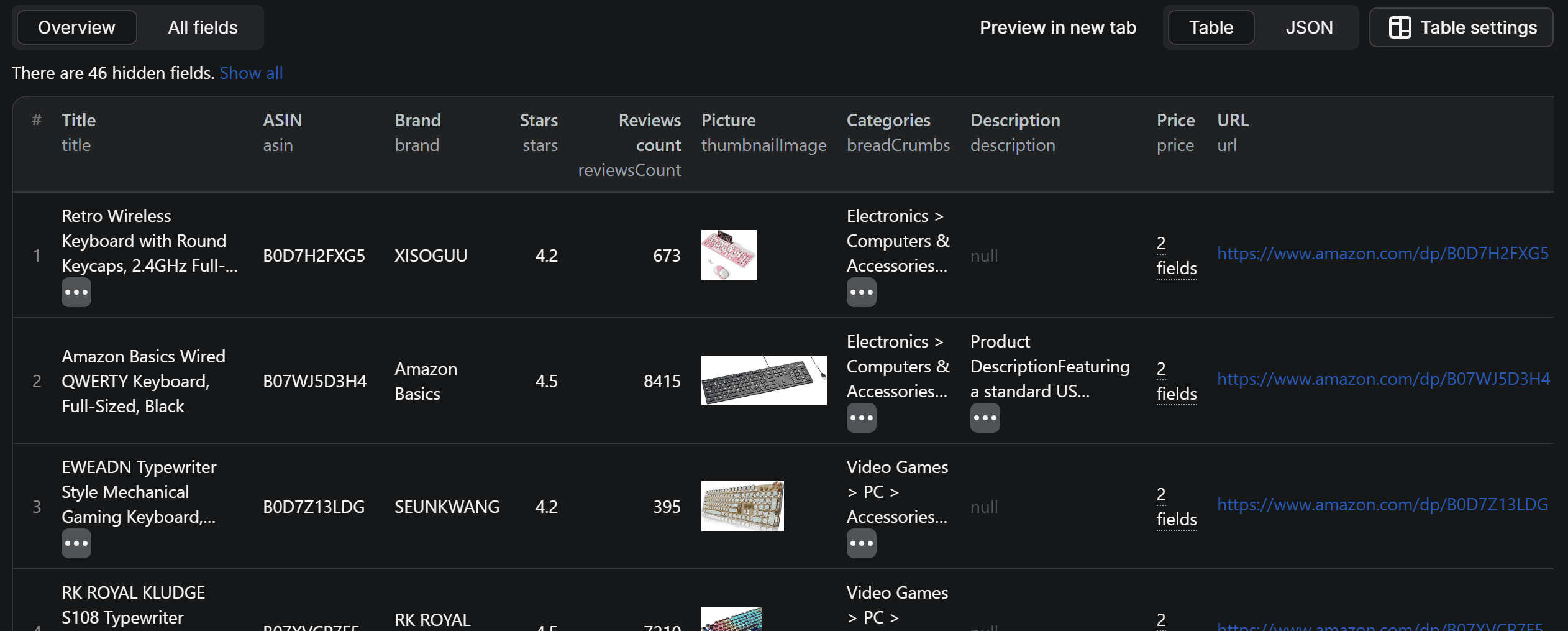
With Apify, the learning curve can be slightly steeper because each Actor may involve input capabilities, and some minimal setup in Apify Console is needed to get started. On the other hand, Apify features a built-in no-code option that SerpApi does not, through a visual web app where you can manage and run Actors, as well as view and download data in multiple formats:
Integrations
SerpApi supports more than 8 programming languages via official API client SDKs. For AI workflows, it integrates with platforms like LangChain and CrewAI through dedicated tools. Additionally, an official MCP server is available. Automation integrations with Make and n8n are also accessible.
Apify, by comparison, supports fewer programming languages when it comes to API clients - only JavaScript and Python - but comes with a far broader set of integration options. You can connect to Apify via RESTful APIs (using an HTTP client, whether visual or in any programming language) and the official API clients. Plus, you can configure webhooks that trigger actions based on system events.
For data storage and processing, Apify integrates with Airbyte, Keboola, Google Drive, Hevo, and Airtable. For AI workflows, it works with MCP, LangChain, LlamaIndex, LangGraph, CrewAI, Mastra, FlowiseAI, Pinecone, Haystack, OpenAI Agents SDK, Amazon Bedrock, Langflow, and many more.
Finally, Actor creators can link Git, GitHub, GitLab, or Bitbucket repositories to import code directly into the platform.
Scalability and limits
In SerpApi, plans with fewer than 1 million searches per month allow an hourly throughput equal to 20% of the monthly volume. For example, the Developer plan includes 5,000 searches per month, which means you can perform up to 1,000 successful searches per hour (about 16/17 requests per minute). For plans with 1 million searches per month or more, the hourly throughput is calculated as 100,000 plus 1% of the plan’s total monthly volume.
Similarly, Apify enforces API rate limiters to protect its servers from overload. There are two main types of rate limits:
- Global rate limit: Set to 250,000 requests per minute. For authenticated users, this limit is applied per user account; otherwise, it is applied per IP address.
- Per-resource rate limit: By default, set to 60 requests per second for each resource (e.g., a single Actor, a single Actor run, or a single dataset). Some specific endpoints have higher limits, at 200 or 400 requests per second per resource.
Other limits, such as maximum memory, disk storage, and the number of Actors and tasks per user, also apply. For more details, consult the official documentation.
As you can tell, Apify’s global rate-limiting capacity is much higher than SerpApi’s. Then, keep in mind that both services offer the option to arrange customized SLAs that guarantee uptime of 99.5% or higher.
When to use SerpApi vs. Apify
If you’re unsure which scraping solution to choose between SerpApi and Apify, refer to the summary below.
Choose Apify when:
- You need scraping and automation tools across a wide range of use cases, from SEO to AI, from traveling to e-commerce.
- You're looking for a platform to deploy your own scrapers without worrying about IP rotation, infrastructure, or scaling.
- You want multiple integration options, including AI workflows, no-code automation tools, and MCP support.
- You have limited technical knowledge but still want to collect and manage data through an intuitive user interface.
Choose SerpApi when:
- Your focus is specifically (or solely) on search engine data.
- Your infrastructure doesn’t support Python or JavaScript, and you prefer languages like Ruby, Java, PHP, or others.
- You’re looking for legal shield protection in the U.S.
- Budget is not a primary concern.
Migrating from SerpApi to Apify
Suppose you're a SerpApi user and are using the serpapi package to retrieve Google search data in Python, as shown below:
import serpapi

client = serpapi.Client(api_key="<YOUR_SERPAPI_API_KEY>")
params = {
  "engine": "google",
  "q": "best llm model",
  "hl": "en",
  "gl": "us"
}
results = client.search(params)
print(results)
The above script produces a dictionary whose organic_results field contains:
[
  {
    "position": 1,
    "title": "LLM Leaderboard 2025",
    "link": "https://www.vellum.ai/llm-leaderboard",
    "redirect_link": "https://www.google.com/url?sa=t&source=web&rct=j&opi=89978449&url=https://www.vellum.ai/llm-leaderboard&ved=2ahUKEwi0iMLT_IWRAxVZ4ckDHeifOs4QFnoECDYQAQ",
    "displayed_link": "https://www.vellum.ai › llm-leaderboard",
    "favicon": "https://serpapi.com/searches/6921c956f357f6a41e70d913/images/62bb350d3253d046c61977855fb2a6bbf5dfc113b17dd71e61a8c5eb1a7ee239.png",
    "snippet": "This LLM leaderboard displays the latest public benchmark performance for SOTA model versions released after April 2024.",
    "snippet_highlighted_words": ["LLM", "model"],
    "sitelinks": {
      "inline": [
        {"title": "Best LLM for Coding", "link": "https://www.vellum.ai/best-llm-for-coding"},
        {"title": "OS Leaderboard", "link": "https://www.vellum.ai/open-llm-leaderboard"},
        {"title": "Vellum Evaluations", "link": "https://www.vellum.ai/products/evaluation"},
        {"title": "Vellum Prompts", "link": "https://www.vellum.ai/products/prompt-engineering"}
      ]
    },
    "source": "Vellum AI"
  },
  {
    "position": 2,
    "title": "What is your favorite LLM right now? : r/singularity",
    "link": "https://www.reddit.com/r/singularity/comments/1impsjl/what_is_your_favorite_llm_right_now/",
    "redirect_link": "https://www.google.com/url?sa=t&source=web&rct=j&opi=89978449&url=https://www.reddit.com/r/singularity/comments/1impsjl/what_is_your_favorite_llm_right_now/&ved=2ahUKEwi0iMLT_IWRAxVZ4ckDHeifOs4QFnoECC4QAQ",
    "displayed_link": "50+ comments · 9 months ago",
    "favicon": "https://serpapi.com/searches/6921c956f357f6a41e70d913/images/62bb350d3253d046c61977855fb2a6bb3c154af8fe9af3c72e8477720f1dcf1d.png",
    "snippet": "For me, it's gotta be Gemini Flash Thinking. It is incredibly smart, good at explaining things in a way that's easy to understand, and it even has a nice ...",
    "snippet_highlighted_words": ["Gemini Flash Thinking"],
    "sitelinks": {
      "list": [
        {
          "title": "which is the best LLM right now ? : r ...",
          "link": "https://www.reddit.com/r/learnmachinelearning/comments/1dw6g8u/which_is_the_best_llm_right_now/",
          "answer_count": 8,
          "date": "Jul 5, 2024"
        },
        {
          "title": "What's the best LLM overall right now for you? : r ...",
          "link": "https://www.reddit.com/r/singularity/comments/1oarl37/whats_the_best_llm_overall_right_now_for_you/",
          "answer_count": 75,
          "date": "Oct 19, 2025"
        }
      ]
    },
    "source": "Reddit · r/singularity"
  },
  {
    "position": 3,
    "title": "Top 9 Large Language Models as of November 2025",
    "link": "https://www.shakudo.io/blog/top-9-large-language-models",
    "redirect_link": "https://www.google.com/url?sa=t&source=web&rct=j&opi=89978449&url=https://www.shakudo.io/blog/top-9-large-language-models&ved=2ahUKEwi0iMLT_IWRAxVZ4ckDHeifOs4QFnoECCoQAQ",
    "displayed_link": "https://www.shakudo.io › blog › top-9-large-language-...",
    "favicon": "https://serpapi.com/searches/6921c956f357f6a41e70d913/images/62bb350d3253d046c61977855fb2a6bb494dab08c30af7d2be19f4072d79fe0f.png",
    "snippet": "Top 9 Large Language Models as of November 2025 · 1. OpenAI · 2. DeepSeek · 3. Qwen · 4. Grok · 5. Llama · 6. Claude · 7. Mistral · 8. Gemini.",
    "snippet_highlighted_words": ["1. OpenAI"],
    "source": "Shakudo"
  },
  // omitted for brevity...
]
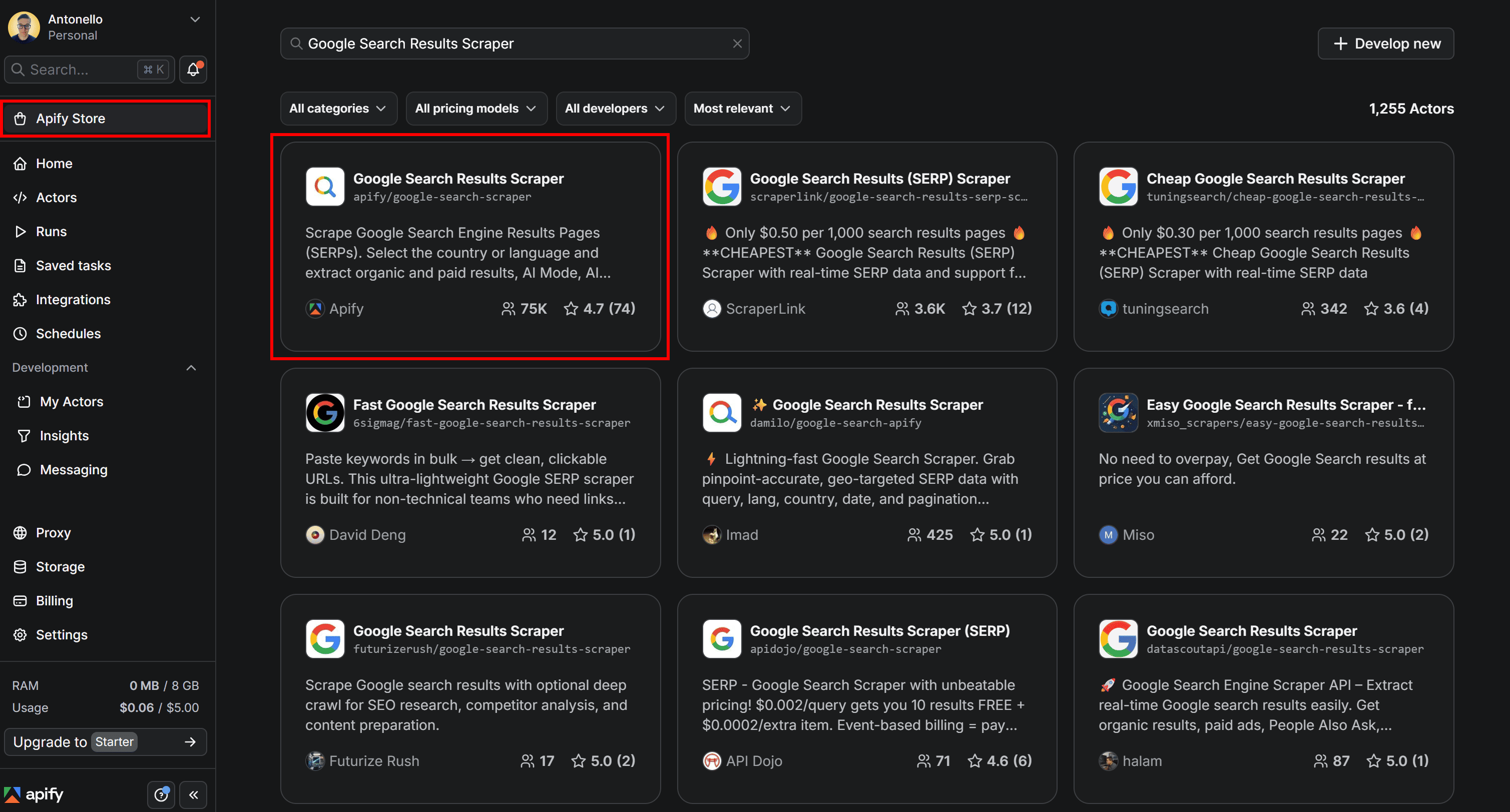
To migrate to Apify, start by creating an account. Log in to Apify Console, select Apify Store, and search for Google Search Results Scraper (or the equivalent Actor for your specific SERP use case):
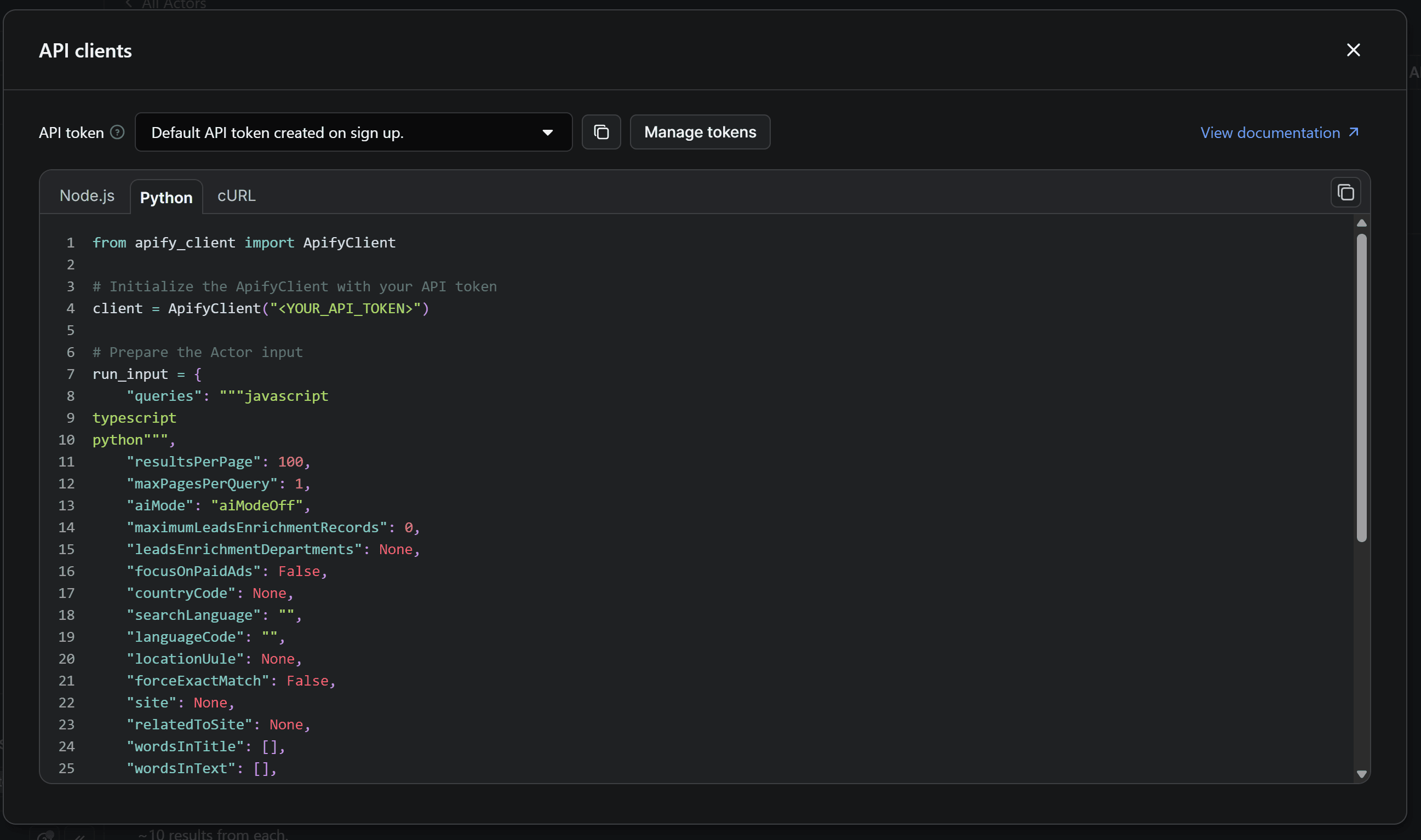
On the Actor page, select the “API > APi clients“ option and copy the Python code snippet provided:
In your Python project, start by installing the Apify Python SDK using the apify-client package:
pip install apify-client
Adapt it to your “best LLM model” SERP scraping use case, and you should get:
from apify_client import ApifyClient

# Initialize the ApifyClient with your API token
client = ApifyClient("<YOUR_APIFY_API_TOKEN>")

# Prepare the Actor input
run_input = {
    "queries": "best llm model",
   "languageCode": "en",
}

# Run the Actor and wait for it to finish
run = client.actor("nFJndFXA5zjCTuudP").call(run_input=run_input)

# Fetch and print Actor results from the run's dataset (if there are any)
for item in client.dataset(run["defaultDatasetId"]).iterate_items():
    print(item)
Replace <YOUR_APIFY_API_TOKEN> with your actual Apify API token. In the organic_results field of the scraped item, you will see:
[Java
  {
    "title": "LLM Leaderboard 2025",
    "url": "https://www.vellum.ai/llm-leaderboard",
    "displayedUrl": "https://www.vellum.ai › llm-leaderboard",
    "description": "This LLM leaderboard displays the latest public benchmark performance for SOTA model versions released after April 2024.",
    "emphasizedKeywords": [
      "LLM",
      "model"
    ],
    "siteLinks": [],
    "productInfo": {},
    "type": "organic",
    "position": 1
  },
  {
    "title": "What is your favorite LLM right now? : r/singularity",
    "url": "https://www.reddit.com/r/singularity/comments/1impsjl/what_is_your_favorite_llm_right_now/",
    "displayedUrl": "Reddit › r/singularity",
    "description": "For me, it's gotta be Gemini Flash Thinking. It is incredibly smart, good at explaining things in a way that's easy to understand, and it even has a nice ...",
    "emphasizedKeywords": [
      "Gemini Flash Thinking"
    ],
    "siteLinks": [],
    "productInfo": {},
    "commentsAmount": "50+ comments",
    "lastUpdated": "9 months ago",
    "type": "organic",
    "position": 2
  },
  {
    "title": "Top 9 Large Language Models as of November 2025",
    "url": "https://www.shakudo.io/blog/top-9-large-language-models",
    "displayedUrl": "https://www.shakudo.io › blog › top-9-large-language-...",
    "description": "Top 9 Large Language Models as of November 2025 · 1. OpenAI · 2. DeepSeek · 3. Qwen · 4. Grok · 5. Llama · 6. Claude · 7. Mistral · 8. Gemini.",
    "emphasizedKeywords": [
      "1. OpenAI"
    ],
    "siteLinks": [],
    "productInfo": {},
    "type": "organic",
    "position": 3
  },
  // omitted for brevity...
]
These results are completely equivalent and can be easily interchanged with those from SerpApi.
In just a few minutes, you’ve successfully transitioned from SerpApi to Apify.
Conclusion
Both SerpApi and Apify have their unique strengths. SerpApi excels as a specialized service for retrieving structured search engine results across platforms, while Apify is a more flexible solution, offering pre-built Actors for countless use cases and supporting custom scraper creation, deployment, and management.

Note: This evaluation is based on our understanding of information available to us as of January 2026. Readers should conduct their own research for detailed comparisons. Product names, logos, and brands are used for identification only and remain the property of their respective owners. Their use does not imply affiliation or endorsement.
FAQ
What is SerpApi used for?
SerpApi is mainly used for retrieving real-time data from SERPs via API. The main goal is to help developers retrieve structured search data for use cases like SEO, lead generation, and more.
What is Apify used for?
Apify is used for building custom web scraping and automation workflows or connecting to ready-to-use Actors, enabling you to extract, store, and process web data at scale from hundreds of sites.
Can Apify replace SerpApi for SERP scraping?
Yes, Apify can replace SerpApi for SERP scraping. This is possible thanks to the hundreds of Actors that match the “serp” keyword. For example, the SerpApi Google Search API can be replaced with Apify’s Google Search Results Scraper when called via API, and SerpApi’s DuckDuckGo Search API can be replaced with Apify's DuckDuckGo SERP API, and so on.
Which is cheaper, SerpApi or Apify?
Apify tends to be cheaper than SerpApi, although the exact pricing difference depends on the chosen Actor. At the time of writing, SerpApi’s entry plan costs $75 per month and includes 5,000 searches, which equals $0.015 per request ($75/5,000). In comparison, Apify’s Google Search Results Scraper entry price is $4.50 per 1,000 requests, or $0.0045 per request. For the specific Google SERP scraping use case, Apify is more than 3 times cheaper than SerpApi.
Is SerpApi easier to use than Apify?
No, SerpApi isn’t easier to use than Apify. Both provide their scraping services through API endpoints and offer solid documentation on how to call them. To simplify the API calling process, SerpApi comes with several SDKs, and Apify does the same with dedicated SDKs in Python and Node.js to make calling Actors via API straightforward.
Can I build and monetize my own scrapers on SerpApi?
No, unlike Apify, SerpApi doesn’t provide a platform where you can build, upload, or monetize your own scrapers. SerpApi operates purely as a managed service that just delivers structured JSON data through API endpoints. In contrast, Apify lets you build, publish, run, and monetize your own scrapers.
Does Apify handle proxies and CAPTCHAs like SerpApi?
Yes, both Apify and SerpApi handle proxies and CAPTCHAs for you. In both cases, you don’t have to worry about Google reCAPTCHAs or similar challenges blocking your requests. SerpApi and Apify automatically manage IP rotation and anti-scraping measures for you.