A proxy allows you to browse the web under an alternative IP address, masking your true location and identity. That's quite handy for everyday internet users seeking privacy or trying to access geo-restricted content. But proxies are also essential tools for data-driven tasks like web scraping.
Proxies allow scrapers to gather data without getting blocked or banned by websites, which often have mechanisms to detect and restrict scraping activities. By rotating through different proxies, scrapers can mimic the behavior of multiple users to reduce the risk of detection and enable a smoother data collection process.
But how do you get your hands on such proxies? It’s simpler than you might think. The market is flooded with free and paid proxy services with varying levels of anonymity, speed, and reliability.

8 free or low-cost proxies for web scraping
1. ProxyScrape
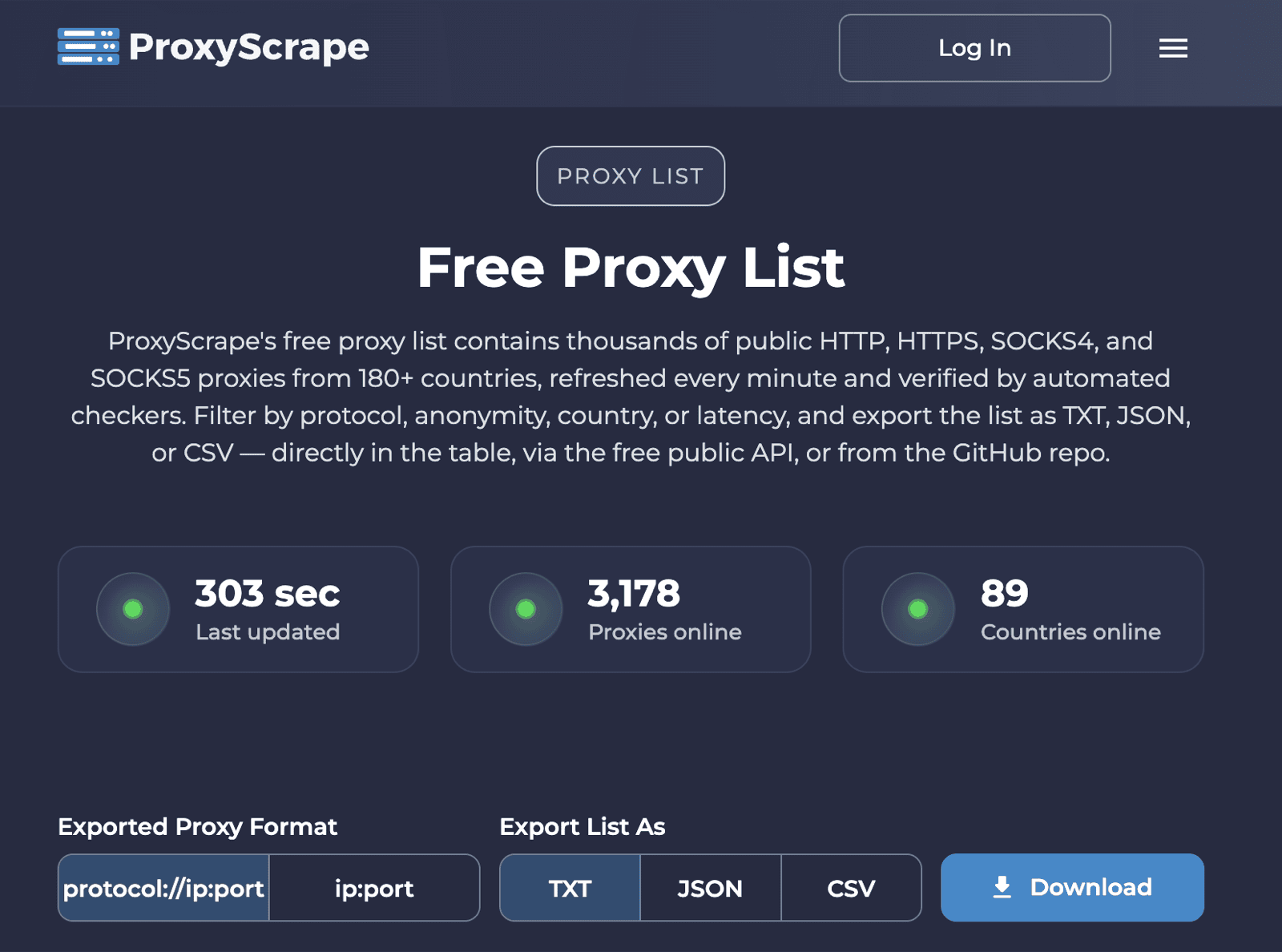
ProxyScrape aggregates more than 20,000 public proxies from over 180 countries and rechecks each one every minute, with dead entries removed within a 15-second timeout window.
Free tier: Unlimited access to the public list. Download as TXT, JSON, or CSV, pull via a free public API, or clone the GitHub mirror.
Protocols: HTTP, HTTPS, SOCKS4, SOCKS5.
Pros:
- Frequent updates and rapid removal of dead proxies
- Multiple delivery formats, including a free API and GitHub mirror
- Filter by protocol, anonymity, country, or latency
Cons:
- Public IPs are already on most anti-bot blocklists
- No bandwidth guarantees, so proxies cap out unpredictably
- Manual rotation only. You have to wire up the cycling logic
Best for: bulk-grabbing proxy candidates for low-stakes testing, or building a fallback list before committing to a paid service.
2. Free Proxy List
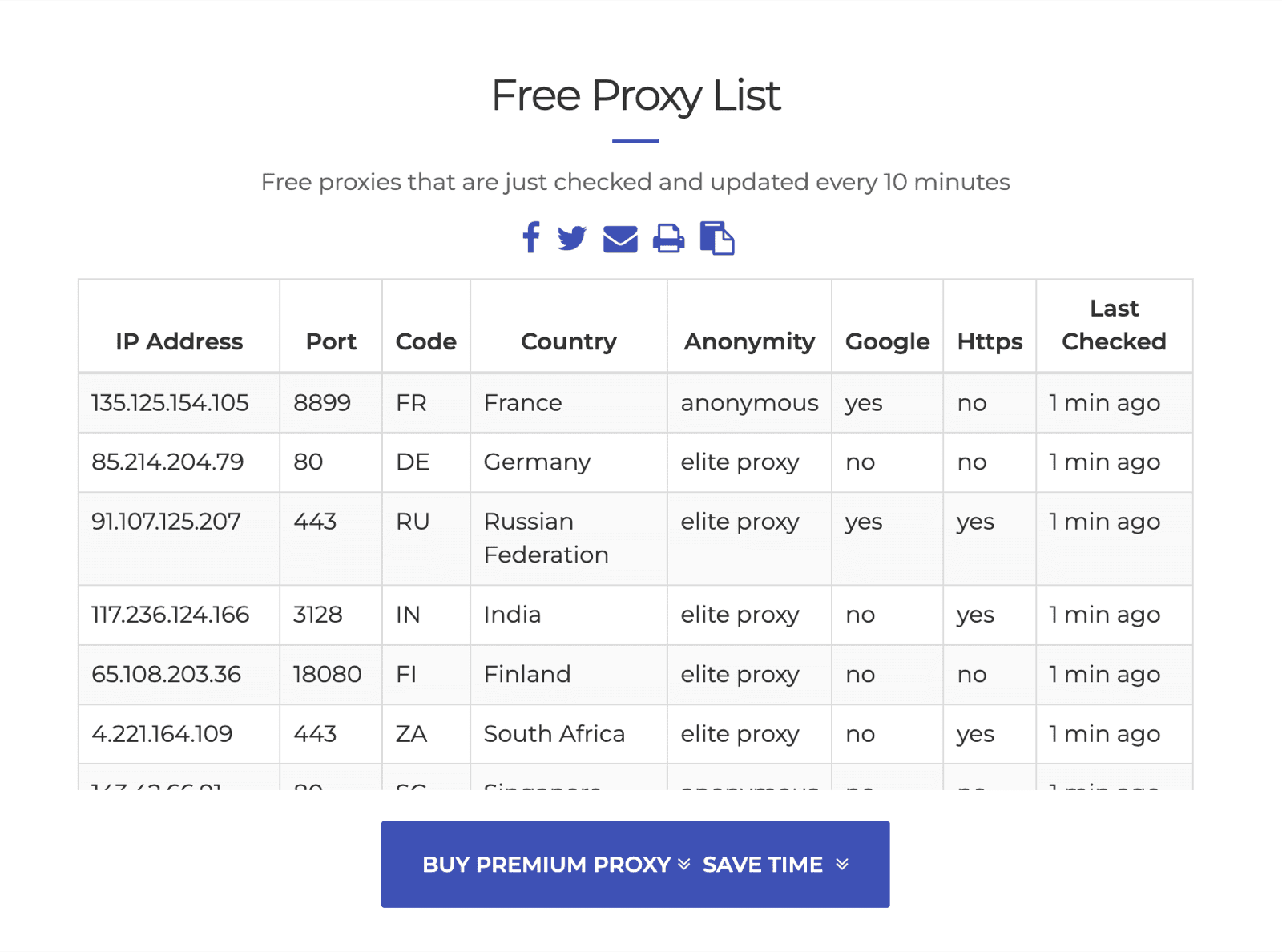
Free Proxy List displays around 11,000 proxies in a single sortable table updated every 10 minutes, with columns for country, port, anonymity level, and last-checked timestamp.
Free tier: Direct browser access to the list. No account or download required.
Protocols: HTTP, HTTPS, SOCKS5.
Pros
- Clean table layout with anonymity labels (elite, anonymous, transparent)
- Country filter for geo-specific testing
- Last-checked timestamps make it easy to skip stale entries
Cons
- No native API. Copy-paste or scrape the page yourself
- No SOCKS4 support
- Stale entries are common despite the 10-minute refresh cadence
Best for: quick manual lookups when you need a working IP in a specific country right now.
3. Free Proxy World
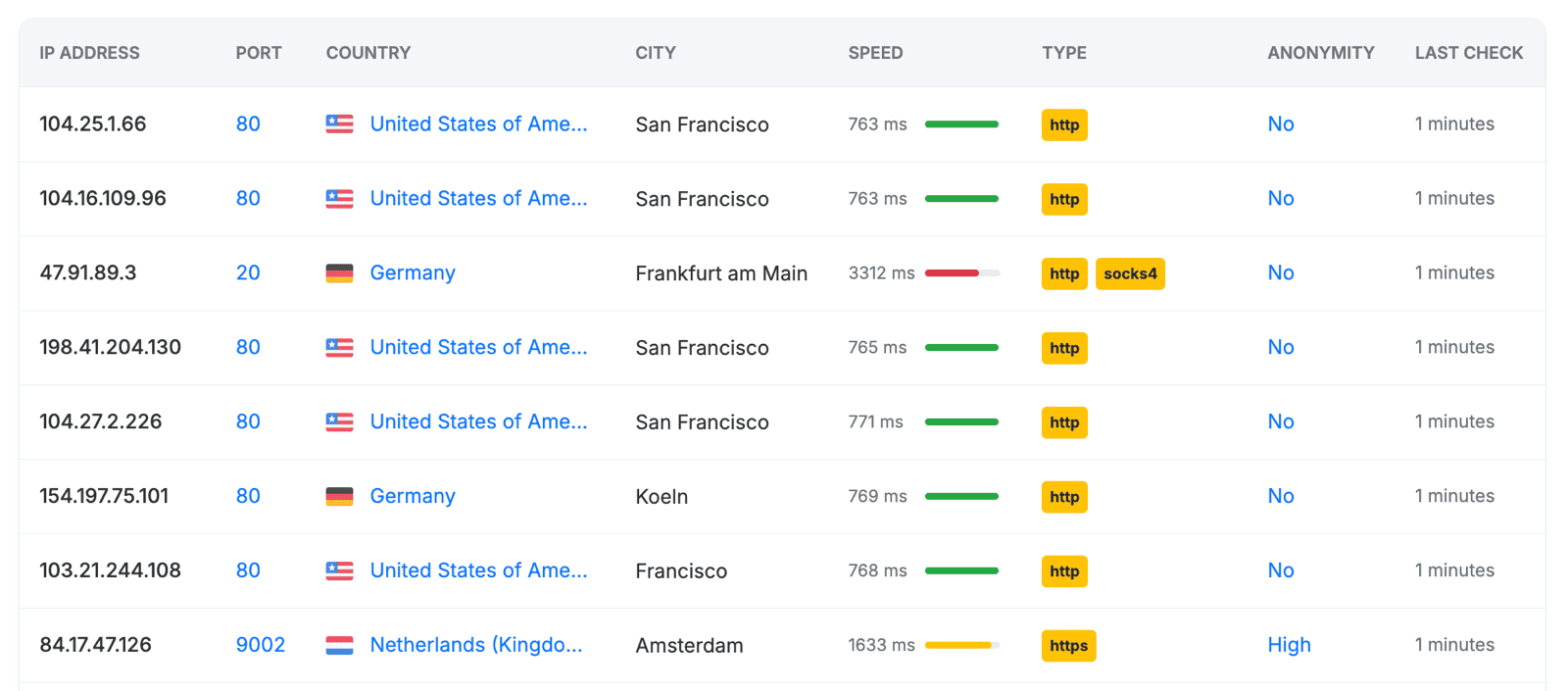
Free Proxy World currently lists around 49,000 proxies, the largest free pool on this list, with filters for anonymity, country, response speed, port, and protocol type.
Free tier: Full access to the public list, no sign-up required.
Protocols: HTTP, HTTPS, SOCKS4, SOCKS5.
Pros
- Largest free pool by raw count
- Response-speed filter helps eliminate the slowest entries before you waste a request on them
- All four common protocols covered
Cons
- Public IPs share the usual blocklist problem.
- No API or download. In-browser use only.
- Anonymity filter only distinguishes “high” or “no”, with no transparent vs. elite split
Best for: building a wide candidate pool when you plan to validate proxies yourself before use.
4. HasData
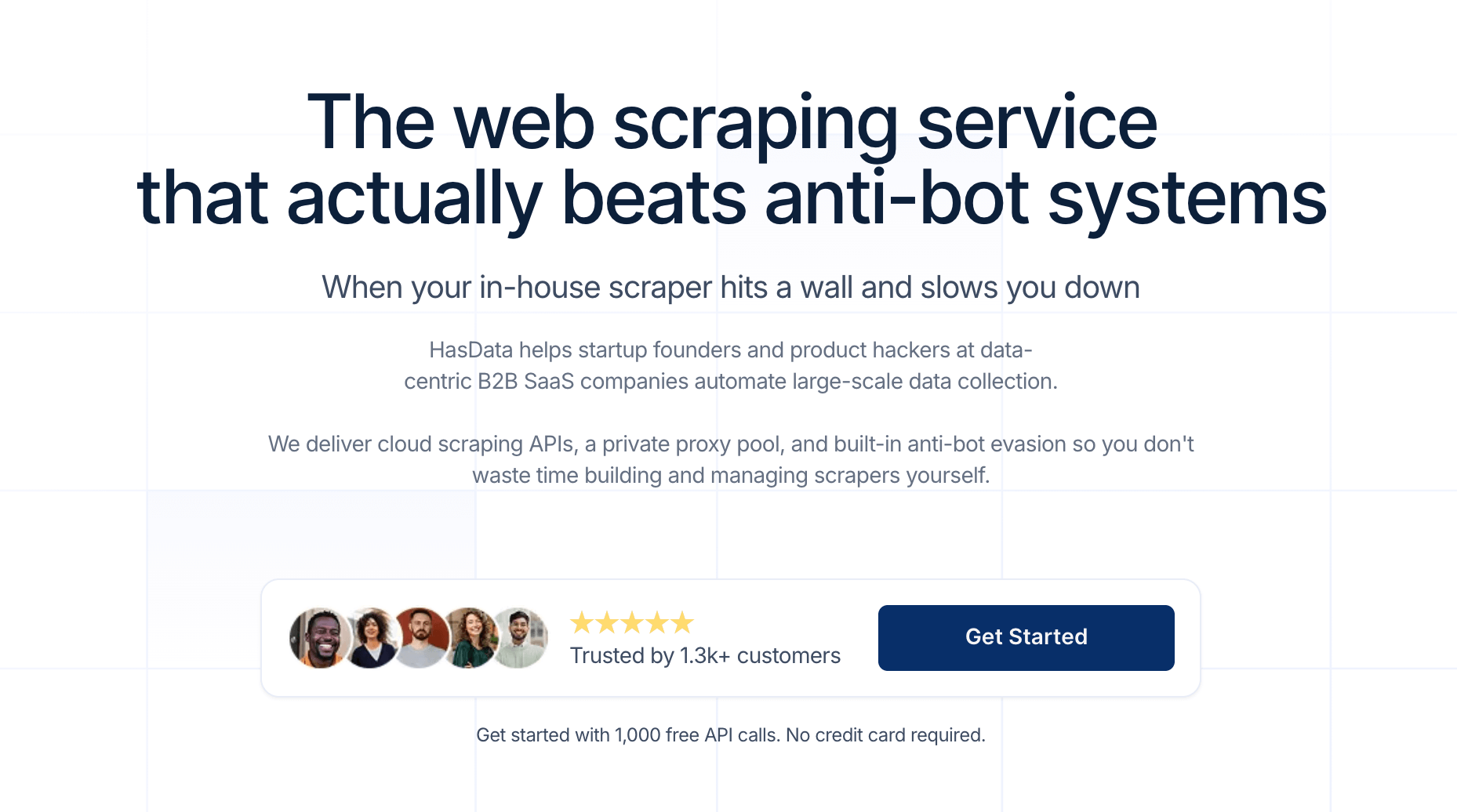
HasData is a managed scraping API rather than a raw proxy list. It handles proxy rotation, headless browser rendering, and CAPTCHA bypass behind a single endpoint and returns structured JSON or Markdown.
Free tier: 1,000 API credits, no credit card required. Includes the full feature set on a 30-day trial.
Protocols: API access (HTTP, HTTPS). Underlying proxies handled by the service.
Pros
- Proxy rotation, retries, and JavaScript rendering handled automatically
- 70+ pre-built scrapers for popular targets like Google SERP, Maps, and Flights
- AI extraction turns any URL into structured JSON using plain-text prompts
Cons
- Free tier is a 1,000 credit trial, not a permanent allowance. Continued use starts at $49 per month
- Credit costs vary by scraper, from 1 to 10 credits per call
- No option to bring your own proxies. You’re tied to HasData’s pool
Best for: skipping proxy management entirely and paying per successful request once volume picks up.
5. Geonode
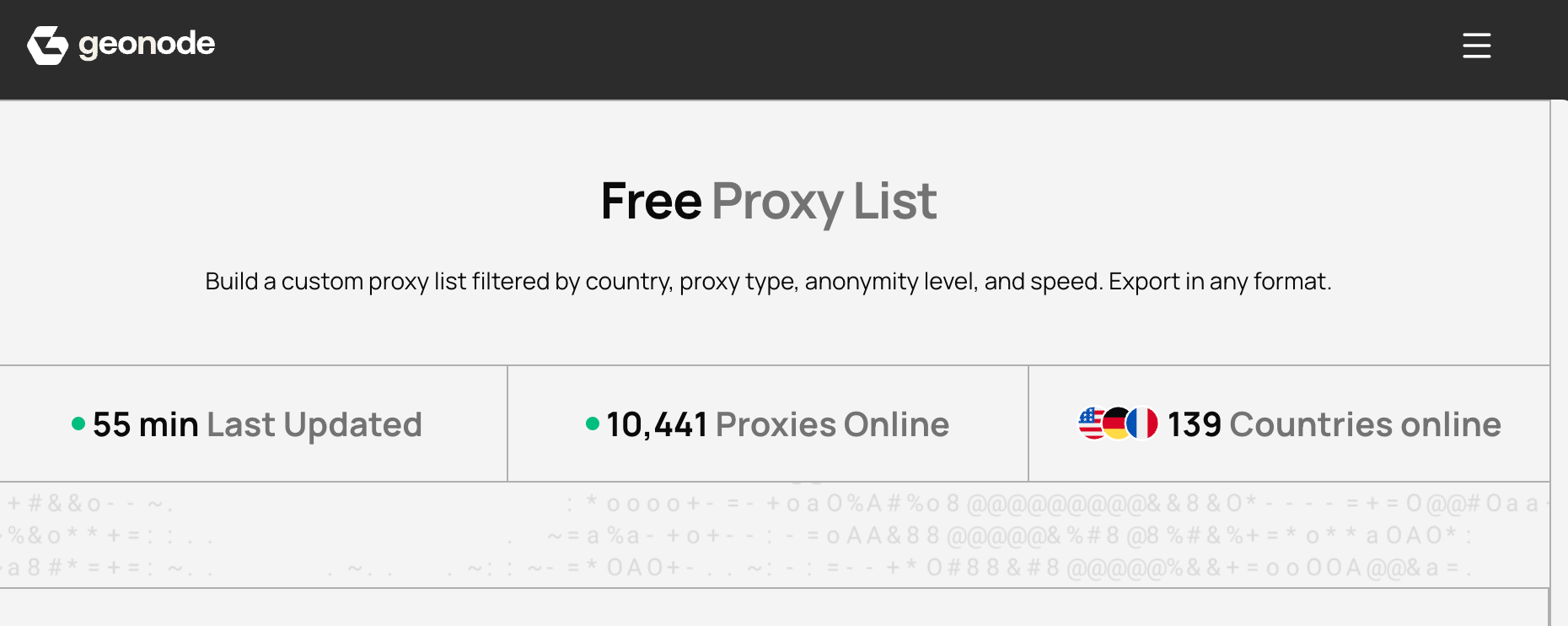
Geonode publishes a free proxy list alongside a paid residential service. The free list is upfront about its limitations: 30-50% uptime and response times between 500ms and 3,000ms, compared with the paid tier's 99.9% SLA and 320ms average.
Free tier: Unlimited access to the public list.
Protocols: HTTP, HTTPS, SOCKS4, SOCKS5.
Pros
- Transparent free-vs-paid benchmarks set realistic expectations upfront
- Country selection built into the list
- Clear upgrade path if free proxies hit their ceiling
Cons
- 30-50% uptime is too low for anything production-bound
- Response times can hit three seconds, which kills scraping throughput
- Paid tier is the real product. The free tier is a trial.
Best for: testing a scraper end-to-end before committing to a paid plan.
6. Webshare
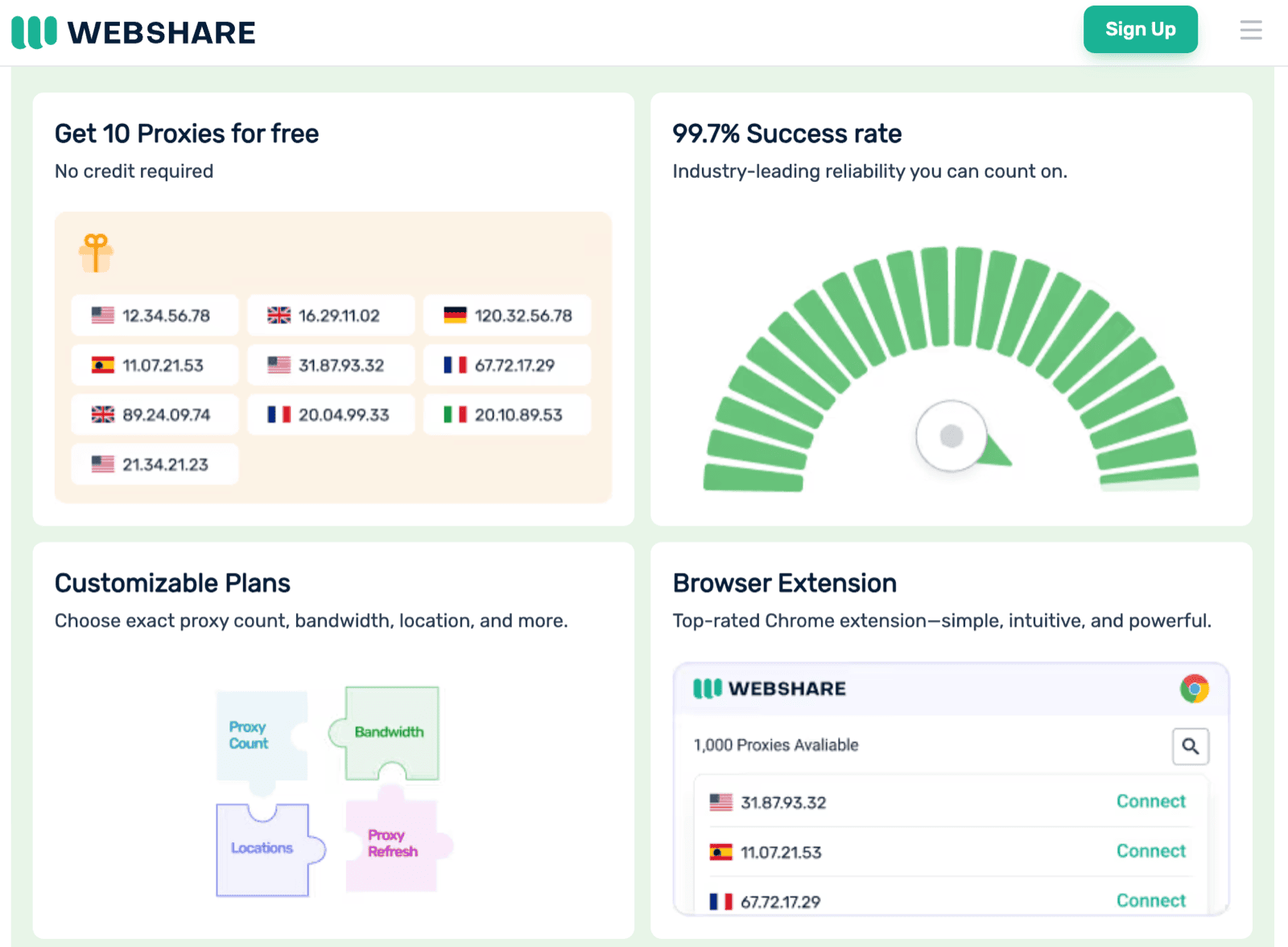
Webshare gives every signup ten dedicated datacenter proxies with 1GB of bandwidth per month, no credit card required, and no time limit. It's the most generous permanent free tier on this list.
Free tier: 10 proxies, 1GB/month bandwidth, no expiration, no credit card.
Protocols: HTTP, SOCKS5.
Pros
- Permanent free quota. The 1GB allowance never expires
- Dedicated proxies rather than shared public IPs, so blocklists are less of an issue
- Clean dashboard and reasonable datacenter speeds
Cons
- 1GB per month is tiny for scheduled scraping
- Datacenter only on the free tier. No residential IPs included
- Limited to 10 proxies, so the rotation pool is small
Best for: a persistent sandbox for testing scrapers without burning trial credits.
7. Decodo
Decodo (formerly Smartproxy) isn't free, but its entry tier runs $3.75/GB for residential proxies, dropping to $2/GB only if you commit to the 1,000GB plan at $2,000 per month. That's competitive at scale, but less so at the small volumes most testing-stage users need.
Free tier: None. Pay-as-you-go starts at $4/GB; subscription plans start at $11.25 per month for 3GB.
Protocols: HTTP, HTTPS, SOCKS5.
Pros
- Per-GB rate scales down as commitment grows, bottoming out at $2/GB on the 1,000GB tier
- 125M+ residential IPs with country, state, and city targeting
- Mature tooling and an established brand, formerly Smartproxy
Cons
- The $2/GB headline rate only kicks in at a $2,000 per month commitment
- Entry plan is $3.75/GB at 3GB, so the cheap-by-headline figure doesn’t match the cheap-by-bill reality
- No free tier, only a paid trial
Best for: established scraping operations that can commit to a volume tier and want a known brand with predictable per-GB pricing.
8. Apify Proxy
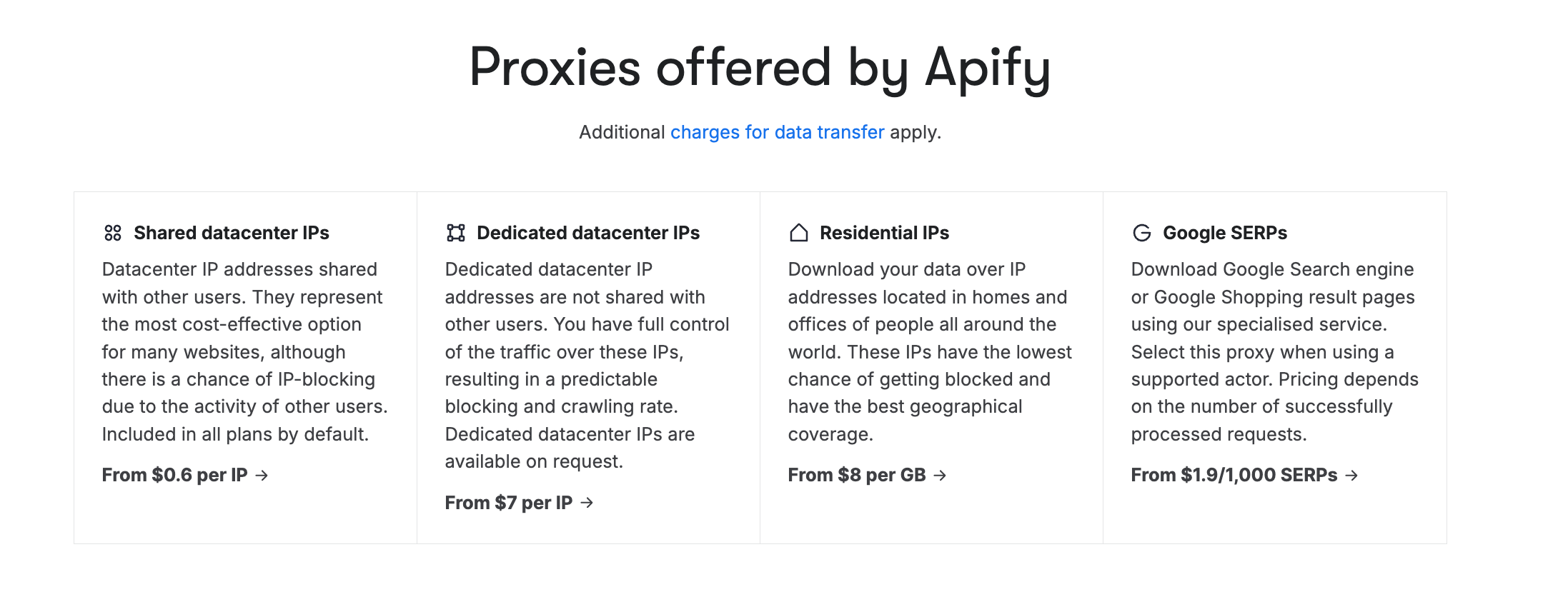
Apify Proxy handles datacenter, residential, and Google SERP IPs behind a single endpoint, with automatic rotation and health monitoring built in. It’s included on every Apify plan, including the free one.
Free tier: Included with the Apify free plan for use inside Apify Console. External use requires a paid plan from $19 per month.
Protocols: HTTP, HTTPS.
Pros
- Automatic rotation, fixed-IP sessions for login flows, and country-level targeting
- Single endpoint covers shared and dedicated datacenter, residential, and Google SERP types
- Pay-as-you-go pricing billed only by what you consume. No separate proxy subscription stacked on top of platform fees
Cons
- External (non-Apify) use requires a paid plan starting at $19 per month
- Residential IPs at $8/GB sit above the cheapest residential-only providers
- Bundles with the platform, so it’s less attractive if Apify isn’t already your scraping stack
Best for: Apify users who want one bill for compute, storage, and proxies, with rotation handled automatically.
Quick comparison
| Provider | Free tier | Protocols | Rotation | Best for |
|---|---|---|---|---|
| ProxyScrape | 20,000+ public proxies, API + GitHub mirror | HTTP, HTTPS, SOCKS4, SOCKS5 | Manual | Filtering by latency before a paid service |
| Free Proxy List | ~11,000 public proxies | HTTP, HTTPS, SOCKS5 | Manual | Quick country-specific lookups |
| Free Proxy World | ~49,000 public proxies (largest free pool) | HTTP, HTTPS, SOCKS4, SOCKS5 | Manual | Wide candidate pool to validate |
| HasData | 1,000 API credits (trial, then $49/mo) | API (HTTP, HTTPS) | Automatic | Skipping proxy management entirely |
| Geonode | Public list, 30-50% uptime | HTTP, HTTPS, SOCKS4, SOCKS5 | Manual | End-to-end scraper testing |
| Webshare | 10 proxies, 1 GB/month (permanent) | HTTP, SOCKS5 | Manual | Persistent testing sandbox |
| Decodo | None (from $11.25/mo or $4/GB PAYG) | HTTP, HTTPS, SOCKS5 | Automatic | High-volume residential scraping |
| Apify Proxy | Included on Apify free plan (in-Console only) | HTTP, HTTPS | Automatic | Unified compute, storage, and proxy billing |
Spotlight: Apify Proxy
Apify provides a platform for web scraping that includes proxies, rather than just a proxy service. This makes it useful for an integrated workflow combining scraping tools with proxy services. For users who only need proxy services, the free options might be limited compared to specialized proxy providers.
The Apify free plan
The free plan lets you use proxies within Apify Console. To use Apify Proxy externally, you need to subscribe to a paid plan. The free plan covers most platform features within certain limits, and additional charges apply for higher-usage tiers or specialized proxy types like residential or Google SERP proxies.
Proxy server types
Apify Proxy offers four proxy types: shared datacenter IPs, dedicated datacenter IPs, residential IPs, and Google SERP proxies, each with different advantages and pricing structures. For full pricing and a side-by-side with other providers, see the 13 best proxy providers for web scraping in 2026.
Super-proxy
Some features are available only to Apify Proxy users, mainly because Apify Proxy is a super-proxy. It's not a single proxy server but an API endpoint that routes requests through Apify Proxy's pool of datacenter, residential, and Google SERP IPs.
How to use Apify Proxy
To use Apify Proxy, configure your HTTP client to connect to the Apify Proxy server using your Apify Proxy password. This setup involves specifying the proxy type, hostname, port, username, and password. The username field accepts parameters like proxy groups, session ID, and country. You can also use your own proxies within Apify Console.
Should you use a free proxy?
Free is tempting, but for web scraping, it usually costs you more than you save. Here's how free proxies actually behave in production:
- Anyone can read your traffic. Whoever runs the proxy sees every request you send. Most free proxies don't support HTTPS to the proxy itself, so credentials, cookies, and form data move in the clear. Some strip HTTPS, inject scripts, or log everything passing through.
- Most don't work for long. Public proxy lists churn constantly - an IP that responds at 9:00 a.m. is often dead by lunch. The ones that do stay up are slow, overloaded, and shared with thousands of users. You'll spend more time validating proxies than scraping.
- Already on every blocklist. The same free IPs are used by everyone, so anti-bot services like Cloudflare and DataDome already know them. A proxy that worked yesterday is the first to get a CAPTCHA or 403 today.
- Honeypots and shady origins. Some free proxies are bait - set up to harvest credentials or log who's scraping what. And if a residential free proxy turns out to be a botnet, you're routing your traffic through compromised consumer devices without their owners' consent.
Free proxies are fine for one-off testing of a public page, or verifying your scraper handles a proxy connection at all. For anything you'd run on a schedule, or anything touching a login, pay for a proxy. The cost is almost always less than the engineering time spent babysitting free ones.
Note: This evaluation is based on our understanding of information available to us as of June 2026. Readers should conduct their own research for detailed comparisons. Product names, logos, and brands are used for identification only and remain the property of their respective owners. Their use does not imply affiliation or endorsement.