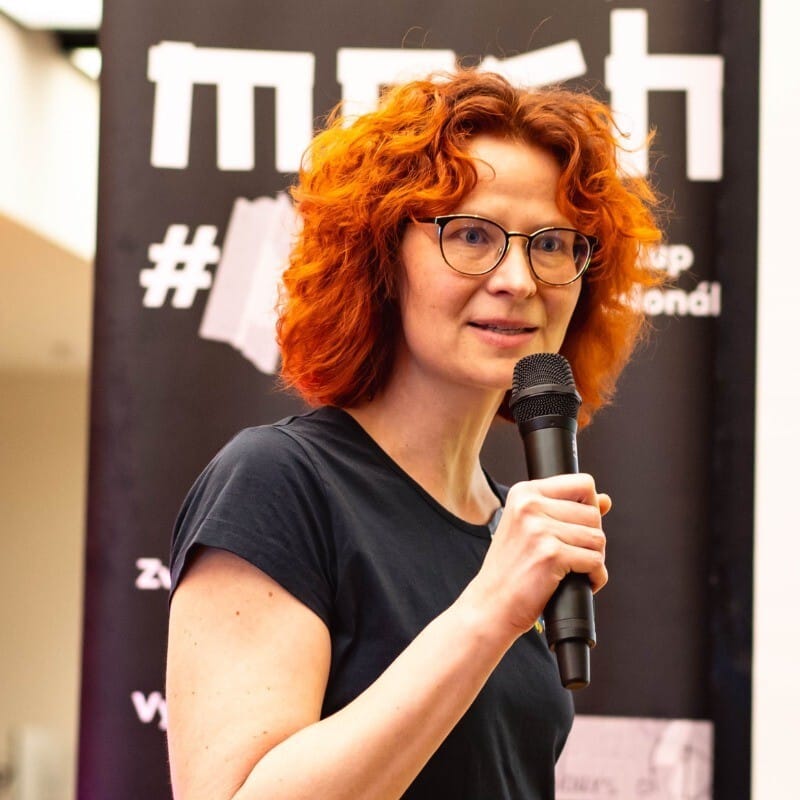
Martina Gelnerová spent twenty years at a travel agency, pricing packages, and she loved it. "I was so satisfied with the job there," she says.
Then COVID arrived and the tourism industry collapsed. She waited about a year to see whether it would get back on its feet. It didn't, and she found herself living outside Prague with four kids, looking for work in a field she knew nothing about, which she calls "a bit scary."
What she wanted from the next job was specific: work she could do remotely, without a fixed clock, arranged around the children. Data was a good fit. It had a practical advantage too, which was that she could reach junior level fast enough for the switch to be realistic.
A weekend course, then three months
She tested the idea before committing, with a single weekend course in the basics of data, and one weekend was enough to tell her. "I felt like, well, this clicks," she says. "This is the field I really like, and it's somehow connected to my previous work."
So she signed up for the Digital Academy at Czechitas, a Czech non-profit set up to get women into tech. The academy runs three months, twice a year in spring and autumn, and takes around 34 women a round, with no assumption of prior experience. It covers Python, SQL, data visualization, and Keboola as an ETL tool, and it's built to get someone hireable by the end.
The mentors she drew
The academy is built around a project. Teams take a single idea the whole way through: thinking it up, sourcing the data, transforming it, finding something in it, then presenting it to an audience. Each team gets two mentors from partner companies, and Apify has taken part for years, giving a lesson on web scraping and mentoring a team each round.
Martina drew Jakub Balada, Apify's co-founder, and Zuzka Pelechová, a Czechitas graduate who'd made the same switch a few years earlier. Both were lucky draws, and the timing was luckier still. Zuzka was about to start building Apify Store and was looking for someone to replace her on the project she'd been running.
A safe project to start on
Martina's first project was Hlídač shopů, which tracks whether Czech and Slovak e-shops are advertising real discounts or fake ones. Apify runs it pro bono alongside TopMonks, Keboola, and hckr.studio, with one person covering the Apify side. Martina took that over in her first week, working on it with Jakub Balada.
The Apify side meant the scrapers, the daily check that the data had arrived and was correct, and the whole transformation pipeline through to the discount compliance evaluation. For someone three months out of a course, that's a wide brief, and she was, in her own words, a little afraid of mistakes and of great responsibility. She still calls it the right first project, because it was pro bono. "If I made a mistake, it didn't mean the company would lose a million dollars," she says.
Apify hired her as a junior data analyst at a point when it had no data team at all. What it did have was people who answered questions. Ask one, and somebody answered immediately and walked her through it. A data team formed about a year in, and she moved across to it and onto Apify's own analytics.
Two years later, the European Commission
The safe start didn't last. Martina finds the sequence funny herself: she'd been afraid of mistakes and of great responsibility, and two years in, Apify began building for the European Commission.
The Hlídač shopů work became a monitoring system for the Commission, checking whether retailers across Europe comply with the consumer protection directive on discount pricing over Black Friday. As of October 2025, Apify had helped the EU monitor 136,931 products from 1,556 retailers across 24 member states using scrapers and AI to flag the fake discounts.
She was on it from the start, and it became the part of the job she enjoyed most. "My job was not only about dashboards or about writing queries," she says. "It was a combination of project management and product design related to the data, because I knew the data underneath." The team designed the app and decided how it would communicate what it found to the people using it.
Once a Czechita
Martina didn't warm to Czechitas immediately. "For me it felt a little bit like a religion," she says. "I was a bit scared of all this positivity and support."
Then she worked out where the discomfort was coming from. "I found out it was my own internal fear," she says. Once that went, what was left was a community she has no reservations about: supportive and genuinely invested in whether you make it. "Once you are a Czechita, you are forever a Czechita."
She’s mentored at roughly ten Digital Academy rounds since she graduated, enough that she guards against autopilot: every team needs taking down a path of its own. It hasn't put her off going back: "I cannot resist. I go back again."
The circle closes
That mentoring has fed back into the company repeatedly. Zuzka was the first Czechita at Apify and the person who hired Martina. Miša Fialová, Kateřina Hroníková, and others have joined since, from the Digital Academy and from other Czechitas courses, and Kateřina has hired her own mentee.
In July, it came round properly: Martina's mentee from the most recent academy round, Zuzana Laubeová, joined Apify to take over Hlídač shopů.
Martina makes a practical case for mentoring as a way to hire. Two months of it shows you how someone approaches a problem, whether they push to work independently, and how they behave when they don't know something. "That's much better than hiring someone and finding out later," she says.
What she tells her mentees
She opens every mentorship the same way: enjoy the project, do all the parts of it, and then work out which part is closest to your heart.
Most beginners arrive assuming data is one job. It's several. Her argument is that you can't know which of those suits you until you've done all of them, and that the parts you dislike are as useful to find as the parts you take to. "Or you'll find, this part really bothers me and I don't want to do it anymore," she says. "And now you have clear boundaries for what you're looking for in a job."
She says she tries to be a combination of all the mentors she's met along the way. One in particular stuck: Markéta Trunkátová, a colleague who co-mentored a round with her and gave every team the same attention instead of gravitating to the projects she personally found interesting.
Then there's the advice that didn't exist when she started. "Just to be honest, this was before the AI revolution," she says of her own start. "It was much easier for juniors to jump in than nowadays." The work didn't get harder. AI will hand you a working query in seconds, so you can keep producing right answers without ever learning to write one. She tells her mentees not to take it first time. "You must be able to write the query yourself," she says. "Go through the struggle, try it yourself first, and maybe then ask for the help of the AI".
Working around four kids
When Martina started at Apify during the second half of COVID, everyone was remote, and the arrangement has held since. With four kids, early afternoons belong to the family and the work revolves around them. "In the morning, evening, nobody cares," she says, "because what's important is that the work is done and everything is working properly."
Last year, she started coming into the Prague office once a week, because she missed the people, and she plans that day around the fact that she won't get much done in it. The work happens on the way, on the train or bus. "But once I'm in the office, it's really social," she says. "Connecting with people, discussing, overhearing things."

The first step
Five years on, Martina is a senior data analyst at Apify. Anyone wondering whether data is for them can find out with Excel or Google Sheets, she says, and nothing more. If you catch yourself curious about patterns, predicting how something will develop, or running statistics on sports results for no particular reason, that’ll do as a start.
Beyond curiosity, she thinks it takes a certain temperament, and hers takes a specific form. "I hate it if my numbers do not match," she says. "It bothers me, and I cannot sleep properly until I know."
The first step towards data is the hardest one, whatever course you take it on. Take it with a community behind you, and everything past it is an adventure. She was 40-something when she joined her course. Starting again as a junior can feel like a downgrade if you’re already established somewhere else. What you get for it is a completely new field to play in.
Learning something new in her forties was, she says, a big gift, and worth every bit of the struggle.
It's never too late. It's just about your courage to make the step.
-- Martina Gelnerová, Apify