


A sealed LEGO Star Wars Millennium Falcon (75257) is listed on eBay for $175, and sealed copies of the set have been selling for about $200. That looks like an easy $25, until you take off eBay's fee and the shipping and find you'd lose about $25 instead.
eBay product research is how you catch that before you buy. It means checking how quickly an item sells, what buyers pay for it, what your listing would sit next to, and what's left once eBay has taken its cut. This post starts with what eBay's own Product Research tool gives you, then works through each of those checks on the Falcon: 90 days of real sales for demand and price, one Actor run for the listings you'd be up against, and a weekly scheduled task that keeps recording those listings afterward.
What eBay's Product Research tool gives you
Product Research (formerly Terapeak) is eBay's own research tool. It's free under the Research tab in Seller Hub, and you don't need a selling history to use it. It covers three years of sold data, starting with the last 90 days, and for any search it shows:
- Average sold price and the range of sold prices
- Average shipping cost and how many listings offer free shipping
- Sell-through rate
- How many sellers have sold the item
- Sales trends over the period you pick
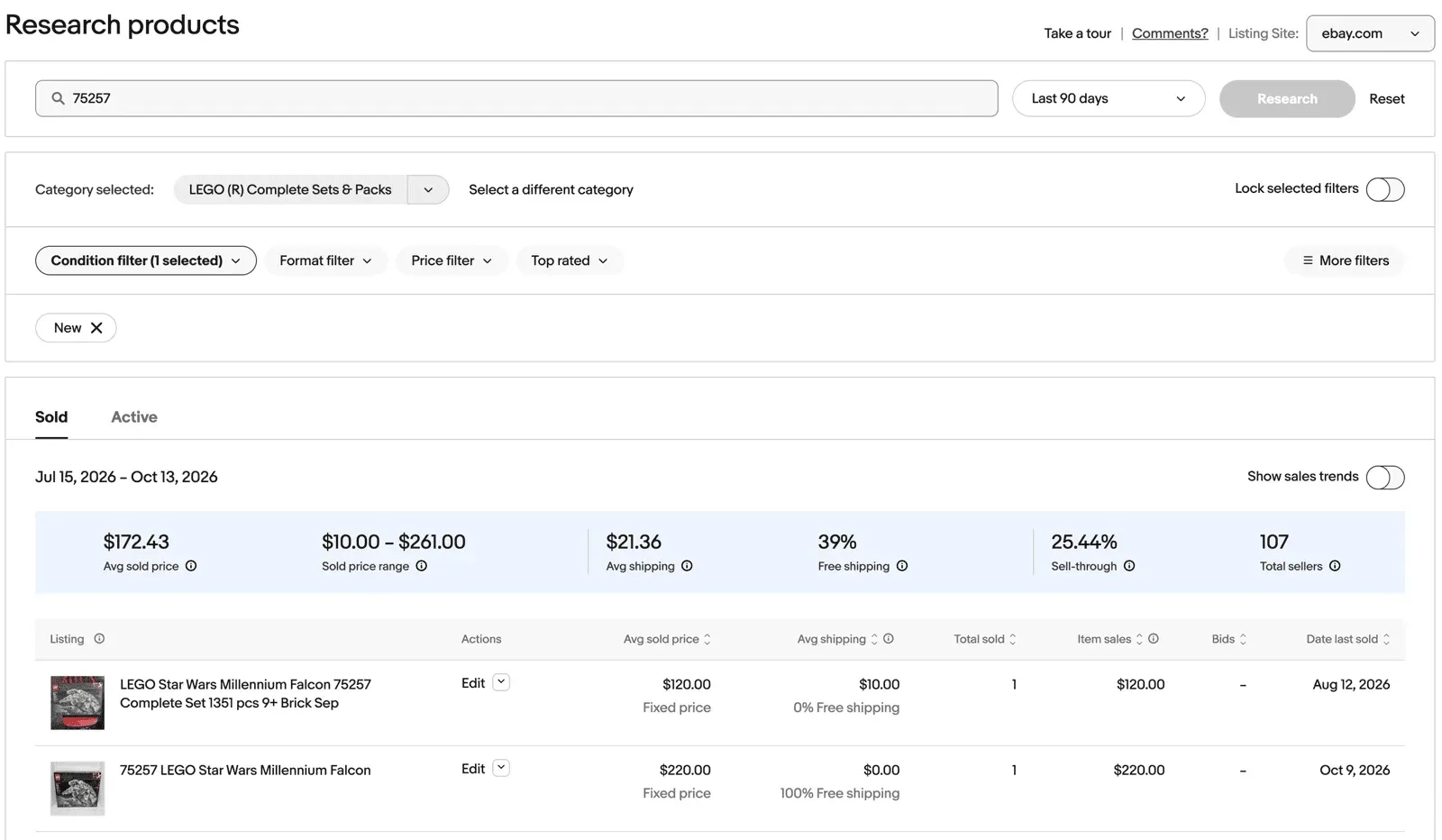
Results are split between a Sold tab and an Active tab, 50 rows at a time. For sales made by Best Offer, Product Research also shows the price the buyer paid, which eBay's normal search results don't (step 2 has an example).
It's also in the eBay app on iOS and Android. If you price one item at a time and never need the numbers outside eBay, Product Research does the job and costs nothing.
Where it stops
- The data stays in eBay. With no export or API, you can't sort the live listings your own way or join them to your own cost sheet.
- You read it 50 rows at a time. A search for a new Falcon returns 271 live listings, which means clicking through six pages.
- Nothing runs on a schedule. You get answers when you sit down and search, and no alert when a price moves.
- It only covers eBay. If you also sell on Amazon or Walmart, you research those separately.
The quick route has narrowed too. Anyone used to be able to tick Sold listings in eBay search and see about 90 days of completed sales. eBay now sends signed-out visitors to a sign-in page when they use that filter. Even a quick sold-price check needs an eBay account, though a free buyer account is enough.
| Sold listings filter | Product Research | WatchCount | ZIK Analytics | E-commerce Scraping Tool on a schedule | |
|---|---|---|---|---|---|
| Sold prices | Yes | Yes | Yes | Yes | No |
| Accepted Best Offer prices | No (shows the asking price) | Yes | No (shows the asking price) | Not stated | No |
| History | About 90 days | 3 years | Up to 60 days of sales | 7 to 30 days | Live listings, from your first run onward |
| Marketplaces | One eBay site at a time | eBay sites | 15 eBay sites (sold search: US only) | 9 eBay sites | 8 eBay sites, plus Amazon, Walmart, and other stores |
| Export | No | No | No | CSV | CSV, JSON, Excel |
| API | No | No | No | No | Yes |
| Scheduling | No | No | No | Not listed (on-demand checks) | Yes |
| Alerts | No | No | No | Not listed | Run notifications only (email, Slack, webhook) |
| Cost | Free | Free | Free | From $39.90/month | $0.244 for 40 listings, about $1 a month weekly |
| Account needed | Any eBay account | Any eBay account | None | ZIK account | Apify account |
eBay product research, step by step
The rest of this post takes the Falcon through the whole process, in the order you'd follow when you're thinking of buying something to resell. It's a good set to practice on: LEGO has retired it, so eBay is now the main place it trades, and its resale price has climbed above the $159.99 it launched at in 2019. Steps 1 and 2 use eBay's sold data, so sign in before you start. From step 3 onward, live listings and price tracking are handled by an Actor.
Step 1: Check demand
Start with how fast the item sells - a good price doesn't help much if it sits for six months. Resellers measure that with sell-through rate, which you can calculate using two numbers on eBay.
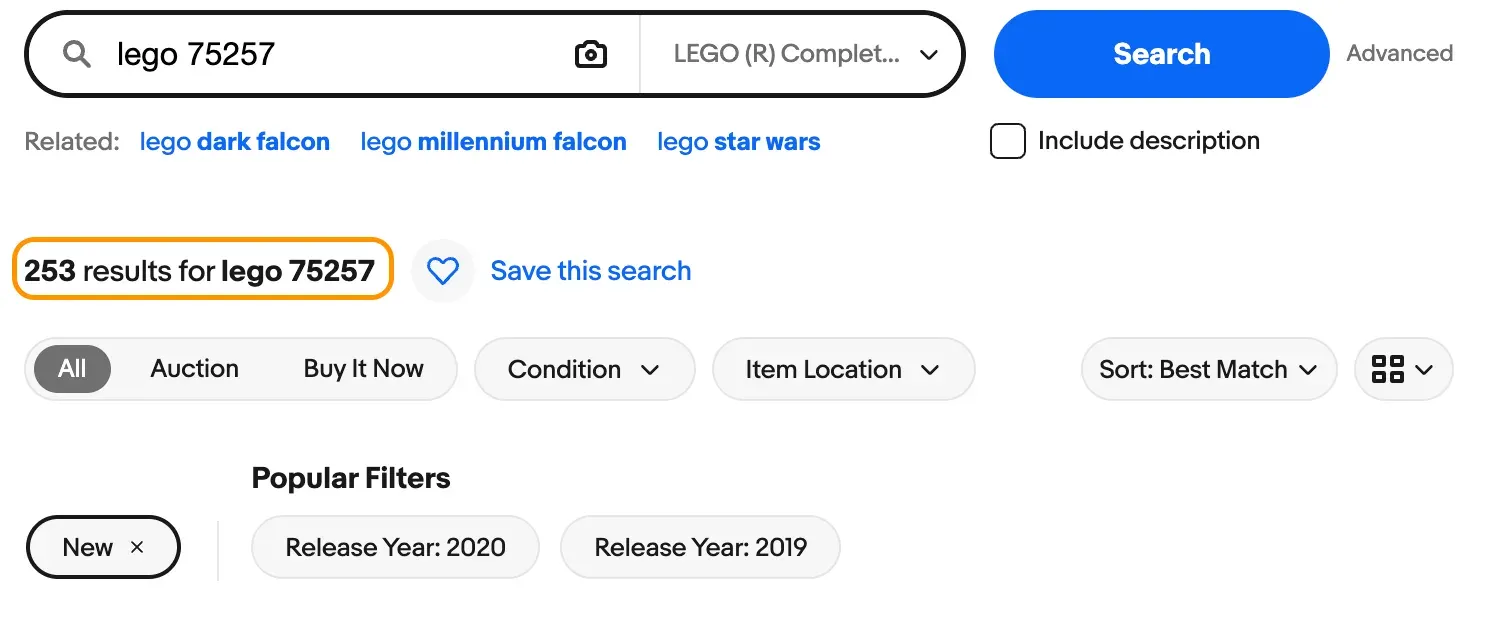
Signed in, search for the set number, pick the category, and filter by condition. For the Falcon, that's lego 75257 with the condition set to New, which returns 253 live listings.
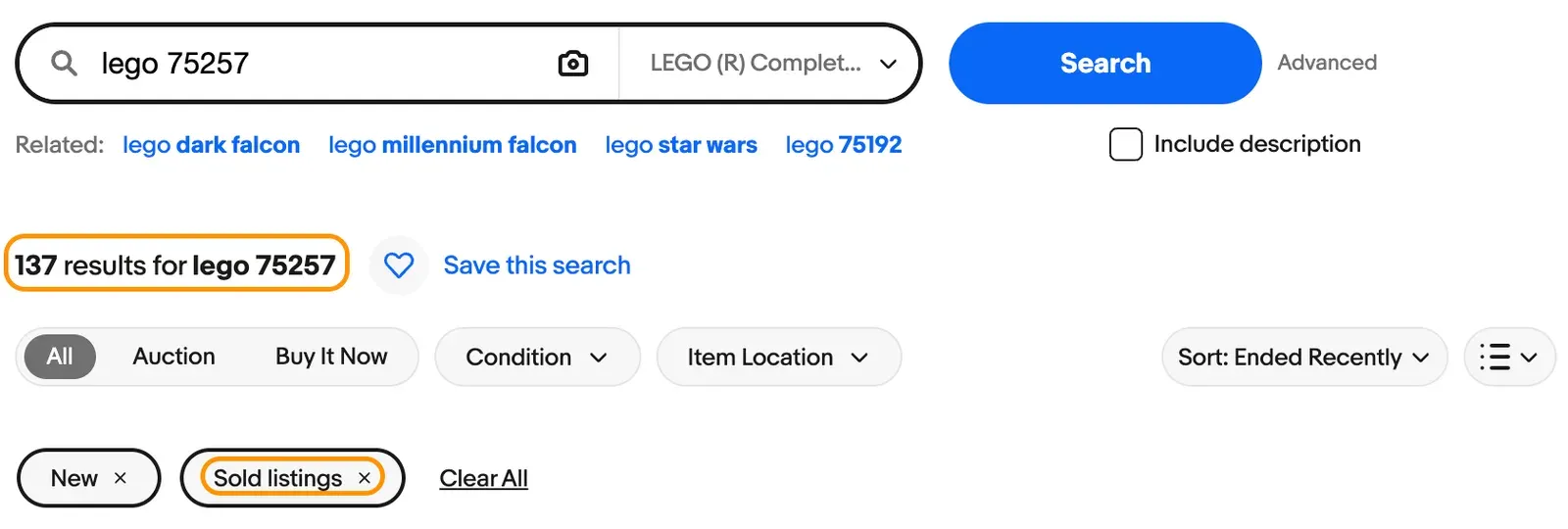
Tick Sold listings, and the count changes to 137, covering roughly the last 90 days. Divide sold by live, and you have the sell-through rate resellers quote; for the Falcon, it's 137 ÷ 253, or 54%.
FlowLister's bands are a fair way to read the result:
- Under 20%: slow. You're up against a wall of unsold stock.
- 20% to 50%: workable if your price is right.
- 50% to 100%: strong.
- Over 100%: hot, with more sold in 90 days than is listed today.
At 54%, a sealed Falcon is already in the strong band, and a cleaner count puts it higher still. The raw counts are messy in both directions: the sold results include parts bags, multi-set lots, and the newer 75375 Falcon, which push the count up, while a listing that sold several copies still counts as one sale, which pulls it down. Product Research counts copies sold rather than listings, and once the extras are taken out, its sold and active counts work out at about 75%: the same band the quick check gave you.
Product Research also shows a sell-through rate of its own (25.44% for the Falcon), but don't read it against the bands above. It divides sales by every listing in the period, which always gives a lower figure than the sold-to-live ratio.
The same ratio tells you roughly how long the current supply would take to sell: 90 days divided by the rate, which is about four months for the Falcon at 75%. A well-priced listing will go faster than the pile around it, but don't expect a quick flip.
Step 2: Price it from sold comps
The price you can expect comes from what buyers have already paid, so work from the sold results:
- Split them by condition. Sealed, open-box, and used copies sell for very different prices.
- Use delivered prices (item plus shipping). Some sellers move part of the price into shipping, like the used Falcon that sold for $35 plus $136.81 in shipping.
- Take the median. The average gets dragged around by whatever else sits in the category: Product Research puts the Falcon's average sold price at $172.43, thanks to parts bags and a four-set lot, while real sealed copies sold for a median of $199.99.
- Check any sale marked "or Best Offer". The sold results show the original asking price even when the seller accepted less, and Product Research shows what the buyer paid. For one sealed Falcon, that was $249.97 against $225:
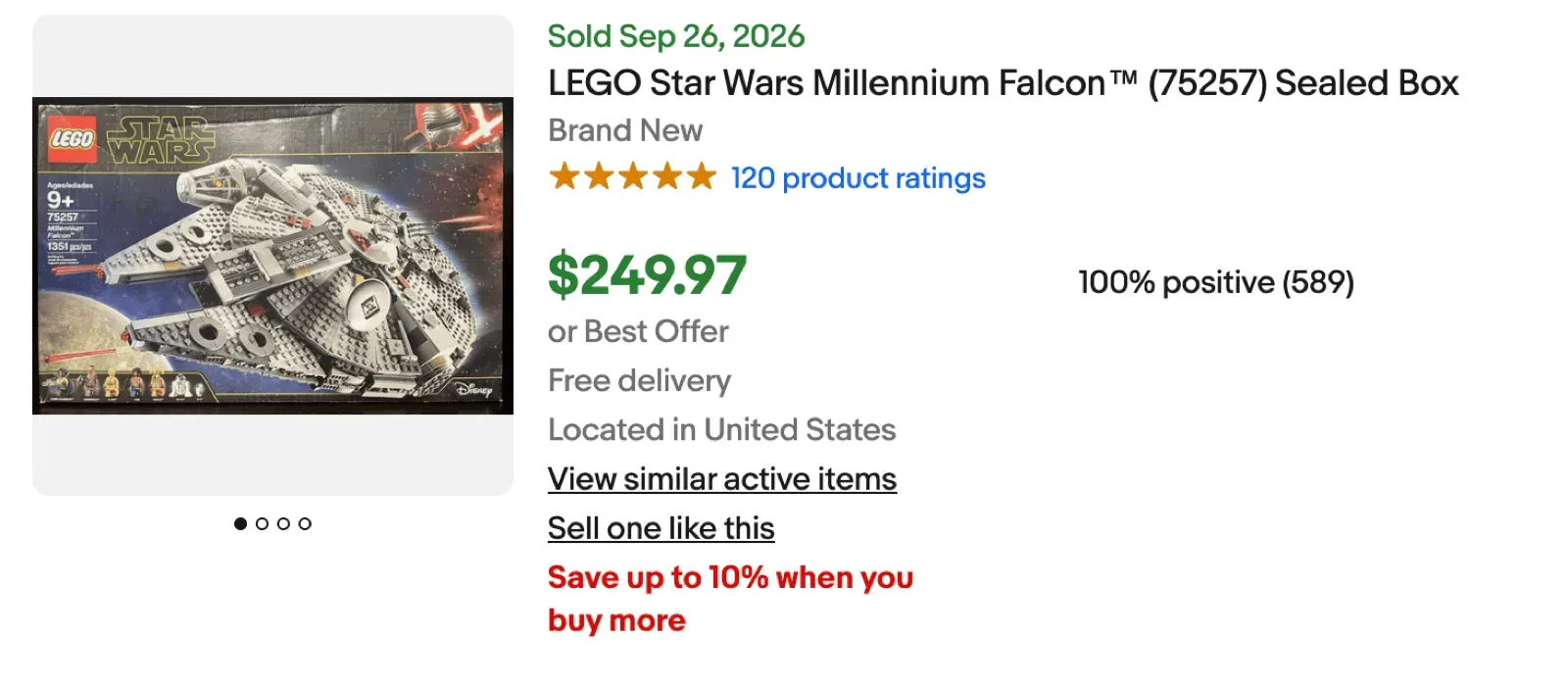

Here's what the Falcon's sales come to by condition:
| Condition | Sales in 90 days | Median price | Median delivered |
|---|---|---|---|
| New, sealed | 128 | $185 | $199.99 |
| New, open box | 6 | $153 | $189 |
| Used, complete | 49 | $90 | $105 |
| Used, no minifigures | 11 | $70 | $82 |
A sealed Falcon sells for about $200, roughly 25% above its $159.99 launch price, while a complete used one sells for less than it cost new. That $200 is the price to carry into the next two steps. Treat the open-box figure as rough, since only six sales sit behind it.
Step 3: Check the live competition with E-commerce Scraping Tool
By now you know the Falcon sells and roughly what for. What you don't know yet is what your listing would sit next to: how many sealed copies are up right now, and how many of them undercut the price you have in mind.
E-commerce Scraping Tool pulls the live listings into a table you can sort and download, which eBay's own tools won't give you. Scraping eBay yourself is the harder route: eBay blocks automated traffic, and a scraper built around its pages breaks whenever the layout changes. Apify maintains E-commerce Scraping Tool and handles both, switching to residential proxies on sites that need them, so you get the table without building or fixing anything.
In Apify Console, open E-commerce Scraping Tool, enter lego 75257 millennium falcon in Keyword for search, and pick eBay.com under Marketplaces for keyword search.
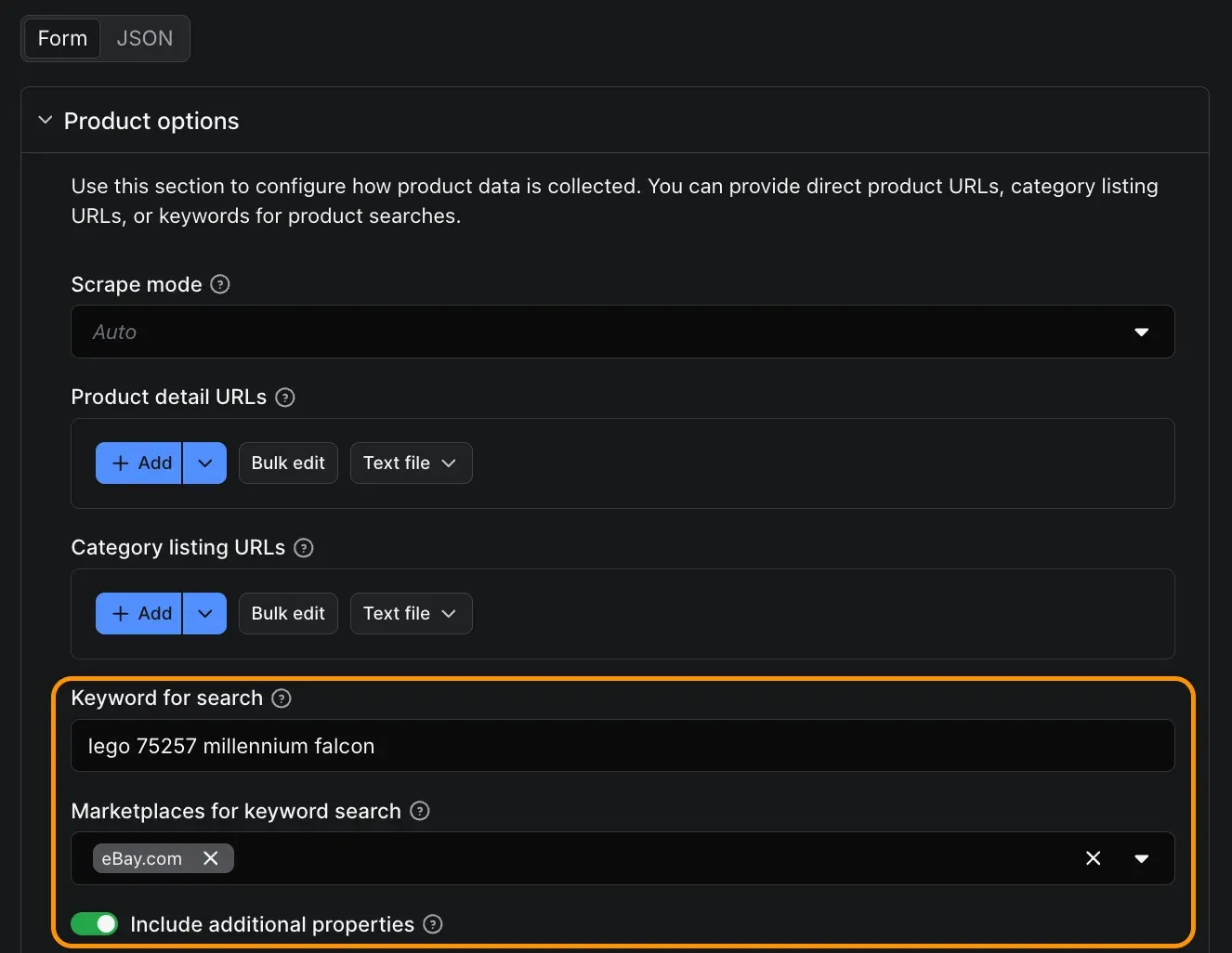
Further down the form, set Total maximum products to 40, leave everything else at its default, and click Start. The run took under two minutes and cost $0.244. Each row has the listing's name, price, eBay's condition grade (Brand New, New (Other), or Pre-Owned), and a link to the listing.
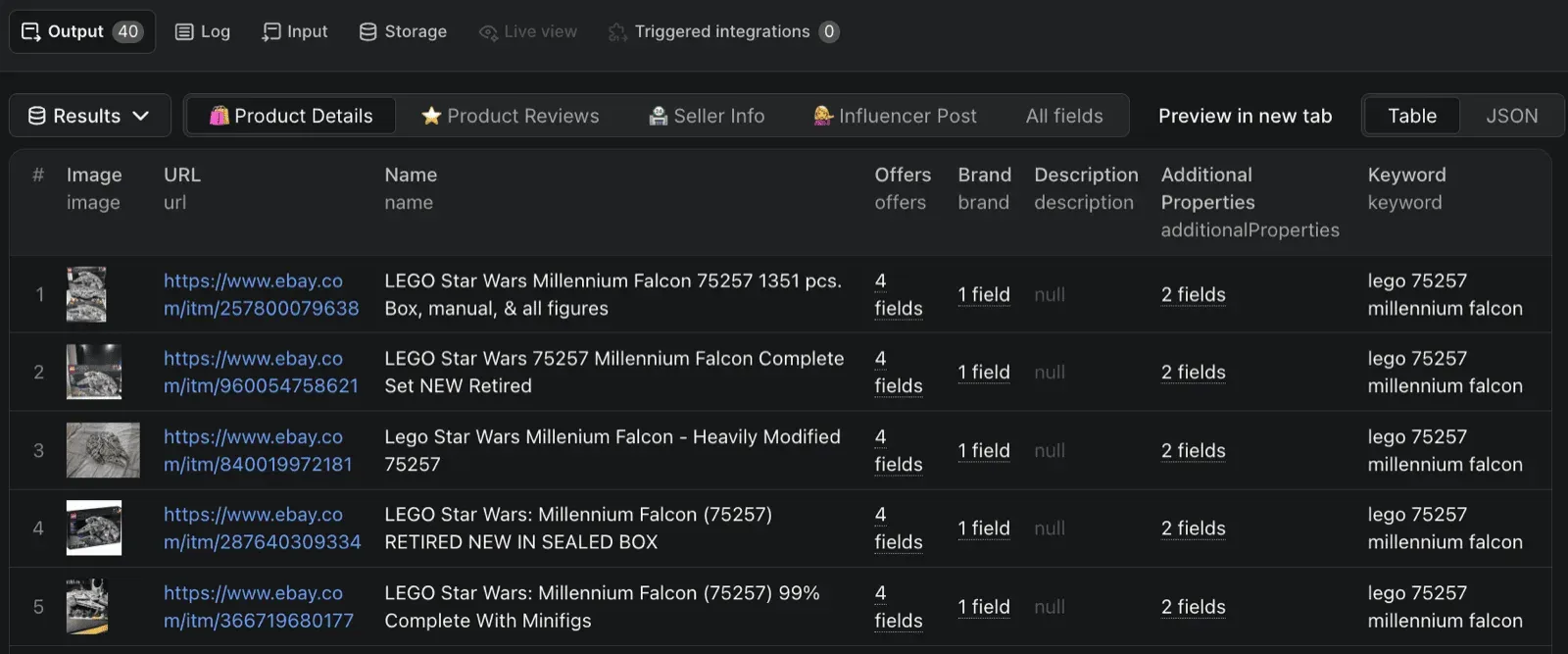
Before you read the prices, cut the table down to the copies you'd be competing with. Keep one condition (new, for a sealed Falcon), and check each name for the set number, since a search for 75257 also brings back other sets, like the newer 75375 Falcon, and the occasional knockoff listed as Brand New. Take out auctions too: their rows show the current bid, which is why one sealed Falcon came through at $82.
That leaves 14 of the 40 rows: new Buy It Now listings, from $175 to $248.95. Listing at the $199.99 that sealed copies sell for would put you in the middle of them, and none of the 14 is cheap enough to buy and resell at a profit (step 4 works out where that line is).
Shipping costs don't come through in the results (the column shows null), so check them in Product Research's Active tab instead. For the Falcon, 95% of live listings ship free, which puts the listed price close to what a buyer pays.
Step 4: Work out your margin and buy price
eBay doesn't have a separate fee for LEGO, so sets fall under Most categories in eBay's selling fees: 13.6% of the total the buyer pays, plus $0.40 per order. What trips people up is that the total includes shipping and sales tax, which pushes the fee above 13.6% of your price.
Here's how that works out if you list a sealed Falcon at the $199.99 it typically sells for, with free shipping, and it goes to a buyer in New York (8.875% sales tax):
| Amount | |
|---|---|
| Sale price | $199.99 |
| eBay fee: 13.6% of $217.74 (price plus $17.75 sales tax), plus $0.40 | -$30.01 |
| Shipping, paid by you (the median sellers charge for a boxed Falcon) | About -$20 |
| You keep | About $150 |
Work back from the sale price to find what you can pay. Take off eBay's fee and the shipping, and you're at break-even: about $150 for a sealed Falcon. Take off the profit you want as well, and you have your maximum buy price, which for $30 of profit is about $120.
For the Falcon, eBay doesn't offer that price. Over the last 90 days, the cheapest sealed copies sold for around $140, and the cheapest one in the step 3 run was listed at $175, so a copy bought on eBay won't leave you much, if anything, when you resell it there. Getting one for $120 means paying less than its $159.99 launch price, which in practice means finding it somewhere other than eBay.
Step 5: Set up an eBay price tracker
None of the listings in step 3 came close to $120, so the job now is to watch for one that does, and to see which way prices are heading while you wait. eBay has two alerts of its own: a saved search emails you when new listings match, and your watchlist can notify you when a watched item drops in price. Neither keeps any history, though: you can't look back and see how the market has moved over the past month.
For that, run the step 3 search on a schedule. Open the finished run's Input tab and click Save input to a new task, which saves the search as a task you can run again.
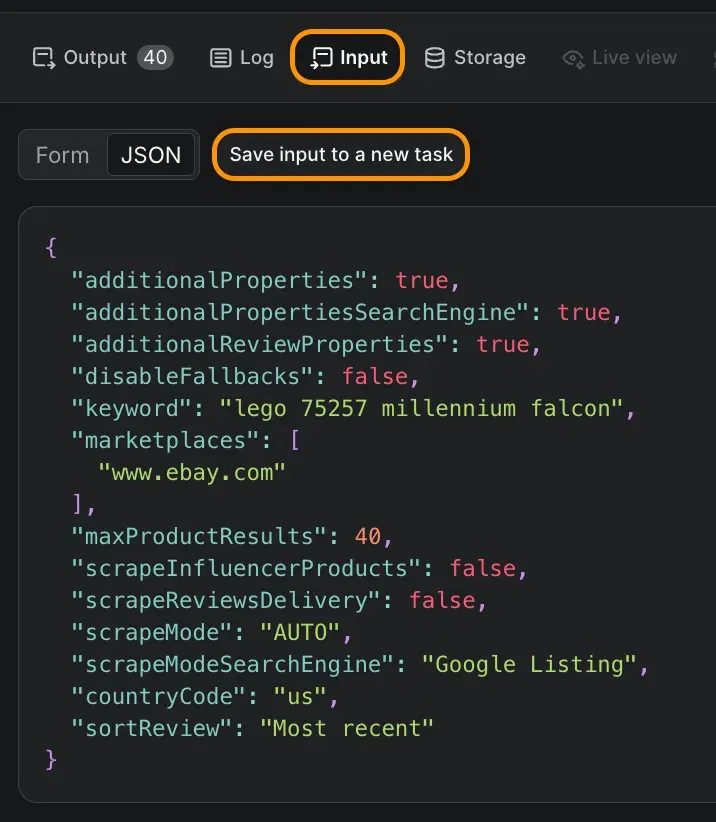
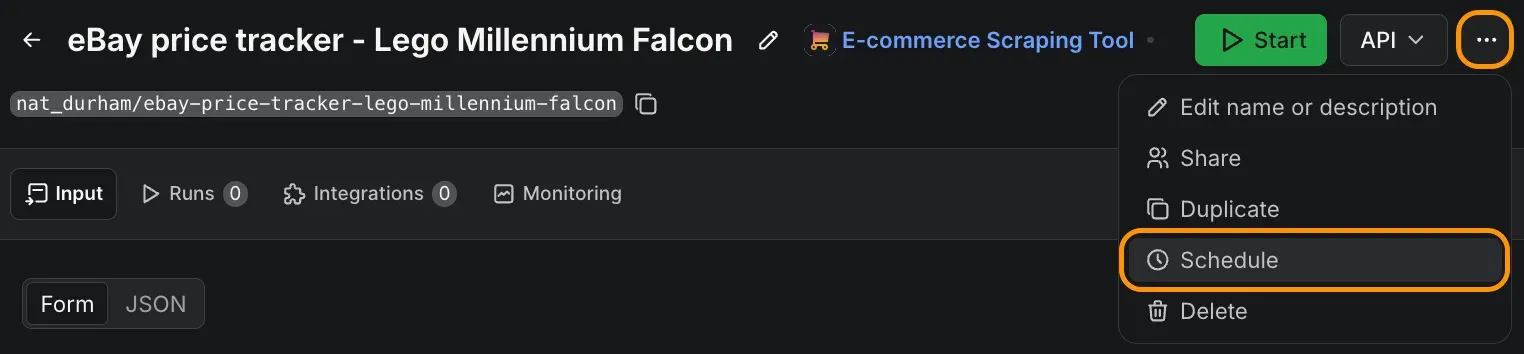
On the task's page, open the three-dot menu at the top right and choose Schedule.
Pick Daily or Weekly, and click Create.
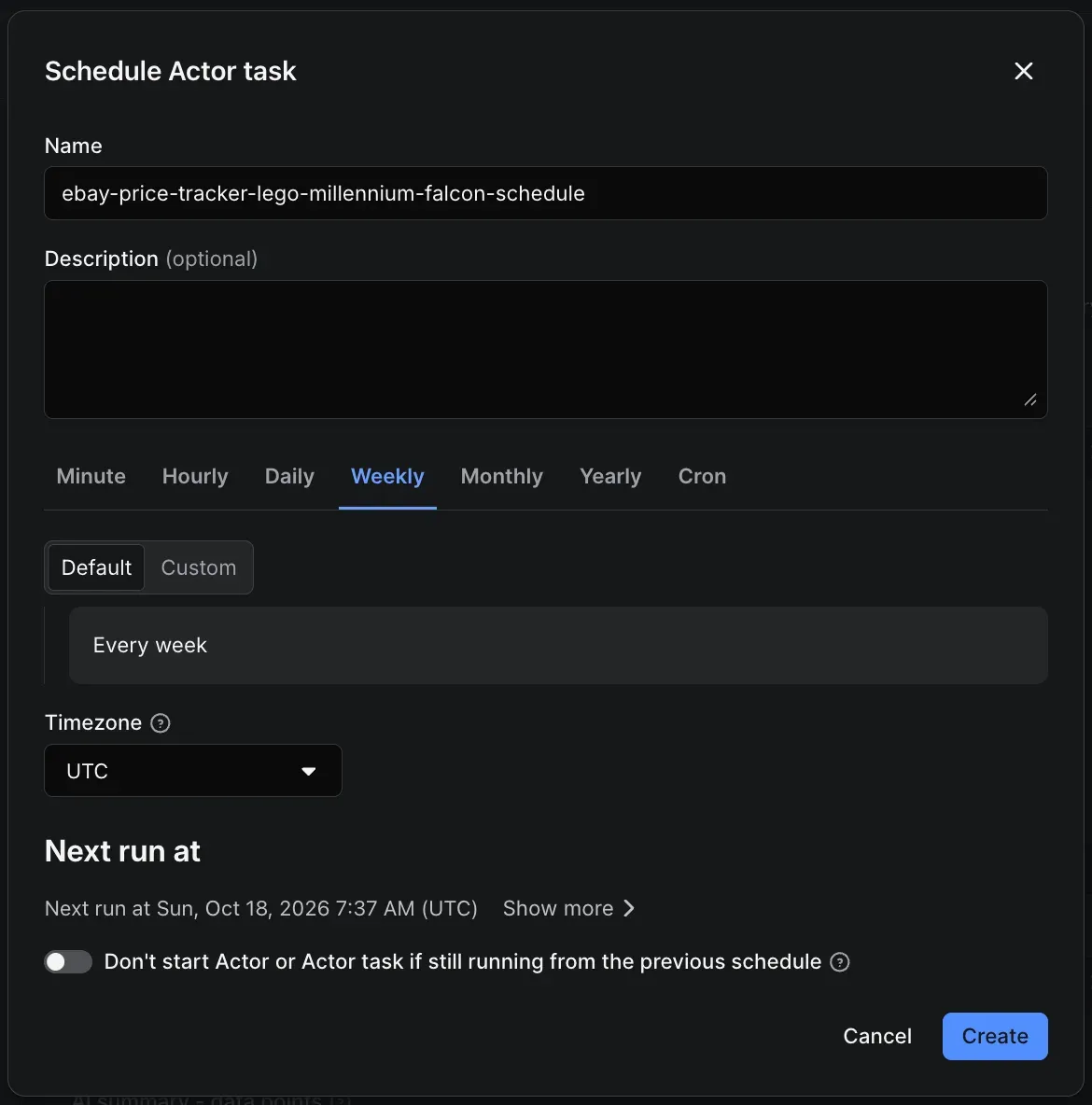
Every run is a dated snapshot of the live listings. After a few weeks, you can see new copies being listed under your price, and whether asking prices are moving up or down.
At $0.244 a run, a weekly check costs about $1 a month, and a daily one about $7.40. Apify's free plan includes $5 of usage every month, which covers four weekly trackers, or one weekly tracker pulling about four times as many listings.
Apify keeps your ten most recent runs indefinitely and deletes older ones after your plan's data retention period, so export any run you want to keep for longer.
Conclusion
Back to the Falcon listed at $175. It sells well, but once eBay's fee and the shipping come off a sealed sale you keep about $150, so buying it at $175 would lose money. A good buy is $120 or less, below anything a sealed copy has sold for on eBay lately, so for now it's one to track, and to buy only if a cheap copy turns up.
eBay's own tools answered most of that for free. Where they run out is the live market, which E-commerce Scraping Tool turns into a table in under two minutes, with a weekly task to keep watching it for about $1 a month. To try it on your own set, run the same search with your set number and save it as a task once the numbers look right.

FAQ
Is eBay product research free?
Yes. Product Research is free in Seller Hub, and it works on a brand-new account with no sales history.
What happened to Terapeak?
eBay renamed it Product Research and made it free for sellers on Seller Hub.
How far back does eBay price history go?
The Sold listings filter in eBay search covers about 90 days, and you have to sign in to use it. Product Research goes back three years but has no export. For a history of live prices, run the same search on a schedule: each run is a dated snapshot.
Is there an eBay price tracker?
eBay has two alerts: saved searches email you when new listings match, and your watchlist can notify you when a watched item drops in price. Neither keeps a price history. For that, schedule E-commerce Scraping Tool on the same search as a weekly task. Each run records the live listings and their prices, for about $1 a month.
How do I see sold prices on eBay?
Sign in, search for the item, and tick Sold listings in the filters. Sales made by Best Offer show the asking price there. Product Research shows what the buyer actually paid, along with three years of history and sell-through rates.
Does eBay show Best Offer prices?
Not in the sold search results, which show the asking price marked "or Best Offer". Product Research shows the accepted price. For one LEGO set, matched sales came in 5 to 24% under the price the search page showed.
What's a good sell-through rate on eBay?
Resellers divide eBay's 90-day sold count by the number of live listings for the same search. Under 20% is slow, 20% to 50% is workable, 50% to 100% is strong, and over 100% means more sold in 90 days than is listed now.
Is it legal to scrape eBay data?
Scraping publicly available data is generally legal, but terms of service, personal data, and anything behind a login change the picture. The method here scrapes only public live listings and takes sold data from eBay while signed in. For the details, read Is web scraping legal?