Hlídač shopů (Shop watcher) has prepared its ninth annual Black Friday discount analysis. In last year’s report, we largely praised the major Czech e-shops for adapting to the new rules on displaying discounts. We also promised to take a closer look at the growing use of discount coupons - and we did. Unfortunately, the findings are far from encouraging.
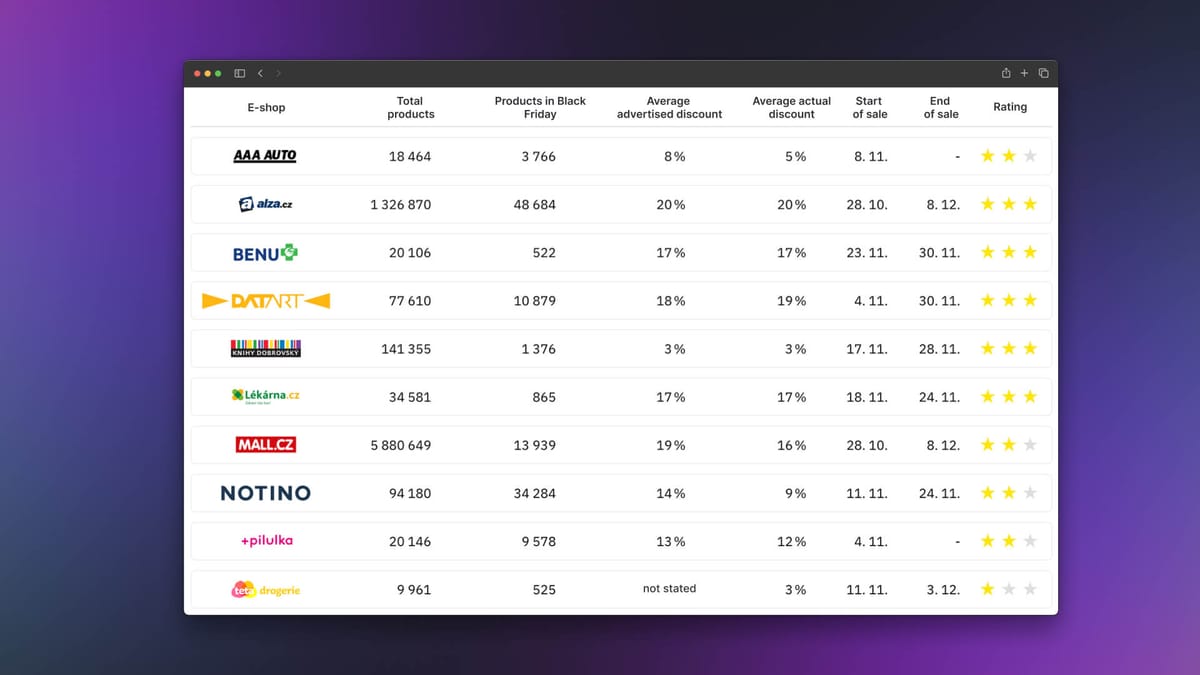
In previous years, our analysis began with an overview table of the monitored e-shops, including the number of products in Black Friday promotions and a comparison of average advertised versus real discounts. However, the rapid rise of discount coupons has made it impossible to keep this table updated. Instead, this year we focus on specific examples that illustrate the key issues.
Troublesome discount coupons
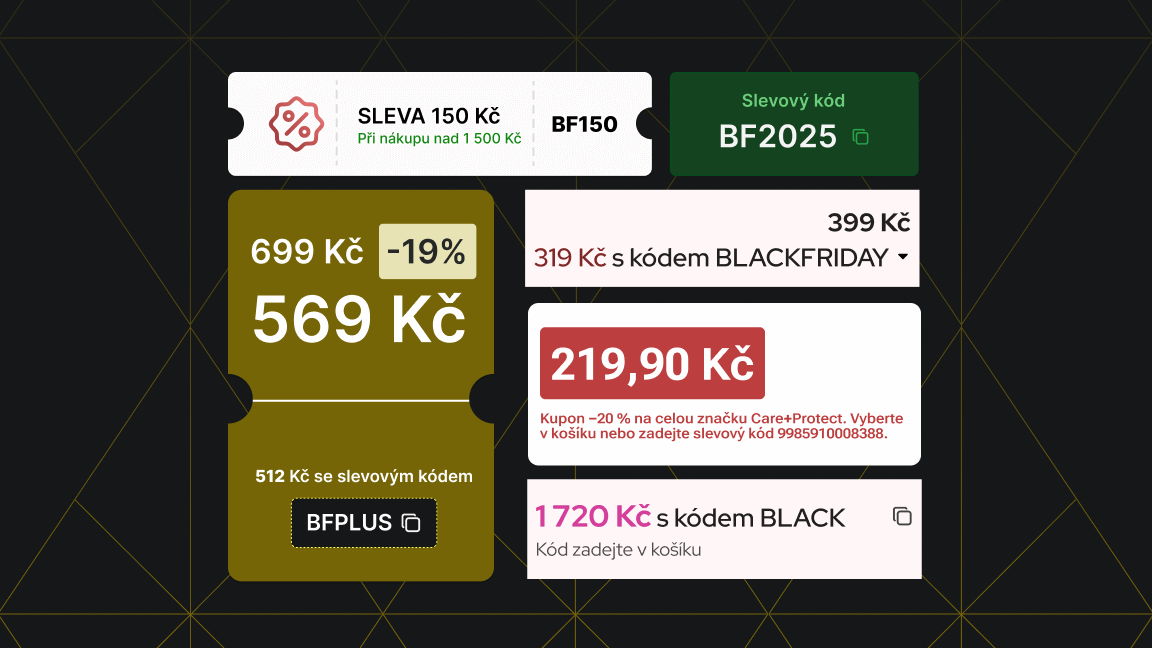
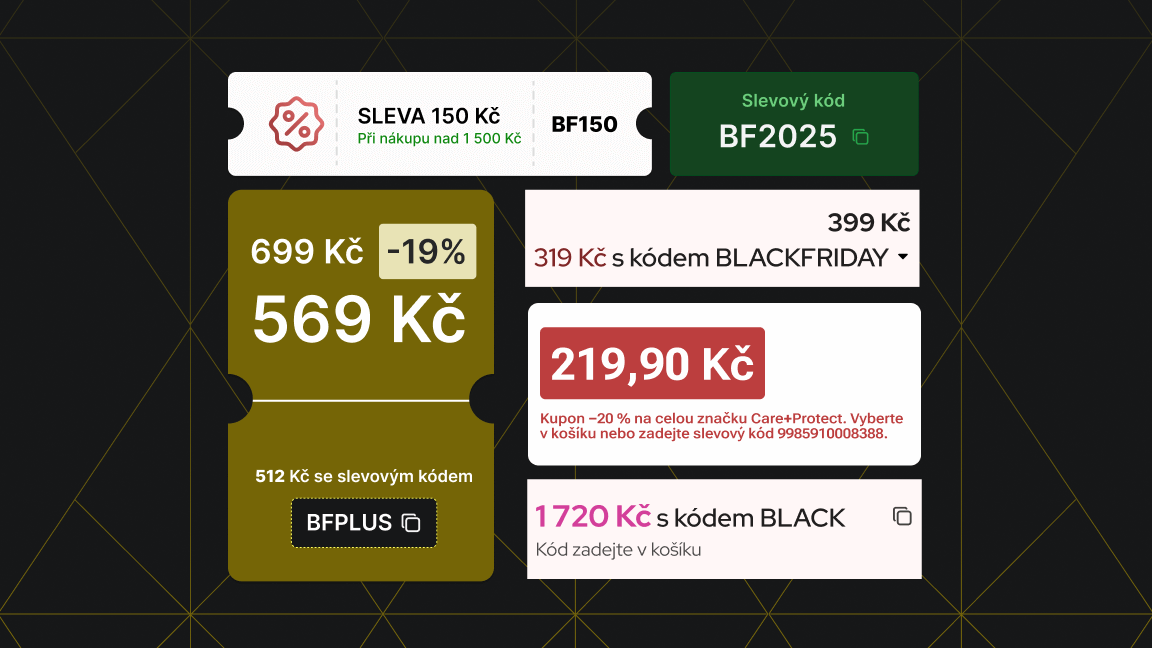
In the past, we encountered discount coupons only occasionally, typically as special offers for selected customers. Recently, however, publicly available coupons and discount codes have surged, and many are now displayed directly on the product page. In most cases, customers don’t even need to enter the code themselves - a simple click on a Buy with code button is enough.
The amended Consumer Protection Act (Zákon o ochraně spotřebitele) clearly states that such coupons qualify as discount announcements. This means e-shops must show the minimum price the product had in the 30 days before the promotion. Czech e-shops generally follow this rule. However, problems arise with subsequent promotions. If a product was offered with a coupon or code at any point in the 30 days before a new promotion, that lower price must be reflected in the minimum price used for comparison. During this year’s Black Friday, this requirement was often not met. As a result, a product might have appeared discounted, even though, in reality, it wasn’t discounted at all.
Even Alza has shifted toward coupon-based discounts. In recent years, it performed exceptionally well in our evaluations and was among the first to adopt transparent discount practices. This year, however, our data tells a different story. Out of roughly one million products, about 50,000 were included in the Black Friday promotion. For more than 17,000 of them, we found discrepancies in the displayed discount. In the vast majority of these cases, the product had also been discounted with a different coupon in the month leading up to Black Friday - yet that lower price was not reflected in the minimum price used for the Black Friday comparison.
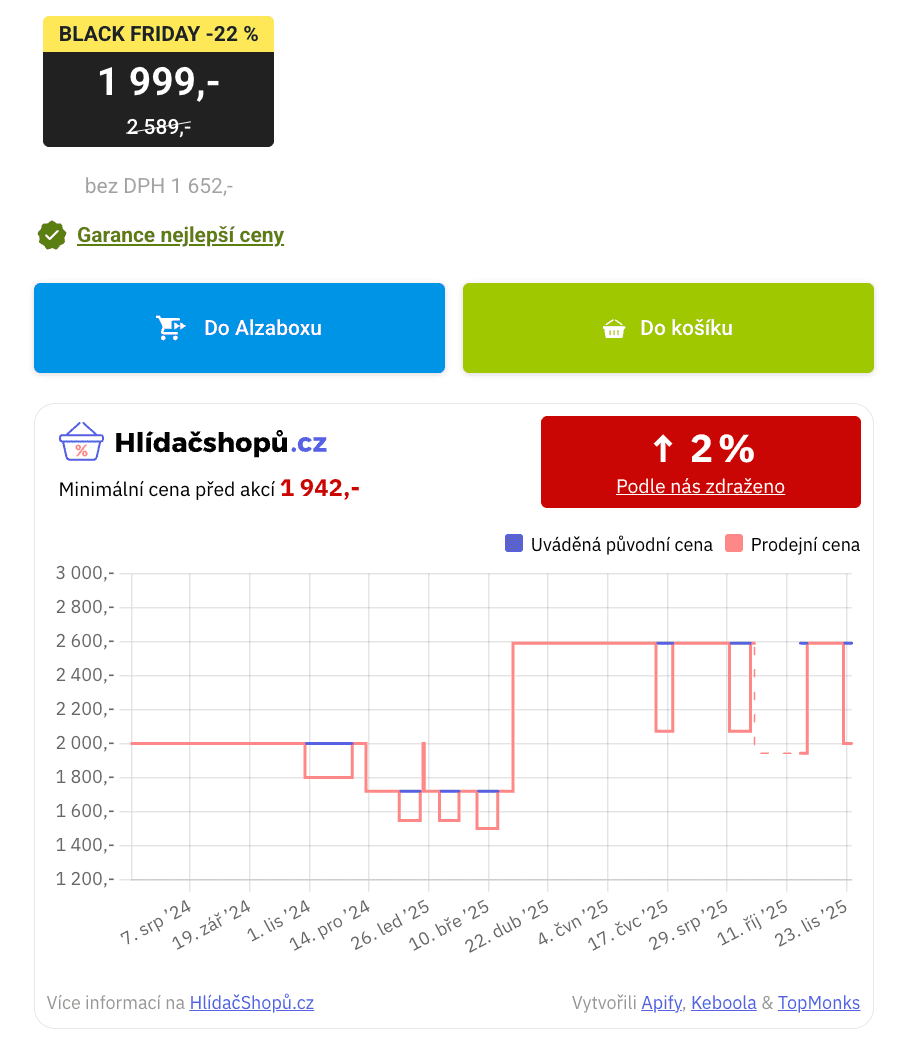
Here’s an example: This electric grill was offered during Black Friday for CZK 1,999 with an advertised 22% discount. But less than a month earlier, it had been offered with another coupon for CZK 1,942. In reality, the Black Friday deal is 2% more expensive.
Notino, Datart, and Lékárna follow a similar approach, omitting prior coupon prices from their minimum price calculations. Pilulka, on the other hand, consulted with us shortly before this year’s Black Friday and now correctly incorporates coupon prices into its price history.
E-shops often argue that not all customers use coupons, and therefore, the discounted price should not always count as “the lowest price at which the seller offered and sold the product,” as defined by law.
Legal experts at both the European Commission and the Czech Trade Inspection Authority (ČOI), however, take a different view. ČOI provided the following statement:
The argument that a customer may choose not to use the coupon is irrelevant. What matters is that the seller publicly offered the product at that price. The only exception is coupons intended for a limited group of customers (such as loyalty programs or personalized codes). These do not count as price-reduction announcements and generally do not affect the lowest price, as they are not available to all consumers.
Failing to include a previously available public coupon discount when calculating the lowest price constitutes a violation of §12a of the Consumer Protection Act.
Recurring problems in discount practices
Notino has long operated at the edge of the rules with offers such as Better price, often arguing that these don’t qualify as discounts. This year, however, we can point to an example that clearly shows Notino’s discount calculations don’t follow the applicable regulations.
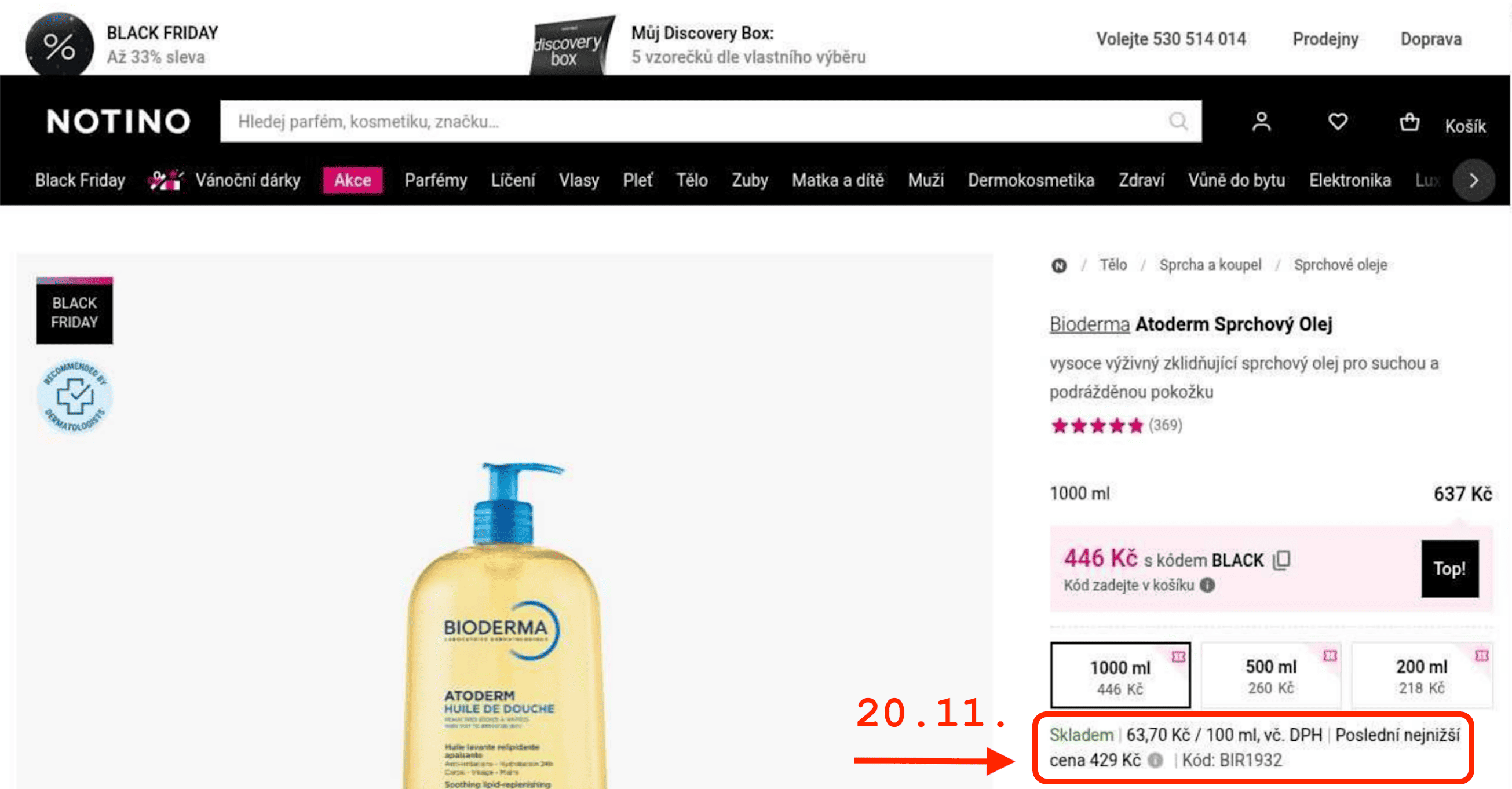
A specific case involves a shower gel sold with the code BLACK for CZK 446. On November 19, it was advertised with a 30% discount and a listed “last lowest price” of CZK 637.

One day later, on November 20, the product cost exactly the same - still using the BLACK code - but the discount was no longer displayed, and the “last lowest price” had suddenly dropped to CZK 429. This makes little sense: the minimum price must be set once at the start of a discount event and can’t change unless the selling price changes.
The opposite situation is equally important: If the price increases during Black Friday, it is a genuine price increase. The minimum price can’t remain the same. It must be updated to reflect the previous lowest selling price.
This issue appeared on Mironet, where the minimum price was set on November 7 and remained unchanged even after the “discount” was reduced during Black Friday. The JBL Partybox example illustrates this.

On November 12, the product was priced at CZK 6,552 during the Black Friday promotion, and the discount was calculated correctly based on the pre-promotion minimum price. But the following day, the price rose to CZK 6,999 - meaning the discount could no longer be compared to the pre-Black-Friday price, because the product had actually become more expensive.
This year, we also added the successful Grizly e-shop to our monitoring. Their discounting practices can be demonstrated with their “Product of the Year 2024 according to Heureka” example: Grizly Mango Exclusive, 500 g. It was sold with the BLACKFRIDAY code for CZK 223, with a reference price listed as CZK 279.

However, reviewing the price history shows that this Black Friday price was actually the standard selling price for much of the year, simply paired with different codes. The reference price also remained unchanged throughout the year, which clearly doesn’t meet the requirement to show the minimum price before the promotion.
A similar long-term strategy is used by Mountfield, which frequently alternates between publicly available discounts and club discounts, creating the impression that products are always on sale.
Who stood out this year?
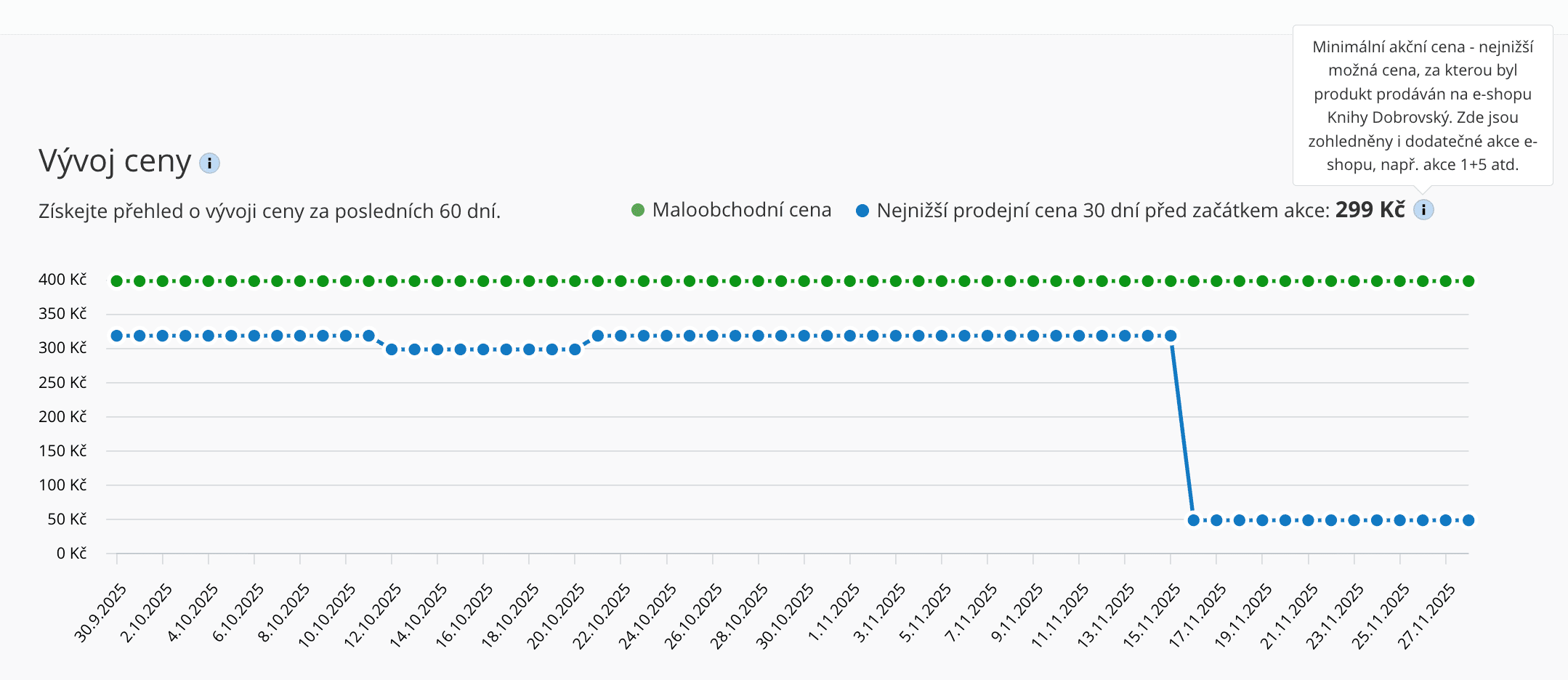
To balance the picture with positive examples: according to our data and methodology, Knihy Dobrovský stood out as the strongest performer this year. During Black Friday, they offered around 500 books with an average advertised discount of 57% - a figure that aligned perfectly with our calculated real discount. All discount information was presented clearly and correctly, both on product detail pages and in listings. Their e-shop even includes a transparent chart showing the history of the minimum price.
Other e-shops without any issues this year include Košík, Megapixel, and Tchibo.
Foreign marketplaces are still lagging behind
Last year, we highlighted the rapid rise of foreign marketplaces - and their shortcomings in discount transparency. Unfortunately, we haven’t seen much improvement this year.
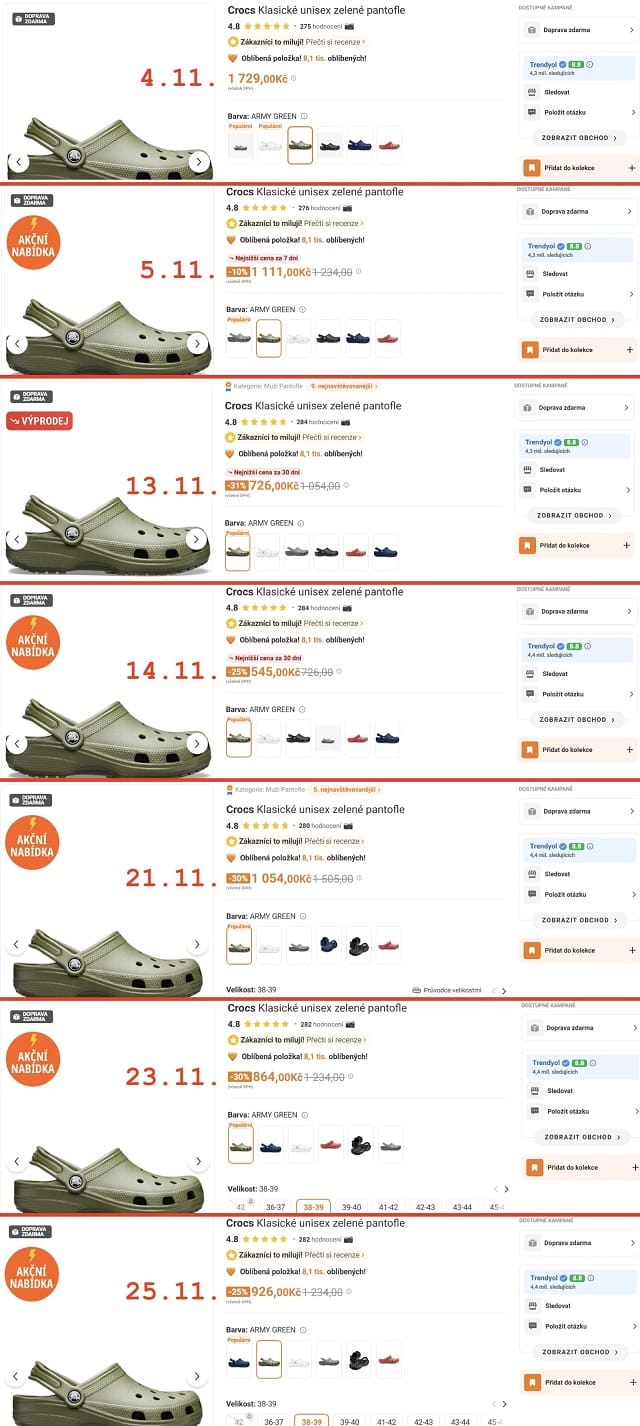
A clear example comes from Trendyol. When tracking the price - and especially the strikethrough price - of these Crocs throughout November, it becomes evident that the discount is not calculated from the minimum price before the promotion. Instead, the pattern suggests an effort to maintain a consistent percentage discount, regardless of how the price changes.
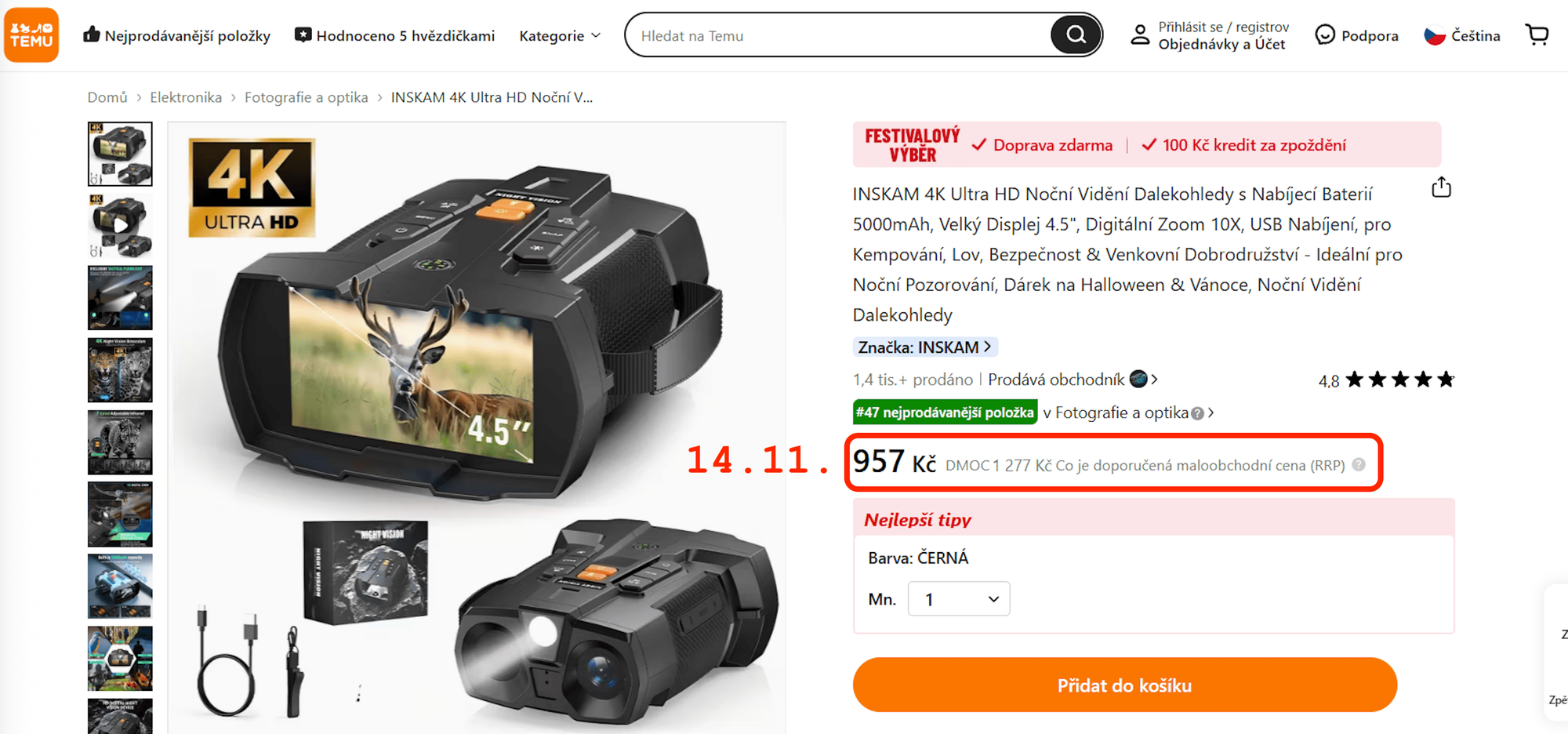
Temu follows a similar pattern. The platform typically promotes very low prices and displays a recommended retail price (RRP) as a reference point. What’s notable, however, is that both the selling price and the RRP often change simultaneously. Take these binoculars as an example:

On November 7, the product was listed for CZK 922 with a reference price of CZK 936. A week later, on November 14, the selling price increased to CZK 957 - and, surprisingly, the reference price jumped to CZK 1,277. “A better deal,” yet at a higher price.
What’s next
At Hlídač shopů, we will continue focusing on the misuse of discount coupons and work to encourage e-shops to include these discounts in their minimum price histories. We also plan to expand our monitoring to cover more popular e-shops.
We offer free consultations to all interested retailers on how to set up their discount calculations, and we work together to align our methodologies. For instance, following discussions with the Czech Confederation of Commerce and Tourism, we extended the maximum permissible duration of a discount from 90 to 180 days.
On the European level, we contribute to monitoring foreign marketplaces through the Shop Monitoring Tool for the European Commission, as these platforms often distort fair competition - not only in the Czech Republic.
The non-profit Hlídač shopů project is operated by Apify, TopMonks, Keboola, and hckr.studio. You can explore our Black Friday analyses from previous years here: 2024, 2023, 2022, 2021, 2020, 2019, 2018, 2017. Next year marks our tenth anniversary!